Agent Skills Explained: Giving AI Plug-and-Play Capability Packs

Agent Skills give AI agents plug-and-play, modular capability packs that load on demand.
Agent Skills is a lightweight open-source format that lets AI agents extend professional capabilities like loading plugins—no retraining required. Using everyday analogies, this article explains what Agent Skills are, the problems they solve, and their modular, low-cost, high-flexibility advantages for AI Agent development.
What Are Agent Skills
In today's ever-evolving landscape of large model applications, the Agent has become a core paradigm for building AI applications. To understand the value of Agent Skills, we first need to trace the technical lineage of the Agent concept. When large language models (LLMs) first emerged, they primarily served through conversational Q&A—essentially one-shot text generation. The key breakthrough of the Agent lies in equipping the model with a closed-loop capability of 'perceive—plan—act': an Agent can understand goals, decompose tasks, invoke external tools (such as search engines, code executors, and API interfaces), and iterate over multiple rounds based on feedback. Technologies like the ReAct (Reasoning + Acting) framework and Function Calling form the important foundation of this paradigm. However, traditional Agents often have a singular responsibility—they can handle one category of tasks but struggle to flexibly extend to other domains. Precisely because Agents need to tackle increasingly complex, cross-domain tasks, efficiently extending their professional capabilities has become an engineering challenge—and the emergence of Agent Skills is breaking through this limitation.
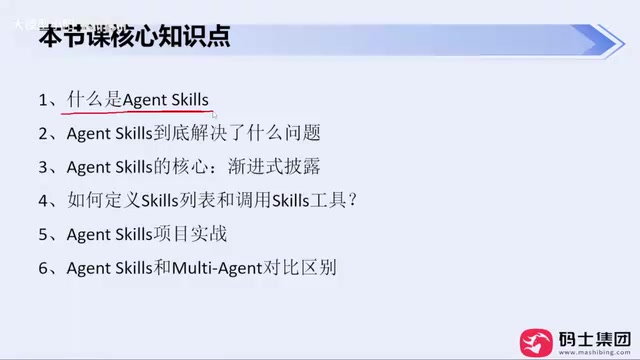
According to relevant technical tutorials on Bilibili, Agent Skills can be simply understood as an "Agent under the Skills architecture." In other words, when developing an Agent project, your agent architecture can take three forms: single-agent, multi-agent, and the "agent + Skills" modular enhancement architecture. The value of Skills lies in giving an originally single-capability Agent the potential for nearly "unlimited expansion."

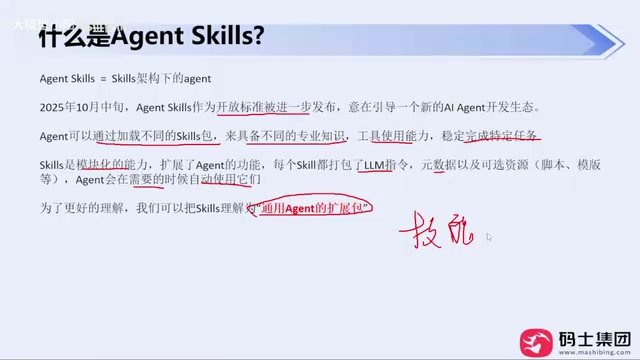
According to the official definition, Agent Skills is a lightweight open-source format that extends the capabilities of AI agents through professional knowledge and workflows. Specifically, a Skill is essentially a folder containing a SKILL.md file, which stores metadata, operational instructions, and various resources such as scripts, reference materials, and templates—all used to guide the agent in completing specific tasks.
It's worth elaborating that there is an ingenious engineering design behind this folder-plus-SKILL.md organization approach. The header of the SKILL.md file typically contains YAML-formatted metadata (such as skill name, description, and trigger conditions), while the body describes operational instructions and workflows in natural language. The key advantage of this design lies in Progressive Disclosure—in the initial stage, the Agent only needs to read the skill's brief metadata to determine relevance, and only when it decides to use a particular skill does it load the complete operational instructions along with referenced scripts, templates, and other resources. This effectively addresses the pain point of large models' limited context windows: if all details of every skill were stuffed into the context at once, it would not only consume large amounts of tokens and increase costs, but also potentially reduce the model's judgment accuracy due to information overload.
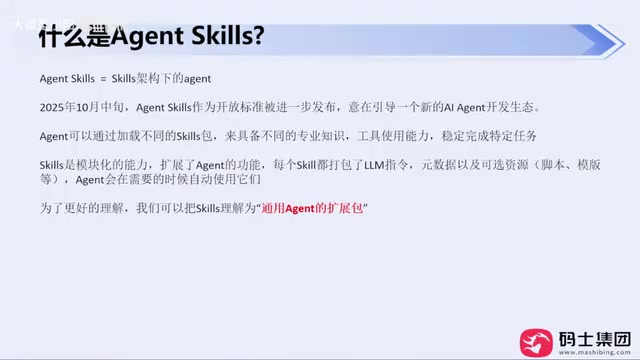
As a detail worth noting, Agent Skills, as an open standard, was officially released in mid-October 2025, marking the formation of a brand-new AI Agent development ecosystem. Agents can acquire different professional knowledge and tool-usage capabilities by loading different "skill packs."
Understanding Agent Skills Through Everyday Examples
Abstract definitions are often difficult for beginners to grasp quickly, so let's use a more relatable analogy to illustrate how Agent Skills work.
The Dilemma of an "All-Around Secretary"
Suppose you're the boss of a company with a very capable secretary. This secretary has solid general knowledge and handles daily affairs with ease. But when you assign highly specialized tasks, their shortcomings surface:
- Ask them to write a contract—they don't understand law well
- Ask them to design a poster—they can't use Photoshop
- Ask them to book flights—they're unfamiliar with the relevant booking systems
Faced with this situation, you traditionally have two solutions, but neither is ideal.
The High Costs of Traditional Solutions
First solution: Spend several months sending your secretary to professional training institutions for advanced study—having them attend law school or take Photoshop courses. The problem with this is obvious: it consumes enormous amounts of time and energy.
Second solution: Hire additional professionals—for instance, hiring a lawyer whenever you need contracts written. But this means extra labor costs.
Both solutions—whether "training people" or "hiring specialists"—come at a high price. And this is precisely the dilemma faced in traditional Agent development. If you want a programmer-type Agent to have capabilities, you'd have to start from the most basic programming syntax, work all the way up through databases, frameworks, and hands-on projects, and only after mastering everything could it truly do development work. In the context of large models, this kind of "training" often corresponds to Fine-tuning or continued pre-training, requiring large amounts of labeled data, computing power investment, and iteration cycles—costly and difficult to respond quickly to new demands.
The Third Way Offered by Agent Skills
This is exactly why Agent Skills is called an "era-defining design." It offers a brand-new approach to solving the problem: neither training people nor hiring extra people, but packaging various professional capabilities into ready-to-use plugins.
Plug-and-Play Capability Packs
Returning to the secretary example:
- When you need to handle a lawsuit, simply load a "legal expert" skill pack for them
- When you need to make a poster, mount a "Photoshop design" skill pack
- When you need to arrange a business trip, mount a "ticket booking" skill pack
Once the task is complete, you can unload the skill pack to free up corresponding resources. For the boss, this means neither spending time learning skills nor money reserving talent—it's an extremely worry-free arrangement.
The Core Essence of Modularity
To summarize the essence of Agent Skills in one sentence: load whatever you need, and unload it promptly when done. This design embodies three core characteristics:
- Modularity: Each skill is an independently packaged unit containing instructions, data, and optional resources
- Low cost: No need to train models from scratch—directly reuse ready-made or custom skill packs
- High flexibility: Capabilities can be dynamically mounted and released as needed
For programmers, this means that whether it's Java project development, Python project development, or any other type of development, each can be encapsulated as a skill. You no longer need to walk through a complete learning path to give an Agent such capabilities.
It's worth mentioning that Agent Skills did not emerge in isolation. Together with a series of AI Agent interoperability standards that have arisen in recent years, it forms a new development ecosystem. MCP (Model Context Protocol), launched by Anthropic in late 2024, solved the problem of standardized connections between Agents and external data sources and tools, while Agent Skills focuses more on encapsulating 'professional knowledge and workflows' themselves into reusable units. The two can work in synergy: Skills provide the methodology and instructions for tasks, while MCP provides the actual channels for tool invocation. This design philosophy—based on open standards and community-shareable—is of the same lineage as the earlier Plugin ecosystem, but places greater emphasis on being lightweight and modular.
What Problems Do Agent Skills Solve
From a more macro perspective, what Agent Skills solve is the efficiency problem of capability expansion in AI application development.
The capability boundaries of traditional Agents are fixed, and expanding new capabilities often means redesigning and retraining—high cost and long cycles. Under the Skills architecture, an Agent's capabilities become composable, reusable modules. This brings several direct benefits:
- Reusable professional knowledge: A skill pack written once can be reused across multiple projects and scenarios
- On-demand capability composition: The same Agent can dynamically load different skills based on different tasks
- Shareable ecosystem: As an open standard, Skills can circulate and be shared within the community, forming an ecosystem
This also explains why more and more Agent products are now integrating all kinds of Skills—it is essentially adding professional capabilities to agents at the lowest possible cost.
Conclusion: A Technical Direction Worth Watching
Although Agent Skills was released not long ago, its design philosophy of "plug-and-play, modular extension" will likely profoundly influence the way AI Agents are developed in the future. For practitioners hoping to enter the field of large model application development, understanding the core concept of Skills—that it is the Agent's "expansion pack" or "skill pack"—is an important starting point.
Deeper topics to explore further include the Progressive Disclosure mechanism, how to define a Skills list and invoke Skills tools, and the differences between Multi-Agent and Skills Agent. But as long as you firmly grasp the core idea of "load whatever you need," you have already understood the most essential value of Agent Skills.
Key Takeaways
Related articles

The Truth Behind Codex 'Build a Website in 5 Minutes': AI Isn't Creating Sites—It's Helping You Copy Them
Exposing the truth behind viral Codex 5-minute website videos: creators aren't building original sites with AI—they're copying shared prompts or scraping others' work. Learn AI coding tools' real limits.

Getting Started with AI Agent Development: A Complete Guide from Concept to Practice
A comprehensive guide to AI Agent architecture and development, covering automated marketing, intelligent customer service, and investment analysis scenarios with single and multi-agent collaboration.

The Truth Behind Codex 'Build a Website in 5 Minutes': AI Isn't Creating Sites — It's Helping You Copy Them
Exposing the truth behind viral Codex 5-minute website videos: creators aren't building original sites with AI — they're copying shared prompts or scraping others' work.