Agent Skills Explained: The Secret to Giving AI Models Unlimited Capabilities

Agent Skills lets a single AI agent dynamically load specialized capability packs on demand via a lightweight open-source architecture.
Agent Skills is a lightweight open-source format that lets developers package specialized knowledge and workflows into modular skill packs, which agents can dynamically load as needed and unload when done. Its core mechanism — Progressive Disclosure — injects only the relevant skill content into the context at task time, conserving the model's limited token resources. Unlike Multi-Agent architectures that add more specialized agents, Skills Agent focuses on mounting different capability modules onto a single agent, balancing depth and cost. Each Skill is essentially a folder containing a SKILL.md metadata file along with scripts and resources, enabling true plug-and-play capability.
What Are Agent Skills
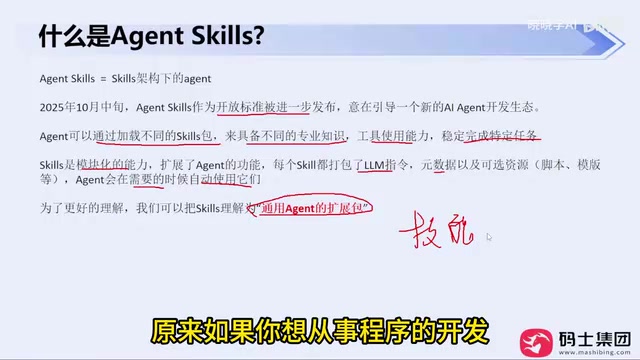
As large model technology rapidly evolves, Agent Skills has become an increasingly unavoidable core concept. By its official definition, Agent Skills is a lightweight open-source format that extends the capabilities of AI agents with specialized knowledge and workflows.
That definition isn't very intuitive for beginners. Put more plainly: Agent Skills is essentially an Agent built within a Skills architecture. When developing real-world agent projects, you can choose a single-agent architecture, a multi-agent architecture, or a modular "Agent + Skills" architecture.
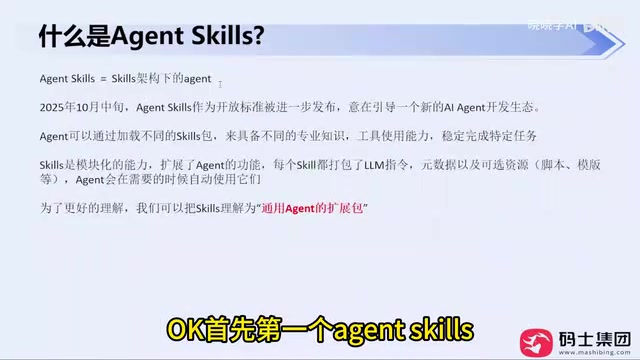
At a technical level, a Skill is simply a folder containing a SKILL.md file — which holds metadata and strategy instructions guiding the agent through specific tasks — along with optional scripts, references, templates, and other resources. In other words, each Skill packages the prompts, data, and optional resources needed to invoke a large model, and the Agent loads and uses them automatically whenever needed.
What Problem Do Agent Skills Actually Solve
The best way to understand the value of Skills is through a real-world analogy.
Imagine you're a company manager with a highly capable assistant. Your assistant has solid general knowledge and handling ability, but struggles with specialized tasks — ask them to draft a contract and they don't know the law; ask them to design a poster and they don't know Photoshop; ask them to book a flight and they're unfamiliar with the booking system.
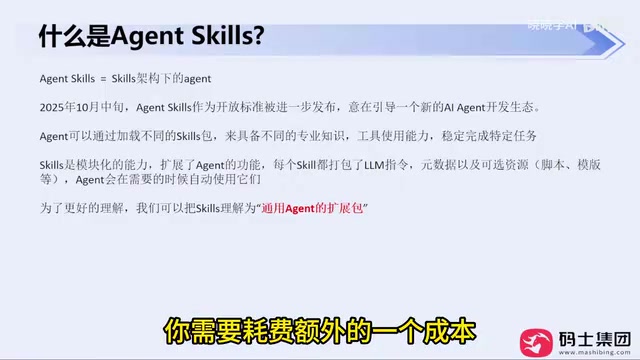
Traditionally, you'd have only two options:
- Option 1: Train your existing assistant. Send them to law school or Photoshop classes. The downside is the enormous time and effort involved.
- Option 2: Hire specialists. Bring in a dedicated lawyer to draft contracts. The downside is the additional staffing cost.
Agent Skills offers a third way: instead of training anyone or hiring anyone new, you package specialized capabilities into plug-and-play modules. Need to handle a legal matter? Mount a "Legal Expert" skill pack. Need to design a poster? Attach a "Photoshop" skill pack. Need to arrange a business trip? Load a "Booking" skill pack. Once the task is done, unload the pack and free up the resources.
This is exactly why Skills is regarded as a generational design — it lets agents evolve from "single responsibility" to "unlimited capability." For users, there's no need to spend time learning new skills or spend money building up a talent pool. It's a remarkably low-friction approach.
Progressive Disclosure: The Core Mechanism of Skills
Another key concept in the Skills architecture is Progressive Disclosure. The idea is that an Agent doesn't need to load the full content of every skill into its context all at once — instead, it expands them layer by layer, on demand.
The direct benefits of this mechanism are modularity, low cost, and high flexibility. Simply put: load what you need, unload it when you're done. For large model applications where context windows are limited and API call costs are a concern, this on-demand loading approach effectively conserves token resources and prevents valuable context space from being filled with irrelevant information.
By comparison, traditional software development learning follows a linear path: learn syntax first, then databases, then frameworks, then finally build projects. Under the Skills paradigm, this long learning chain is compressed — you simply declare "what capability I need," and as long as a ready-made Skill exists (or you can define a custom one), the Agent instantly gains the corresponding ability.
The concept of Progressive Disclosure originated in user interface design, referring to the practice of only showing users more complex information or options when they need them, rather than overwhelming them all at once. In large model applications, this idea has been adapted for context management. A model's context window is finite — common configurations include 8K, 32K, and 128K token limits. Stuffing the full instructions, examples, and templates of every skill into the context at once would rapidly exhaust available space and introduce noise unrelated to the current task, degrading the model's reasoning quality. The Skills architecture adheres to a "minimum necessary information" principle by only injecting the relevant Skill's content into the context when a specific task is triggered — reducing API call costs while maintaining more focused reasoning performance.
How to Define and Call Skills
Getting an Agent to work with Skills comes down to two core tasks: defining a Skills list and calling Skills tools.
Structurally, the basic unit for defining a Skill is the folder-based organization described earlier:
SKILL.md: The core description file for the skill, containing metadata and strategy details- Scripts & resources: Supporting files called upon when the skill executes
- Templates & references: Materials that help the Agent complete tasks more reliably
When an Agent identifies during execution that a task requires a specific capability, it matches the skill in its list and automatically loads the corresponding Skill, enabling it to handle specialized work it couldn't do on its own. This mount → use → unmount flow is the technical embodiment of the Skills architecture's plug-and-play nature.
The Difference Between Multi-Agent and Skills Agent
When choosing an architecture, many developers confuse multi-agent (Multi-Agent) systems with Skills Agents — but the two approaches are fundamentally different.
Multi-Agent is closer to the idea of "hiring more assistants" — multiple agents, each with a dedicated role, collaborate to complete complex tasks. Each Agent is an independent entity that needs to communicate and coordinate with the others.
Skills Agent is the idea of "giving one assistant different capability packs" — the core entity is always the same single Agent, which expands its expertise by loading different skill packs. The emphasis is on modular capability extension, not adding more entities horizontally.
Both architectures have their place: when a task requires multiple roles working in parallel, Multi-Agent is the better fit; when you need a single agent to flexibly acquire various specialized capabilities while keeping costs under control, the Skills architecture is usually the lighter-weight choice.
From an engineering perspective: Multi-Agent architectures typically require an additional orchestration layer (Orchestrator) responsible for task decomposition, sub-agent scheduling, and result aggregation. System complexity and maintenance costs grow linearly with the number of agents, and inter-agent communication can introduce latency and consistency issues. Skills Agent consolidates complexity within a single entity — skill loading and unloading is managed by the Agent itself, making the overall chain shorter and more observable. In budget-constrained scenarios or where task boundaries are well-defined, the Skills architecture often achieves near-Multi-Agent levels of specialization at a much lower engineering cost. That said, the two approaches are not mutually exclusive. In large-scale systems, multiple Skills Agents can each take on different roles and be coordinated at the top level through a Multi-Agent framework, forming a more resilient hybrid architecture.
Closing Thoughts
Agent Skills has been proposed as an open standard intended to shape a new ecosystem for Agent development. Its core philosophy can be summarized in three points: modularity, low cost, and high flexibility. For anyone working in IT — whether in development, operations, or product — understanding the "capability as plugin" design philosophy behind Skills will pay dividends in future agent project development.
The best way to master Skills is still to return to the official documentation and get hands-on by defining and calling your own skill pack in a real project. There's no better way to feel the flexibility of "load what you need, when you need it" than to experience it yourself.
Related articles

Amphibious Transforming Drone: Beyond 100x Power Savings, What Are the Real Needs?
Is the amphibious transforming drone just a gimmick? Starting from the 100x power difference of the M4 Morphobot, explore real application scenarios and thesis topic ideas, analyzing boundary conditions where pure drones and pure ground robots both fail.

Warhound Raises $200 Million: Genetically Engineered "War Dogs" Paired with Anduril Gear
Warhound raises $200M, backed by Ben Lamm and Palmer Luckey, to genetically engineer dogs for military and law enforcement use and equip them with Anduril gear. This article analyzes its technology direction, funding logic, and ethical controversy.

Claude API Comes to Google Cloud: IAM Integration and SDK Access Guide
Anthropic hosts the full Claude API on Google Cloud with IAM-controlled permissions and unified billing. This guide covers the Vertex AI and Anthropic-hosted entry points, IAM role configuration, and SDK access.