Agent Skills: Turn Your Coding Agent into a Senior Engineer

Agent Skills gives coding agents 25 skills and 9 slash commands, using verification gates to enforce delivery quality.
Released by former Google Engineering Director Addy Osmani, Agent Skills is a capability pack for coding agents with over 100,000 GitHub stars. It uses 25 skills and 9 slash commands to cover the full lifecycle from specification and planning to build, test, review, and ship. Its core design is verification gates: each skill has built-in checkpoints, and agents must provide objective evidence such as test runs and diffs before claiming completion, addressing the pain point of coding agents confidently declaring completion while gaps remain. The build auto mode also lets users approve a plan once and then automatically build task by task, with test-first development and per-task commits preserving control points. Compatible with Claude Code, Cursor, Codex, and Gemini CLI, it suits structured daily development, improving automation reliability, and teaching. Its significance lies in making senior engineers' working patterns explicit, representing a trend where coding agents compete on workflow and quality control rather than model capability alone.
Introduction: A Free Package That Brings Code Generation Closer to Senior Engineer Quality
Agent Skills, released by former Google Engineering Director Addy Osmani, provides coding agents with a capability package that closely mirrors how senior engineers work. According to the video, the project has already surpassed 100,000 stars on GitHub. Through 25 skills and 9 slash commands, it covers the full lifecycle from specification and planning through building, testing, reviewing, and shipping.

Unlike ordinary code completion, Agent Skills emphasizes "verification gates": each skill has built-in checkpoints, and the agent cannot claim completion on words alone—it must provide evidence. This design makes automation more auditable and reduces uncertainty in delivery quality.
Coding Agent refers to an AI system capable of understanding natural language instructions, autonomously planning, and executing development tasks such as writing, modifying, and testing code. Typical examples include Claude Code, Cursor, Codex, and Gemini CLI. Unlike traditional code completion tools, coding agents usually support multi-turn interaction, tool invocation (such as running terminal commands and reading/writing files), and task decomposition, enabling them to complete end-to-end development workflows with minimal human intervention. However, a common problem with such agents is "overconfidence"—they may declare a task complete without sufficient verification, leaving hidden defects in the code. Agent Skills targets exactly this pain point, constraining agent behavior through structured skills and verification gates so that its working mode is closer to that of a rigorous senior engineer.
Core Mechanism: Skills, Commands, and Verification Gates
25 Skills: The Working Mode of a Senior Coding Engineer
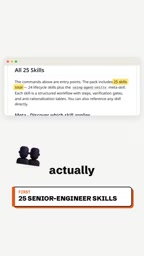
The core of Agent Skills is its 25 skills, which make the implicit experience of senior engineers explicit. These skills are not isolated functions but operational patterns covering every stage of development—for example, writing maintainable code, designing test strategies, and conducting code reviews. By loading these skills, coding agents can invoke the corresponding behavior templates for specific tasks, reducing ad-hoc improvisation.
9 Slash Commands: Covering the Software Lifecycle
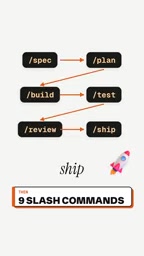
The accompanying 9 slash commands string the skills together into a workflow. It starts with specification (spec) and planning (plan), then proceeds through build, test, and review, all the way to ship. This command-driven interaction lowers the barrier to use—users don't need to manually orchestrate each step, they simply advance along the lifecycle.
Verification Gates: Completion Must Be Backed by Evidence
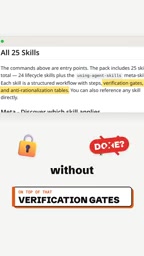
Each skill comes with verification gates. This means that before an agent claims a task is complete, it must pass preset checks—for example, running tests, generating diffs, or providing verification output. This directly addresses a common pain point: coding agents tend to "confidently declare completion" while gaps remain. Verification gates shift the definition of completion from subjective claims to objective evidence.
Verification Gates draw on the concept of quality gates in software engineering. In continuous integration/continuous delivery (CI/CD) pipelines, a quality gate refers to objective criteria that must be met before moving to the next stage—for example, meeting test coverage targets, having no severe static analysis warnings, or a successful build. Agent Skills brings this idea into the coding agent workflow: each skill has preset checkpoints, and the agent must prove task completion by running tests, generating diffs, or providing verification output, rather than merely making a verbal claim. This mechanism transforms the definition of "done" from subjective judgment into auditable objective evidence, significantly reducing uncertainty in automated delivery and providing a credible basis for subsequent human review.
Automated Workflow: build auto Mode
Agent Skills provides a mode called build auto. The usage is to enter the command and approve the plan once; after that, the agent builds task by task, writing tests first and then committing code for each task. This "test-first, per-task commit" rhythm aligns with senior engineer practices and helps maintain the traceability and quality of the codebase.
This process concentrates human approval at the planning stage, while the execution stage is left to the agent to advance automatically. For scenarios that require batch processing of tasks, this approach can significantly reduce repeated confirmations while retaining control points through test-first development and per-task commits.
Test-First is one of the core practices of test-driven development (TDD). It requires writing test cases before writing functional code and ensuring the tests fail (red), then implementing the code to make the tests pass (green), and finally refactoring. This rhythm forces developers to clarify requirements and boundary conditions before starting, thereby improving code quality and maintainability. Agent Skills' build auto mode automates this practice: the agent writes tests first and then commits code when building each task, ensuring every increment is verified. Per-Task Commit draws on the idea of atomic commits, keeping each change small in scope and traceable, which facilitates code review and issue localization—highly consistent with the daily habits of senior engineers.
Compatibility and Use Cases
According to the video, Agent Skills can be used in Claude Code, Cursor, Codex, and Gemini CLI. This means it is not tied to a single tool but targets mainstream coding agent environments. For developers already using these tools, the adoption cost is low. Use cases include daily development that requires structured processes, teams looking to improve the reliability of automated tasks, and teaching scenarios that want to draw on senior engineers' working patterns.
Slash Commands are a common interaction method in chat-based AI tools. Users trigger specific features or workflows by entering short commands that start with "/", such as /spec, /plan, and /build. This design lowers the learning curve: users don't need to memorize complex natural language prompts and can instead invoke commands in lifecycle order to complete the entire process from specification to delivery. Agent Skills encapsulates 25 skills behind 9 slash commands, maintaining the modularity of the skills while providing a clear workflow entry point, allowing developers to drive coding agents in a way that resembles traditional command-line tools.
Significance and Limitations
The value of Agent Skills lies in breaking down "how senior engineers work" into reusable skills and commands, and constraining agent behavior through verification gates. It represents a trend: the competitive focus of coding agents is shifting from model capability to workflow and quality control.
It is worth noting that the video is an overview and does not delve into the specific implementation of each skill, the detailed mechanisms of the verification gates, or the actual results in different projects. The 100,000 stars reflect attention, but actual benefits still depend on project complexity and how well the workflow matches team processes. For developers considering adoption, it is advisable to first validate in a small set of tasks whether the workflow fits existing practices.
Related articles

Random Pruning of the DPO Computation Graph: 1.4x Training Speedup and Lower Peak Memory
DPO training too slow and memory-hungry? This paper proposes a random pruning framework for the DPO computation graph, sampling independently across position, sequence, and branch dimensions; branch pruning achieves a 1.426x step-time speedup and cuts training time by about 30%, with in-depth attribution of memory and time gains.

Why Does JEPA Underperform MLM in Longitudinal EHR Representation Learning?
New study compares JEPA and MLM for longitudinal EHR representation learning on MIMIC-IV: three JEPA variants train stably without collapse but underperform MLM; target size, not heterogeneity, drives prediction error.

Transfer Learning + Visible Light Communication: A New Approach to Energy-Efficient Indoor Positioning
A study proposes a transfer learning-based visible light communication indoor positioning method, achieving 47% accuracy improvement on the BOSCH factory dataset, 67.5% model efficiency under high noise, and introducing the ME composite metric for energy-efficient positioning in energy-constrained industrial IoT scenarios.