Agent Substrate: Building an AI Agent Runtime Kernel in Go

Agent Substrate is a Go-based runtime kernel designed to be the foundational infrastructure layer for AI Agents.
Agent Substrate is an open-source project built in Go that positions itself as the core runtime system for AI Agents. Unlike application-layer frameworks like LangChain, it focuses on providing foundational infrastructure—task lifecycle management, state persistence, resource isolation, and observability. Its choice of Go over Python signals a focus on system-level performance, high concurrency, and production reliability for engineering teams deploying Agents at scale.
What Is Agent Substrate
In the current explosion of the AI Agent ecosystem, frameworks are emerging one after another—from LangChain and AutoGPT to various multi-agent orchestration tools, developers have more choices than ever. But a question that's often overlooked is: what does the underlying runtime that these higher-level frameworks truly depend on actually look like? Agent Substrate is a project that attempts to answer exactly this question.
From its official positioning as "the core system," it's clear that Substrate isn't yet another application-layer framework. Instead, it aims to become the underlying foundational system for AI Agent execution—the so-called "substrate layer." The naming is quite deliberate: in biology and materials science, a substrate refers to the base medium that supports growth. Used here, it aptly expresses its positioning as infrastructure for the Agent ecosystem.
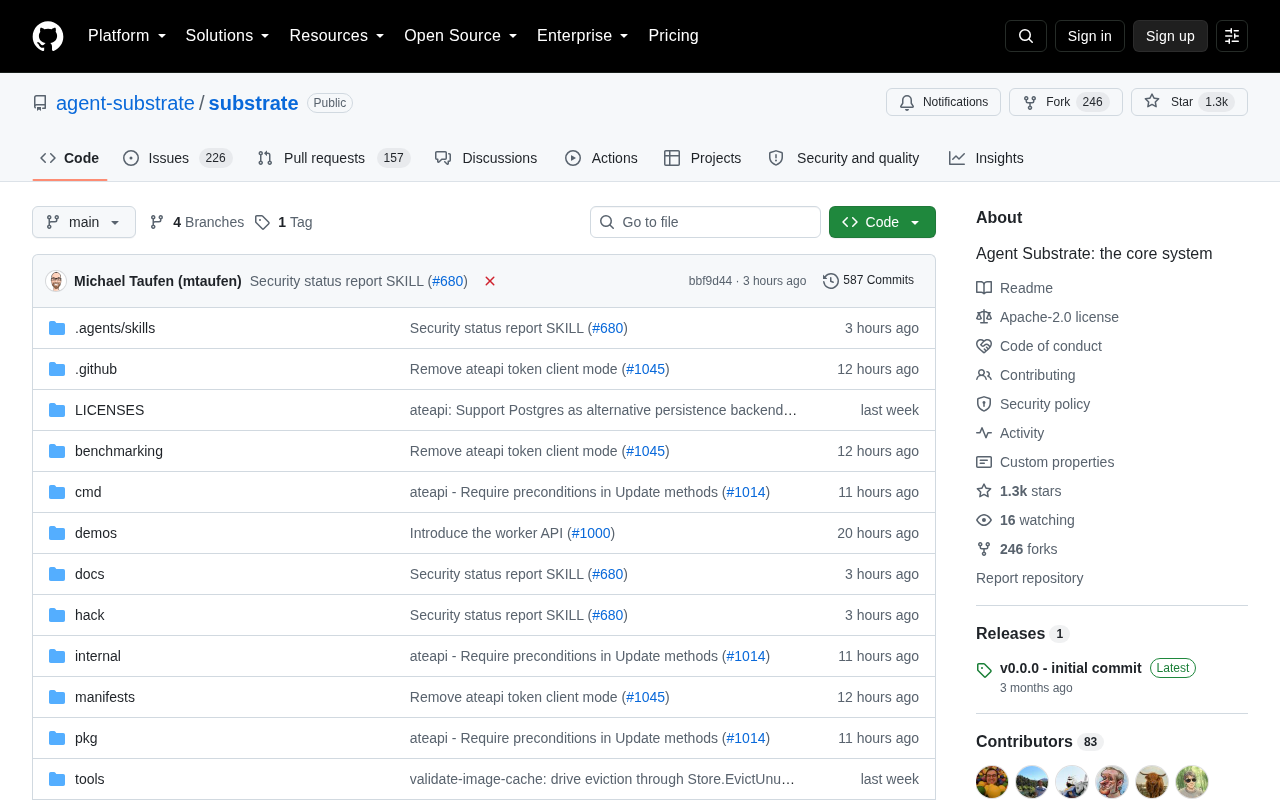
The project is developed in Go and has accumulated 1,279 Stars and 246 Forks on GitHub, with 26 new Stars in a single day—community attention is steadily rising. Choosing Go over Python is itself a technical decision worth deep consideration.
Why Go Instead of Python
The vast majority of AI Agent projects use Python as their primary language, which is inseparable from the current state of the machine learning ecosystem. However, Substrate goes against the grain by choosing Go, revealing a clear pursuit of system-level performance and engineering reliability.
Concurrency and Performance Advantages
AI Agent systems in production often need to handle a large number of tasks simultaneously: multiple Agents reasoning in parallel, asynchronous waiting for tool calls, managing long-running task queues, and more. Go's goroutine and channel mechanisms are naturally suited for these high-concurrency scenarios. Compared to Python's GIL limitations, Go can support large-scale concurrent execution with much lower resource overhead.
To understand the deeper logic behind this technology choice, we need to understand the fundamental differences in concurrency models between the two languages. Python's GIL (Global Interpreter Lock) is a mutex mechanism in the CPython interpreter that ensures only one thread can execute Python bytecode at any given time. This means that even on multi-core CPUs, Python multi-threaded programs cannot truly achieve parallel computation. For I/O-intensive tasks, this can be mitigated through asyncio, but for system-level services requiring high-concurrency scheduling, the GIL remains a structural bottleneck. Although Python 3.13 introduced an experimental free-threaded mode (PEP 703), it's still far from production-ready.
Go's concurrency model is based on CSP (Communicating Sequential Processes) theory. Goroutines, as lightweight coroutines, have an initial stack space of only about 2KB (OS threads typically require 1-8MB), making it easy to create hundreds of thousands or even millions of concurrent units. Go's runtime includes a built-in M:N scheduler that automatically handles preemptive scheduling and work stealing for goroutines. Channels provide a type-safe communication mechanism that avoids race condition issues common in shared-memory concurrent programming. This design philosophy is highly aligned with the Agent runtime's need to schedule a large number of concurrent tasks.
Deployment and Operations Friendliness
Go's characteristic of compiling to a single static binary makes Substrate's deployment in production environments extremely simple—no complex dependency management or virtual environment configuration needed. For Agent systems running as long-lived infrastructure services, this is a very significant operational advantage.
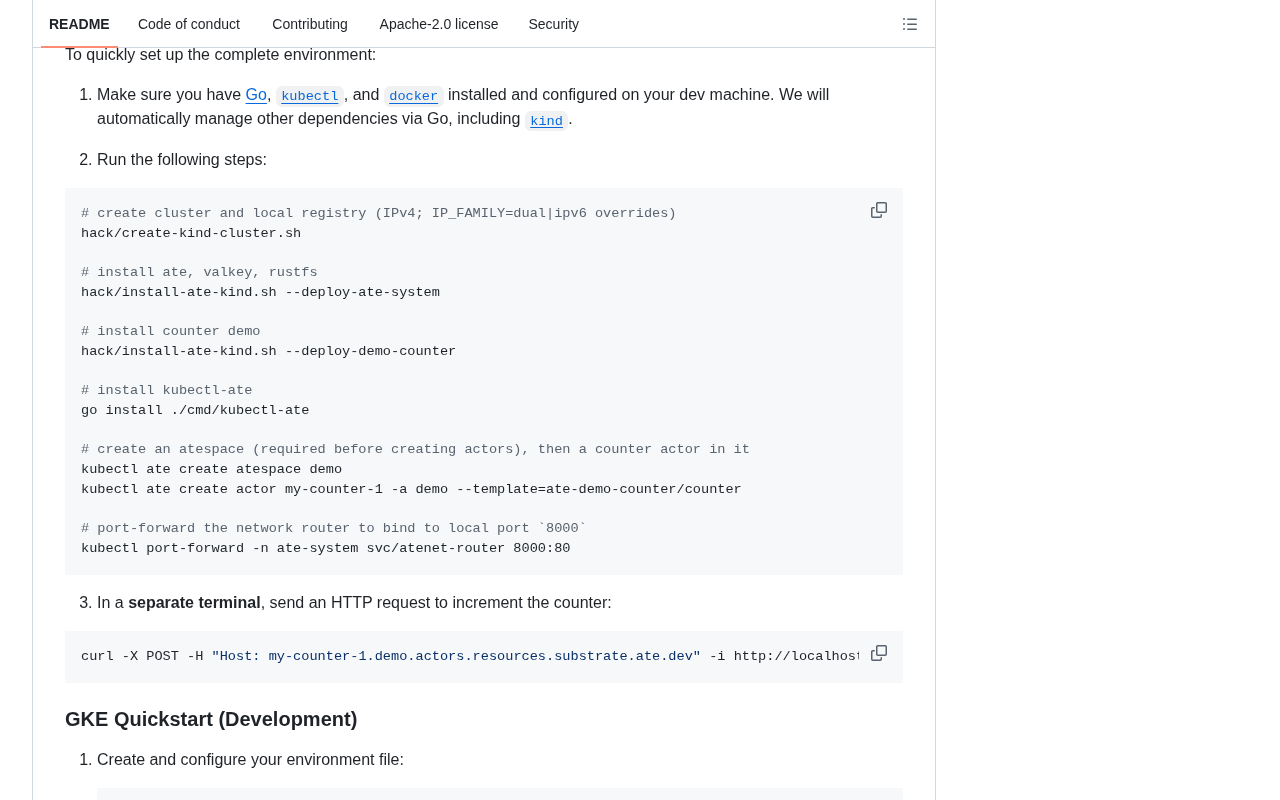
Substrate's language choice itself sends a clear signal: it's not targeting researchers doing rapid prototyping, but engineering teams that need to reliably deploy Agent capabilities into production systems.
What Core Problems Does the Agent Infrastructure Layer Solve
As Agent applications move from demo showcases to production deployment, the entire technology stack is showing a clear trend toward layering. The upper layer consists of various application frameworks and orchestration tools, the middle layer handles model access and tool-calling protocols (such as MCP), and the bottom layer requires a stable, high-performance runtime to support everything above it.
The MCP (Model Context Protocol) mentioned here is an open protocol released by Anthropic in late 2024, aimed at standardizing interactions between large language models and external tools and data sources. Before MCP appeared, each Agent framework needed to define its own tool-calling interface specifications, leading to severe ecosystem fragmentation. MCP defines a client-server architecture that communicates through standardized JSON-RPC messages, similar to how USB-C unified various device connections, establishing a unified "tool socket" standard for the AI Agent ecosystem. Substrate, as an underlying runtime, needs to work seamlessly with such middle-layer protocols.
This layered evolution of the Agent technology stack bears a striking resemblance to the development history of cloud computing. Early cloud computing similarly went through the process of evolving from monolithic applications to IaaS/PaaS/SaaS layers. In 2023, frameworks like LangChain solved the problem of "how to quickly build Agents." In 2024, tools like CrewAI and AutoGen solved "how to orchestrate multi-Agent collaboration." By 2025, the industry began to realize it was missing an infrastructure layer focused on "how to reliably run Agents." This trend indicates that Agent technology is moving from the experimental stage to the engineering stage, beginning to follow the layered decoupling principles of mature software engineering.
Four Core Capabilities
A mature Agent substrate layer typically needs the following categories of capabilities:
- Task Lifecycle Management: Creation, scheduling, suspension, resumption, and termination of Agent tasks
- State Persistence: Reliable saving and restoration of context state for long-running Agents
- Resource Isolation and Scheduling: Resource allocation and isolation mechanisms when multiple Agents run in parallel
- Observability: Logging, distributed tracing, and monitoring capabilities for Agent behavior
Among these, state persistence is particularly critical for long-running Agents. Long-running Agents face a core challenge: how to reliably save and restore state during task execution spanning hours or even days—including conversation context, intermediate reasoning results, tool call history, task progress, and more. In distributed systems, this typically requires Event Sourcing or snapshot mechanisms, similar to a database's WAL (Write-Ahead Logging) or game save mechanisms. After a system crash, execution must be able to resume from the most recent consistent state rather than starting from scratch. For enterprise-grade Agent applications (such as automated customer service or code generation pipelines), state loss means direct business losses and broken user experiences.
These are precisely the parts that application-layer frameworks are unwilling and shouldn't need to reinvent. Substrate positions itself as the "core system" precisely targeting this gap—providing a solid foundation that upper-layer frameworks can reuse.
Complementary Relationship with LangChain and Similar Frameworks
One detail worth noting: Substrate doesn't directly compete with frameworks like LangChain but is more likely to form a complementary relationship. Upper-layer frameworks handle developer experience and business logic orchestration, while Substrate handles high-performance execution and system-level guarantees at the bottom. This division of labor isn't unfamiliar in software engineering—just as mature HTTP servers and runtimes exist beneath web application frameworks. Take the Node.js ecosystem as an example: Express or Nest.js are application-layer frameworks, while the libuv event loop and V8 engine are the underlying runtime. In the Java world, Spring Boot relies on underlying capabilities provided by the JVM and Netty. The Agent ecosystem is undergoing a similar maturation process, and Substrate is trying to play exactly this "runtime" role.
Practical Significance for Developers and Engineering Teams
For teams currently building Agent products, Substrate's emergence provides a new technical option. When your Agent system advances from the "it can run" stage to the "it runs stably and handles load" stage, a substrate layer focused on underlying reliability becomes indispensable.
Specifically, the following types of teams are likely to benefit first: backend teams embedding Agent capabilities into existing Go technology stacks; platform engineering teams that need to stably run hundreds of concurrent Agent instances in production; and enterprise application developers with strict requirements for Agent system observability and fault recovery.
However, an objective perspective is also needed: as an open-source project still in rapid iteration, Substrate's documentation completeness, ecosystem maturity, and community size still lag behind leading Python frameworks. A volume of 1,279 Stars indicates it's in an early growth stage, making it more suitable for teams with keen technical instincts who are willing to invest in system fundamentals to evaluate and experiment with.
Agent Substrate represents an important signal that the AI Agent technology stack is maturing: when the application-layer race gradually cools down, what truly determines whether a system can scale to production is often the less eye-catching underlying infrastructure. Choosing Go and focusing on the "core system" positioning makes Substrate stand out among the many Agent projects.
Whether it can truly become the "substrate layer" of the Agent era still needs time and community validation. But at the very least, it raises the right question—as we constantly chase smarter Agents, don't forget they need a solid enough foundation beneath their feet.
Related articles

Gaussian Process Bandit Optimization: Exploration Strategies and Inference Regret Guarantees
Cumulative regret guarantees in Bayesian optimization fail to reflect final recommendation quality. This article examines a new study that provides inference regret guarantees for Gaussian process bandit optimization through exploration query strategies and fill distance analysis, validated on hyperparameter optimization and control tasks.
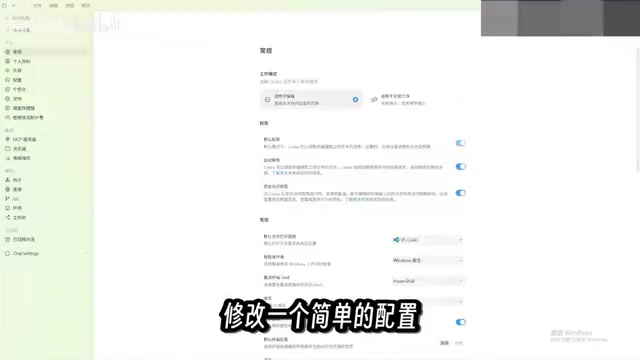
The Most Detailed Codex Guide on Bilibili: From Installation to Real-World Practice
The most detailed Codex guide on Bilibili: from app store installation to daily work mode configuration, with a real coffee shop project demonstrating file organization, data extraction, dashboard creation, and other practical tasks. Learn to use Plan Mode and desktop pets to leverage Codex efficiently.

Appearance Compensation in Volume Rendering: Why RGB Accuracy Cannot Guarantee Density Correctness
Volume rendering research reveals that volumetric data perfectly reproducing external RGB views may still contain density errors: appearance compensation can double central density and keep external rays unchanged even when L2 error exceeds 14.52%. Density recovery depends on appearance capacity, spatial resolution, and measurement design.