AgentFaultBench: How Tool Failure Recovery Capability Is Being Redefined

AgentFaultBench uses state verification to evaluate agent tool failure recovery and finds recovery suggestions are not necessarily beneficial.
AgentFaultBench is a state-verification-based agent evaluation framework that injects tool errors into LangGraph and CrewAI agents in an isolated GitLab environment and checks file modifications, issue records, and required steps rather than only final output. Its core finding is that recovery suggestions are not always helpful: success rate changes were -8.33, 0.00, and +1.06 percentage points, with some comparisons inconclusive due to missing results. Under the revised strategy, GPT-4o mini improved, while Sol and Claude could already handle recoverable cases themselves, suggesting suggestion value depends on model capability baseline. A second checker matched the primary results, but human validation is lacking, leaving methodological limitations.
When a tool call fails, can the agent actually complete the task? AgentFaultBench provides a verifiable answer. It no longer relies on subjective judgment, but instead uses state checks to evaluate the failure recovery performance of LangGraph and CrewAI agents in an isolated GitLab environment. This research comes from an rss source, and its core conclusion points to a counterintuitive fact: recovery suggestions are not always helpful, and in some cases may even reduce the success rate.
Why state-verified evaluation is needed
Traditional agent evaluation often looks only at the final output, but tool failure recovery involves intermediate states: whether files were correctly modified, whether issues were recorded, and whether the necessary read and verification steps were performed. AgentFaultBench is designed precisely to capture these details. Each task provides the expected issue and report text, so it tests execution capability rather than content generation capability. This design makes the evaluation closer to real development scenarios—in a CI/CD pipeline, a single tool error can stall the entire workflow, and the agent needs to recover without human intervention.
According to the original research description, the experiment was conducted in an isolated GitLab installation, injecting tool errors and then checking the resulting files, issues, and the required reads, verification, and final responses. This multidimensional check reflects the agent's actual robustness better than a single success/failure label.
LangGraph and CrewAI are two mainstream agent orchestration frameworks today, but they have different design philosophies. LangGraph models agent workflows as state graphs, where nodes represent operations and edges represent conditional transitions. It naturally supports loops and interruption recovery, making it suitable for scenarios that require fine-grained control over the process. CrewAI, by contrast, adopts a role-collaboration paradigm, in which multiple agents play different roles (such as researcher and writer) and collaborate through task delegation, placing more emphasis on high-level task decomposition. AgentFaultBench evaluates both because differences in the frameworks' recovery mechanisms may directly affect failure handling performance: LangGraph's state machine structure makes it easy to insert checkpoints and retry logic, while error propagation paths in CrewAI's collaborative workflow are more complex. Understanding this background helps interpret the evaluation results—the effect of recovery suggestions may vary depending on the framework's underlying recovery capabilities.
The real effect of recovery suggestions: the data speaks
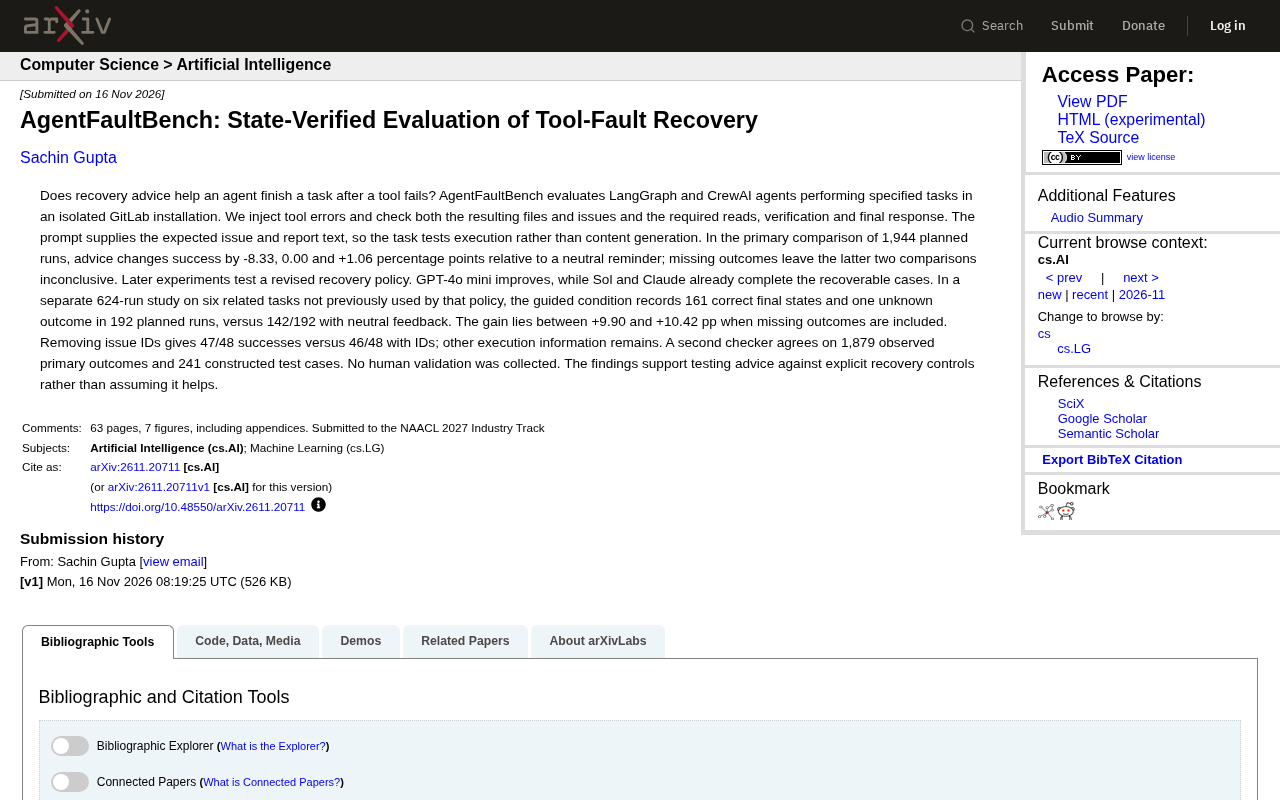
In the main comparison, the study planned 1,944 runs. Compared with neutral reminders, the success rate changes brought by recovery suggestions were -8.33, 0.00, and +1.06 percentage points, respectively. The latter two comparisons could not be concluded due to missing results. This set of data directly challenges the assumption that "providing recovery suggestions always improves performance."
Subsequent experiments tested revised recovery strategies. GPT-4o mini showed improvement, while Sol and Claude were already able to complete recoverable cases. In another study of 624 runs across six related tasks, the guided condition recorded 161 correct final states and one unknown result out of 192 planned runs, while neutral feedback was 142/192. When missing results are included, the gain ranges from +9.90 to +10.42 percentage points.
You may not have noticed that after removing the issue ID, the success rate was 47/48, compared with 46/48 when the ID was retained, with other execution information unchanged. This suggests that some metadata has limited impact on the recovery process, but the execution information itself remains critical.
A percentage point is a unit for measuring the absolute difference between two percentages, unlike percentage change. For example, if the success rate rises from 50% to 55%, that is an increase of 5 percentage points, but the relative increase is 10%. The -8.33, 0.00, and +1.06 percentage points mentioned in the text refer to the difference in success rates between the recovery suggestion group and the neutral reminder group; a negative value means that the recovery suggestion instead reduced the success rate. When the sample size is limited, a difference of a few percentage points may not be statistically significant, which is one reason some comparisons in the text "could not be concluded." Understanding this unit helps avoid misreading small fluctuations as substantive effects.
Multi-source validation and disagreement
The study used a second checker to validate 1,879 observed primary results and 241 constructed test cases, and the two were consistent. This enhances the reliability of the evaluation. However, the study also explicitly acknowledges that no human validation data was collected, which is a methodological limitation.
Different models showed differences in the effect of recovery suggestions: GPT-4o mini benefited from the revised strategy, while Sol and Claude were already able to handle recoverable cases themselves, suggesting that the value of recovery suggestions may depend on the model's capability baseline. For stronger models, additional suggestions may become interference; for weaker models, appropriate guidance may bring improvement.
A secondary checker is a validation mechanism independent of the main evaluation process, usually implemented by a different model or rule set, and is used to review the judgments of the primary checker. In agent evaluation, a single checker may produce systematic misjudgments due to model bias or rule loopholes, and cross-validation can expose such problems. The second checker in the text reviewed 1,879 primary results and 241 constructed test cases, and the two were consistent, indicating that the judgments of the primary checker are reproducible. Note, however, that consistency between two checkers does not mean the judgments are absolutely correct—if both share the same evaluation logic or training data bias, consistency may be an illusion. This is also why the study acknowledges the limitation of lacking human validation: human annotation can provide ground truth independent of automated checkers.
Implications for agent development
AgentFaultBench's core contribution lies in providing a reproducible evaluation framework rather than simply claiming that a certain method is effective. It emphasizes that suggestions should be tested with explicit recovery controls rather than assuming suggestions are beneficial. For developers, this means that when building tool failure recovery mechanisms, empirical testing should be conducted for specific models and task types rather than blindly adding recovery prompts.
From a broader perspective, this research echoes a trend in AI engineering: evaluation is shifting from "it looks like it works" to "verifiable state correctness." Injecting failures in isolated environments, checking intermediate states, and cross-validating with a second checker—these practices set a new standard of rigor for agent evaluation.
Despite the lack of human validation, AgentFaultBench's methodology and preliminary data already provide a solid foundation for future research. Future work can build on this by adding human evaluation and exploring recovery strategies for more models and task types.
One-line Summary
AgentFaultBench uses state verification to evaluate agent tool failure recovery and finds that recovery suggestions are not necessarily beneficial.
Paragraph Summary
AgentFaultBench is an agent evaluation framework based on state verification. It injects tool errors into LangGraph and CrewAI agents in an isolated GitLab environment and checks whether file modifications, issue records, and required steps are completed, rather than looking only at the final output. The core finding is that recovery suggestions are not always helpful: compared with neutral reminders, success rate changes were -8.33, 0.00, and +1.06 percentage points, and some comparisons could not be concluded due to missing results. Under the revised strategy, GPT-4o mini improved, while Sol and Claude were already able to handle recoverable cases on their own, suggesting that the value of suggestions depends on the model's capability baseline. The second checker was consistent with the primary results, but the study lacks human validation, so methodological limitations remain.
Related articles

RePlan-VLA: Progress-Aware Replanning Breakthrough for Long-Horizon Robotic Manipulation
The RePlan-VLA framework converts VLA models' short-horizon capabilities into reliable long-horizon execution through progress-aware adaptive replanning, improving success rates by 21.9% and 10.4% on RoboCasa365 and CALVIN, and validating real-world deployment on a Franka Research 3 robot.

Geometric Bridge Flow Matching: A New Breakthrough in Blind Rigid Motion Correction
Geometric bridge flow matching enables blind rigid motion correction in head CBCT, achieving 37.1 dB PSNR and 0.27 mm RPE on simulated data in ~9.1 minutes, outperforming existing methods.

Google Releases Gemini 4 Hydrogen: 2.5x Faster Without Sacrificing Intelligence
Google releases the lightweight Gemini 4 Hydrogen: 2.5x faster task completion, AA Intelligence Index of 54 beating its flagship sibling, 7.3s single-step on Agent Arena faster than Claude and GPT rivals, four thinking levels with pay-as-you-need pricing, now available across AI Studio and more.