Agentic Batch Changes: The AI Agent for Large-Scale Code Transformation

Sourcegraph's AI agent enables one engineer to execute large-scale code changes across thousands of repositories.
Sourcegraph's Agentic Batch Changes targets the long-standing pain of applying consistent changes across hundreds or thousands of repositories in large enterprises. Unlike traditional batch change tools that rely on deterministic rules, it uses an AI agent to understand each repository's specific context and generate tailored changes — upgrading the workflow from pattern matching to semantic understanding. Tasks that once required entire teams and cross-department scheduling, such as global dependency upgrades or security fixes, could theoretically be driven by a single engineer. The article also notes that key questions around change quality assurance and review/rollback mechanisms still require more real-world validation.
How a Single Engineer Can Drive Code Changes Across Thousands of Repositories
In large enterprise engineering organizations, applying consistent changes across hundreds or even thousands of code repositories has long been a painful challenge. Whether upgrading dependencies, patching security vulnerabilities, or refactoring outdated API calls, engineers typically resort to tedious manual work on each repository or brittle scripts that struggle to handle wildly varying codebases.
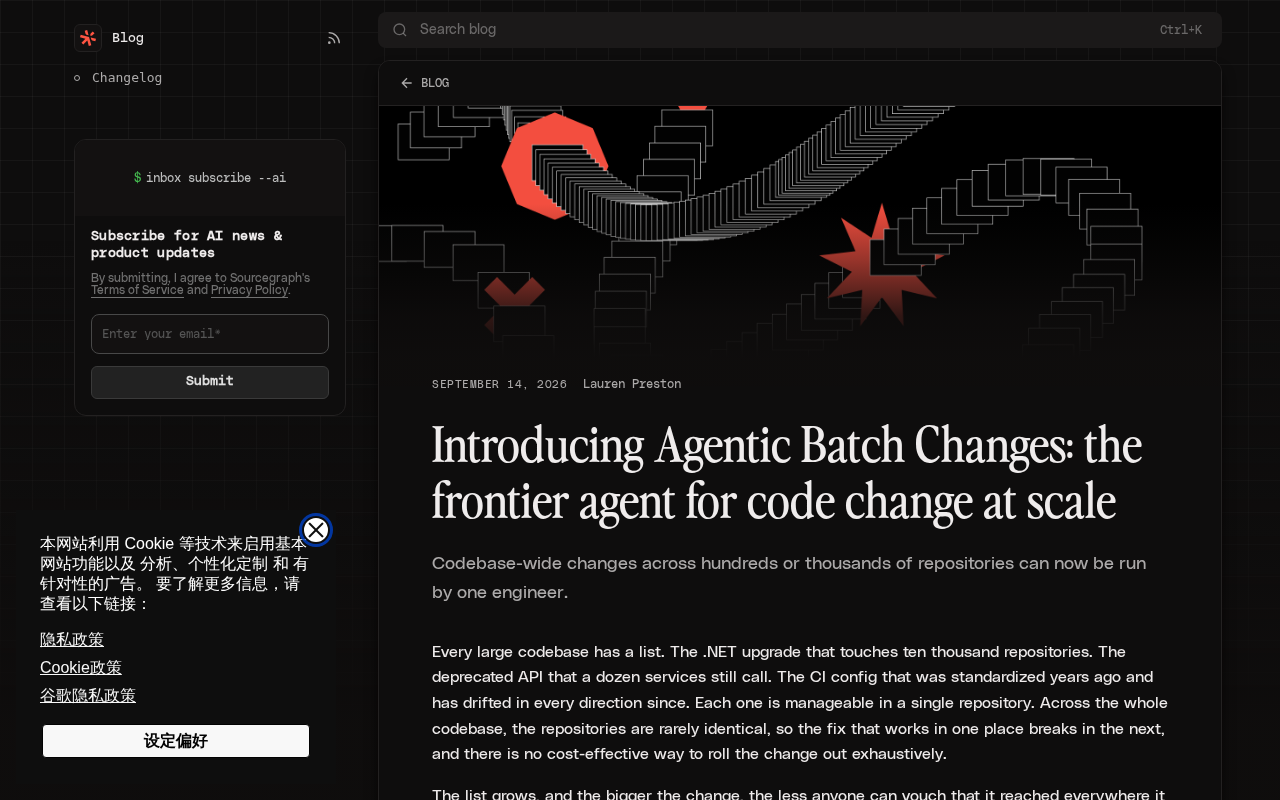
Agentic Batch Changes was built to address exactly this pain point. According to the official announcement, it is positioned as "the frontier agent for code change at scale" — with a clear value proposition: cross-repository changes that once required an entire team can now be handled by a single engineer.
From Batch Changes to "Agentic" Batch Changes
Batch code changes are not a new concept. Tools have existed that apply identical patches across multiple repositories using rules or templates — but these approaches have obvious limitations. They rely on deterministic matching rules that often fall short when confronted with structurally diverse codebases.
The "Agentic" prefix is the key differentiator in this release. It means the change process is no longer about mechanically applying the same diff everywhere. Instead, an AI agent with reasoning capabilities understands the specific context of each repository and generates targeted changes accordingly. This elevates cross-repository changes from "pattern matching" to "semantic understanding" — theoretically enabling it to handle complex refactoring scenarios that traditional scripts simply cannot reach.
Scale Is the Core Problem
The repeated emphasis on "at scale" in the official description cuts to the heart of what this tool is designed to solve. For organizations managing thousands of microservice repositories, a single global technology stack upgrade can touch hundreds of codebases. The human cost and error risk under traditional approaches are simply unsustainable. Compressing this kind of work into something a single engineer can accomplish represents an order-of-magnitude improvement in engineering efficiency.
Representative traditional batch change tools include Sourcegraph's own earlier Batch Changes product, GitHub's CodeSearch + scripted pipelines, and open-source tools like Comby (a structural code rewriting tool based on syntactic patterns). These tools work by having engineers pre-write deterministic transformation logic — regex replacements, AST rewrites, or shell scripts — which the tool then applies in parallel across all target repositories to generate pull requests. Their bottleneck lies in the "homogeneity assumption": they assume the code that needs changing has the same or highly similar structure across every repository. In reality, even when implementing the same functionality, different teams may vary significantly in coding style, dependency versions, and call hierarchies. A fixed ruleset typically covers only 70–80% of repositories, leaving the remaining "long tail" to require manual intervention. The core improvement of the "agentic" approach is that the AI agent independently reasons about the code structure in each repository and generates changes adapted to that repository's specific context — bringing the long tail within the scope of automation.
What This Means for Engineering Teams
If this tool delivers on its promises, it will have a meaningful impact on how large engineering organizations collaborate. Platform engineering, security, and infrastructure teams — who generate the most cross-repository change requirements — stand to benefit most. What once required cross-team scheduling and phased rollouts could potentially be executed quickly by a handful of engineers working with an AI agent.
This also reflects a broader evolution in AI coding tools: moving from "single-file, single-repository" coding assistance toward "cross-repository, engineering-scale" automation. Code completion and conversational programming address local productivity. Agentic batch changes target organizational-level engineering governance challenges.
Questions Worth Watching
Publicly available information remains limited, and several critical questions deserve ongoing attention: How is the quality of agent-generated changes ensured? Are the review and rollback mechanisms for large-scale automated changes robust enough? And when facing highly customized legacy codebases with significant historical baggage, can the agent's real-world performance live up to the marketing claims? More real-world case studies and technical details are needed to answer these questions.
The industry has accumulated meaningful experience in risk management for large-scale automated code changes. Meta's Codemod system and Google's Rosie platform both adopt a "small batches, high frequency, incremental rollout" strategy, combined with automated test gates and staged merge mechanisms to keep change risk within acceptable bounds. For AI agent-generated changes, the additional challenge is output non-determinism — the same task may produce unpredictable results across different repositories, which means traditional deterministic review workflows need to adapt. Approaches currently being explored include: enforcing full CI pipeline runs on agent-generated diffs, introducing "change confidence scores" to distinguish high-confidence changes from those requiring human review, and preserving complete agent reasoning traces for post-hoc auditing. Whether these mechanisms have been integrated into Agentic Batch Changes is a key indicator of its production readiness.
Closing Thoughts
Agentic Batch Changes represents a step forward in the evolution of AI coding tools toward engineering-scale automation. It attempts to answer an increasingly important question: when AI can not only write individual functions but also understand and transform entire code ecosystems, how will the organizational structure of software engineering change? For teams managing large codebases, the maturity of tools like this will directly affect their ability to manage technical debt and execute large-scale migrations efficiently. Available information is still limited — it's worth following the technical documentation and real-world adoption feedback as they emerge.
Related articles

FDE Forward Deployed Engineer: The New Species of AI Implementation and Practical Pathways
What is an FDE Forward Deployed Engineer? This article breaks down FDE's origins, its fundamental difference from outsourcing, the cost logic that spawned it in the AI era, and the capability advancement path from Agent development to fine-tuning and reinforcement learning, plus common bottlenecks and budget realities of enterprise fine-tuning implementation.

A Practical Guide to Fine-Tuning MobileNetV2 and Layer Freezing
A deep dive into layer freezing strategies for MobileNetV2 fine-tuning: training only the head, freezing shallow layers while fine-tuning deep ones, and layer-wise learning rates—plus BatchNorm handling and learning rate pitfalls.

LangGraph Retry Safety in Practice: Idempotency, Approval Gates, and Compensation Handlers
Drawing on a Reddit workshop, we break down three LangGraph production patterns: idempotent state machines to avoid duplicate side effects on retry, human approval gates for high-impact decisions, and compensation handlers to undo completed steps—plus small-encoder routing and Wilson interval evaluation.