AgentScope 2.0 in Practice: A Guide to Enterprise-Level AI Agent Development in Java

AgentScope 2.0 is Alibaba's Java enterprise-grade distributed agent framework, suited to server-side AI application scenarios.
The article focuses on Alibaba's AgentScope 2.0, arguing that Java for AI is not a toy but a productivity tool for server-side enterprise applications. By contrasting client-side and server-side AI applications in permission security, state management, concurrency, and cost, it shows that Java's engineering accumulation in high concurrency, high availability, and distributed systems matches server-side agent needs. AgentScope 2.0 is positioned as an enterprise-grade distributed production agent framework, already widely used within Alibaba, with concise code and a low adoption barrier. The article also introduces Xu Shu's course series, covering environment setup, framework principles, agent orchestration, and project integration, with practical projects such as intelligent customer service and RAG knowledge bases, and concludes with selection advice for three applicable scenarios.
AgentScope 2.0 in Practice: A Guide to Enterprise-Level AI Agent Development in Java
As AI agent development becomes a tech hotspot, a debate has emerged: is writing AI applications in Java just a toy, or is it real productivity? Alibaba's AgentScope gives a clear answer — this enterprise-grade distributed agent framework designed specifically for Java is being widely deployed within Alibaba. Bilibili creator Xu Shu's course series, from environment setup to project integration, fully demonstrates the practical path of AgentScope 2.0.
Why Enterprise AI Applications Need Java and AgentScope
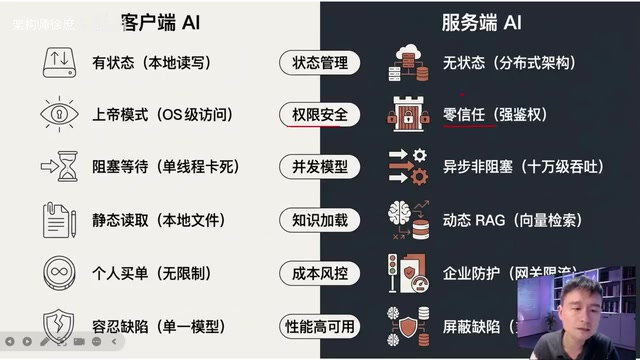
Much of the skepticism about Java for AI stems from conflating client-side AI applications with server-side AI applications. According to Xu Shu's analysis in the videos, tools like Cloud Code, Codex, and Xiaolongxia are client-side AI applications — essentially "one-on-one" services for a single user, with access permissions close to the OS level and relatively simple state management (only one user, so no multi-user isolation issues).
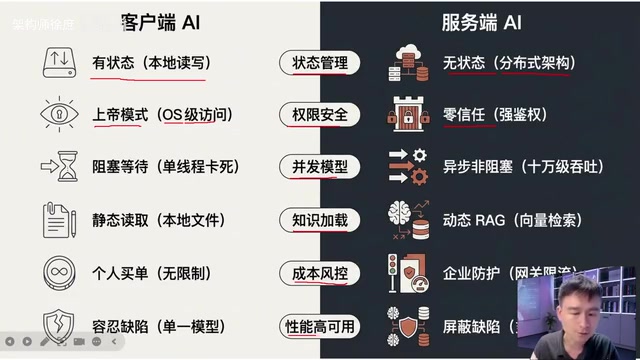
Server-side AI applications face all users across an enterprise or the internet, with completely different requirements. Xu Shu points out that server-side scenarios require zero-trust handling of user input, with permission security as the first gate; the application itself is stateless and must solve multi-user isolation and state persistence in a distributed architecture; additionally, concurrency, public knowledge loading, cost control, and performance tuning must be considered. These challenges fall squarely within Java's long-accumulated capabilities — high concurrency, high availability, performance tuning, and online monitoring, a full set of solutions validated by Double 11 and 618, plus mature practices like microservices, distributed systems, multi-level caching, and traffic peak shaving, which are hard for other languages to replicate in the short term.
This is why Xu Shu makes a clear judgment: for developing enterprise-level backend distributed AI applications, Java is the first choice; within the Java ecosystem, AgentScope is the first choice for implementing agents.
Zero Trust is a security design principle whose core idea is "never trust, always verify" — it does not default to allowing requests just because they come from the intranet or an authenticated user, but instead performs identity verification and permission checks on every access. In server-side AI applications, zero trust means strictly filtering and validating user input and intent to prevent prompt injection, unauthorized tool invocation, or sensitive data leakage. Unlike client-side applications that rely on OS-level isolation, the server side faces an open user base and must build multiple layers of defense at the application level, such as input sanitization, tool invocation whitelists, and output masking — exactly the security capabilities that an enterprise-grade agent framework needs to build in.
AgentScope 2.0's Core Positioning and Code Experience
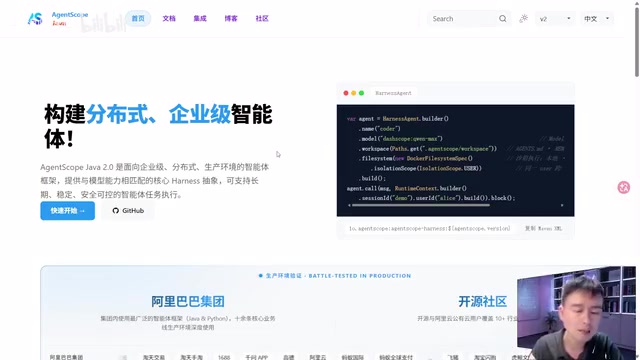
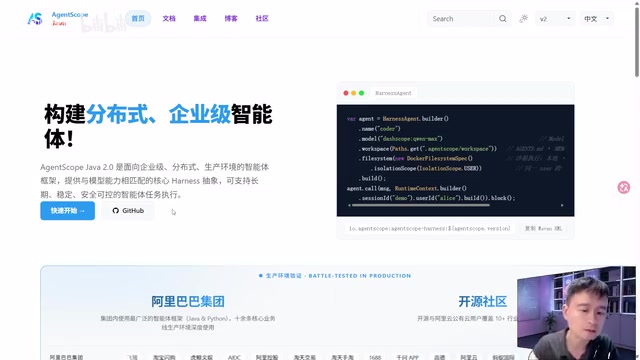
AgentScope 2.0, launched by Alibaba, is positioned as an enterprise-grade distributed agent framework for production environments in Java. In the video, Xu Shu emphasizes that it can quickly implement agents and has already been widely used within Alibaba Group — a key point for enterprise technology selection, as large-scale internal validation means the framework has been honed in real production environments.
From a development experience perspective, one of AgentScope's major advantages is concise code. The comparison shown in the video demonstrates that Java can directly implement an agent with just a few short lines of code, greatly lowering the barrier to agent development. For teams familiar with the Java tech stack, this means they can embed agent capabilities into existing backend architectures without switching languages or rebuilding their engineering systems.
Distributed agent framework refers to a runtime system that supports multiple agent instances working collaboratively across nodes, sharing state, and scaling elastically. Unlike single-machine agent libraries, distributed frameworks must solve problems such as message routing between agents, task orchestration, state persistence, and failure recovery. AgentScope 2.0 is designed for production environments and typically provides declarative orchestration (such as workflow and graph) to describe invocation relationships between agents, and uses external storage to achieve cross-node consistency of session state, thereby supporting multi-user isolation and horizontal scaling under high concurrency.
Engineering Challenges of Server-Side AI Applications: A Contrast with Client-Side AI
Understanding AgentScope's value requires first understanding the engineering thresholds that server-side AI applications must cross. Xu Shu makes a clear set of contrasts in the course:
- Permission security: Client-side applications serve a single person, essentially OS-level access; server-side applications face all users and must adopt a zero-trust attitude toward input information.
- State management: Client-side applications have no distinct users, so state is simple; server-side applications are stateless and must solve multi-user isolation and distributed state persistence.
- Concurrency and cost: Client-side applications need not consider concurrency; server-side applications must handle concurrency, public knowledge loading, cost control, and performance.
This contrast shows that enterprise-grade AI agents are not simply "connecting a large model to the backend" but a complete distributed systems engineering effort. Java's capabilities in microservices, distributed systems, multi-level caching, and traffic peak shaving are exactly the infrastructure for meeting these challenges.
The Practical Learning Path Covered by the Course
Xu Shu's course series is positioned as a "nanny-level" tutorial, covering the complete chain from environment configuration, framework principles, and agent orchestration to project integration, with the goal of hands-on completion of an enterprise-level AI agent practical project. Course materials include notes, code, videos, and a complete Java AI solution, extending from Spring AI to Spring Alibaba and AgentScope, combined with Lantie 4G for practical projects involving intelligent customer service, RAG knowledge base systems, hand-written Xiaolongxia, hand-written Closed Code enterprise-level workflow, and graph dynamic orchestration.
From a learning path perspective, this content is suitable for developers who already have a Java backend foundation and want to bring agent capabilities into enterprise systems. A pragmatic approach is to first understand AgentScope's framework principles and orchestration model, then perform integration through typical scenarios such as intelligent customer service and knowledge bases.
RAG (Retrieval-Augmented Generation) is a technical paradigm that combines external knowledge base retrieval with large model generation: the system first retrieves relevant snippets from a vector store or document store based on the user's question, then injects these snippets as context into the prompt, allowing the model to answer based on factual material. Enterprise RAG implementation typically involves document chunking, vector embeddings, hybrid retrieval, and reranking, which can significantly reduce model hallucinations and support private knowledge Q&A — it is the core technical foundation of intelligent customer service and knowledge base systems.
Graph dynamic orchestration refers to describing dependencies among agents, tools, and model invocations in a graph structure, and dynamically determining execution paths at runtime based on conditional branches, loops, or intermediate results. Compared with fixed-process chain orchestration, graph orchestration supports parallel branches, conditional routing, and human intervention nodes, making it better suited to complex and changing business logic in enterprise workflows. Combined with state machines and persistence mechanisms, graph orchestration can also enable checkpoint resumption and observable tracing in long-running tasks.
Selection Advice: When to Choose AgentScope
Based on Xu Shu's views, AgentScope's applicable scenarios can be summarized into three categories: enterprise backends that need to serve multiple users, systems that require distributed state persistence and multi-user isolation, and teams that already have a Java tech stack and want to reuse high-concurrency and high-availability capabilities. If it is just a personal client tool or a lightweight prototype, client-side AI applications are already sufficient, and an enterprise-grade framework may not be necessary.
You may not have noticed that the core of framework selection is not a language debate but scenario matching. Java's advantages in server-side AI applications come from years of engineering accumulation, and AgentScope extends these advantages into the agent domain — which is exactly why it has been widely used within Alibaba.
Related articles

AI SDK Workflow 2.0.95 Update: Stream Transform API Removed
AI SDK Workflow 2.0.95 removes the experimental_transform option from WorkflowAgent.stream() and the StreamTextTransform type export, as stream transforms cannot reliably cross workflow step boundaries. This article covers the reasons, migration points, and upgrade advice.

AI SDK Vue 4.0.163 Patch Released: Full Dependency Chain Update
AI SDK Vue releases patch 4.0.163, synchronously upgrading dependencies including ai@7.0.163 and @ai-sdk/provider-utils@5.0.75. This article analyzes the practical impact of this dependency chain update.

AI SDK Voyage 2.0.75 Patch Release: What the Dependency Chain Update Means
AI SDK's Voyage Provider releases patch version 2.0.75, syncing only @ai-sdk/provider and provider-utils deps. We analyze the impact and upgrade guidance.