AgentScope-Java: A Practical Guide to Alibaba's Enterprise Agent Framework
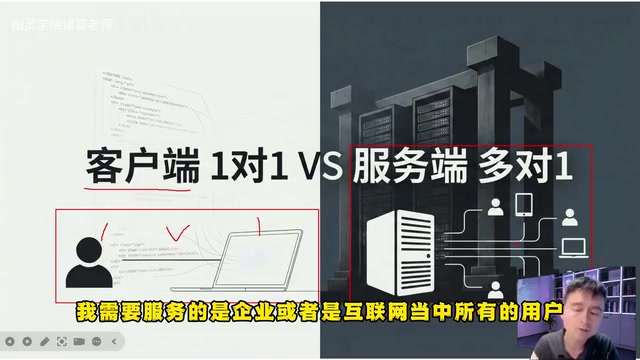
Alibaba's AgentScope-Java lets Java developers ship server-side AI agent apps with enterprise-grade capabilities.
The article refutes the bias that Java AI apps are just toys, arguing Java targets enterprise server-side AI, not client-side. Server-side AI needs permission security, zero-trust input, multi-user isolation, distributed state persistence, concurrency control, and cost control—strengths Java built in high-concurrency microservices. It introduces Alibaba's AgentScope-Java, built for production distributed environments and widely used internally. The course moves from Spring AI to agent orchestration.
Why Building AI Applications in Java Is No Toy
Many people hold a bias against building AI applications in Java, dismissing it as a toy. But in his Bilibili course series, creator Xu Shu directly refutes this: the question isn't whether Java can do AI—it's that many people have never figured out where Java actually fits in the AI landscape.
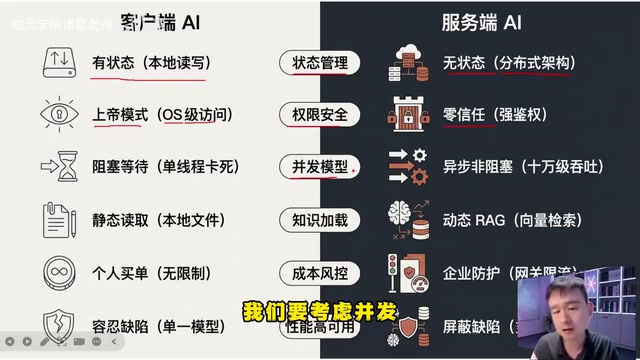
Java isn't aimed at client-side AI applications—it's aimed at enterprise-grade server-side AI applications. The requirements for these two are completely different. Client-side AI follows a one-by-one model, serving just one person with essentially OS-level access, with no need to consider multi-user isolation. Server-side AI, by contrast, must serve every user across an enterprise or the entire internet, demanding permission security, zero trust in user input, multi-user isolation, distributed state persistence, concurrency control, public knowledge loading, granular cost control, and performance tuning—exactly the strengths Java has built up over many years.
Microservices, distributed architecture, multi-tier caching, traffic peak shaving—these capabilities come from the long-term refinement of major tech companies under high-concurrency scenarios, and they can't easily be replaced by other languages. So for enterprise-grade backend distributed AI applications, Java is the pragmatic choice.
What Is AgentScope-Java
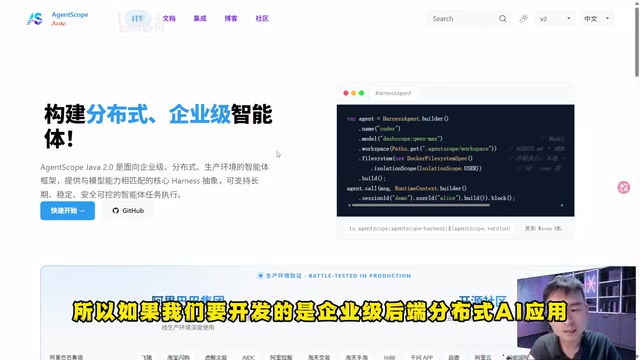
AgentScope-Java, launched by Alibaba, is an agent framework built specifically for Java enterprise-grade distributed production environments. According to the creator, it's already widely used within the Alibaba Group, and its positioning is to let Java developers quickly ship AI Agent capabilities with just a few lines of code.
The framework's core value lies in encapsulating agent orchestration, state management, and tool invocation into programming paradigms familiar to Java developers. In the course, Xu Shu emphasizes that AgentScope-Java's goal isn't to be an experimental project, but to support production-grade deployment.
Judging from the course plan, the content covers the complete chain from environment setup and agent orchestration to project integration testing—it's a hands-on, deployment-oriented tutorial rather than conceptual popular science.
The Technical Path Covered by the Course
The knowledge structure of this tutorial is worth noting, because it connects multiple layers of Java AI.
From Foundational Frameworks to Agent Orchestration
The course starts with Spring AI and Spring AI Alibaba, then moves into the agent orchestration portion of AgentScope-Java. The order matters: first build a foundational understanding of Java AI abstractions, then transition to the orchestration model for distributed agents, and finally land on project integration testing. For developers already familiar with the Spring ecosystem, the learning cost along this path is relatively manageable.
Spring AI is the official AI application development framework from Spring, designed to encapsulate large model invocation, prompt management, vector database integration, and other capabilities into abstractions familiar to Spring developers (such as ChatClient, EmbeddingModel, and VectorStore), thereby lowering the barrier to adopting generative AI in the Java ecosystem. Spring AI Alibaba is an enhanced implementation led by Alibaba Cloud built on top of it, focused on integrating the Tongyi model series and the Alibaba Cloud Bailian platform, and supplementing enterprise-grade components such as prompt templates, Function Calling, and RAG retrieval augmentation. Together they form the foundational abstraction layer for Java AI, and AgentScope-Java's orchestration capabilities are built on top of this layer—which is why the tutorial covers Spring AI before moving into agent orchestration, following the progressive logic from model invocation to multi-agent collaboration.
Types of Hands-On Projects
The hands-on projects the creator lists include an intelligent customer service RAG knowledge base system, a handwritten Claude Code-style tool, and an enterprise-grade Workflow Graph dynamic orchestration project. These projects correspond to typical enterprise AI deployment scenarios: knowledge retrieval augmentation, coding agents, and workflow orchestration. The RAG knowledge base system in particular embodies the complete chain of server-side AI—knowledge loading, retrieval, generation, and permission control, each of which has engineering requirements.
RAG (Retrieval-Augmented Generation) refers to retrieving relevant document fragments from an enterprise knowledge base before calling a large model to generate an answer, feeding them into the model as context, thereby mitigating model hallucinations, injecting private knowledge, and supporting citation traceability. A production-grade RAG system typically includes document parsing and chunking, vector embedding, vector store retrieval (often combined with keyword recall for hybrid retrieval), re-ranking, and permission filtering. The "intelligent customer service RAG knowledge base system" mentioned in the article is exactly about engineering these steps: different users can only retrieve knowledge within their permission scope, and retrieval results must be auditable—requirements that fall squarely within the server-side governance that Java excels at.
Workflow Graph dynamic orchestration refers to breaking a complex Agent task into multiple nodes (such as model invocation, tool execution, conditional judgment, and human approval), describing the dependencies and transitions between nodes as a directed graph, and supporting dynamic path adjustment at runtime based on intermediate results. Compared with fixed workflows, dynamic orchestration can handle branching, loops, and exception rollback, making it suitable for scenarios like enterprise approvals and multi-step task automation. In a distributed environment, the graph's execution state must be persisted to support resuming from checkpoints and multi-user concurrency, which places high demands on state management—one of the reasons AgentScope-Java emphasizes production-grade deployment.
Supporting Materials
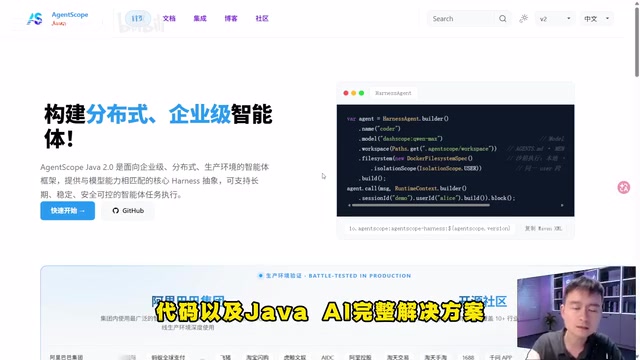
The course comes with notes, code, and complete Java AI solution materials. For developers who want to systematically learn Java AI engineering, this kind of supporting material is more valuable than just watching videos, because many details of agent orchestration can only be understood through repeated debugging at the code level.
Who This Tutorial Is For
Judging from its positioning, this tutorial is better suited to developers with some Java backend foundation who are preparing to deploy AI capabilities in an enterprise environment. It's not aimed at beginners with no programming background, nor at people who just want to call an API to build a demo.
If you're evaluating how to bring large model capabilities into your Java tech stack, or need to manage multi-user Agent session state in a distributed system, AgentScope-Java's orchestration model and enterprise-grade features are worth including in your technology selection comparison. The course runs about two hours at a fairly tight pace, so it's recommended to practice alongside the code repository.
One caveat: the framework's ecosystem maturity, community activity, and long-term maintenance still need to be independently assessed by developers based on their own project requirements. The tutorial provides an entry path; architectural decisions for production environments should be based on actual stress testing and validation.
Agent session state management is the key point that distinguishes server-side AI applications from single-machine demos. In client-side scenarios, conversation history is usually kept only in local memory; in enterprise distributed systems, however, multiple requests from the same user may be load-balanced across different instances, so session context, intermediate tool-call results, and execution progress must be centrally persisted (for example, via Redis or a database), along with handling concurrent writes, timeout reclamation, and multi-tenant isolation. This directly affects the system's scalability and reliability, and it's a capability worth focusing on when evaluating whether an Agent framework is suitable for production environments.
Related articles

Anthropic's IPO Eve: Five Risks Behind the Trillion-Dollar Valuation and the Truth About Its Governance
Breaking down Anthropic's IPO prospectus: $184M daily revenue at a trillion-dollar valuation, the truth behind $104B in paper losses, a five-class share governance structure, unusual disclosures in 94 pages of risk factors, and how the lock-up schedule may affect retail investors.
FBI Warns: Hackers Weaponize AI Agent ARTEX to Attack 200+ Organizations
FBI warns that AI penetration framework ARTEX is being used to attack 200+ organizations, with CrowdStrike tracking the VaporPanda group. We break down ARTEX's agent orchestration architecture, the real attack chain, loss data, and the FBI's five defense recommendations.

FBI Warns: Free AI Hacking Tool Artex Spirals Out of Control, Breaches Cloud Systems in Three Hours
FBI warns that the free open-source AI penetration tool Artex is being abused by criminals and state-backed hackers to breach cloud systems in as little as three hours. This article analyzes real attack cases, overlooked side-door risks, and defense measures enterprises and individuals can take immediately.