FBI Warns: Hackers Weaponize AI Agent ARTEX to Attack 200+ Organizations
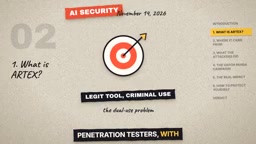
FBI and CrowdStrike reveal that AI penetration framework ARTEX was used to attack 200+ organizations in 14 countries; basic defenses still work.
Based on the FBI advisory and CrowdStrike reports, this article breaks down AI penetration framework ARTEX's real capabilities and attack reality. ARTEX is a Go-written orchestrator that connects to external LLMs like DeepSeek, using planning and worker agents to compress complex intrusions into scalable single-operator operations. Open-sourced in July 2026 and removed in October, it keeps circulating via forks, archives, and a paid edition, with 1,600+ consoles exposed online. The linked VaporPanda group attacked 200+ organizations in 14 countries, with at least 9 compromised and a single intrusion consuming over 1.4 billion input tokens. Attackers told agents to skip CrowdStrike Falcon machines, proving fundamentals still work—prompting five FBI recommendations.
FBI Warning: Hackers Use AI Agent ARTEX to Attack 200+ Organizations
AI agents are being weaponized to launch end-to-end cyberattacks. The U.S. Federal Bureau of Investigation (FBI) has issued a dedicated warning naming a tool called ARTEX; CrowdStrike reports that a China-linked threat actor used it to target more than 200 organizations simultaneously. In some intrusions, the time from first contact with a target to obtaining privileged access was reportedly under three hours.
This is not science fiction—it is the defensive reality we already face. Drawing on the FBI advisory, CrowdStrike's tracking reports, and cross-referenced reporting from multiple security outlets, this article breaks down what ARTEX actually is, what attackers did in practice, and which gaps defenders should close now.
What ARTEX Is: A Penetration Framework That "Orchestrates" AI
ARTEX is described as an autonomous penetration device. Penetration testing is when security teams, with written permission, actively attack their own systems to find weaknesses—the problem is that the same toolkit works just as well without authorization. This is the classic "dual-use" dilemma, and AI amplifies it.
Its key design: ARTEX does not carry an AI model itself; it is an orchestrator. The operator describes the objective in natural language, a planning agent decomposes the goal into tasks, worker agents execute them in parallel, and a cloud-hosted large language model does the "thinking." Written in Go, it can connect to external models including Claude, GPT, DeepSeekAd, GLM, Grok, and Kimi. The FBI advisory notes that Chinese models dominate attacker deployments—especially DeepSeek Flash—due to cost, capability, and fewer visible guardrails.
According to analysis by Bleeping Computer and a YouTube security channel, what this architecture delivers is not a "super-hacker AI" but scalability: complex intrusions that once required a skilled team working for days can now be supervised by a single operator running multiple attacks at once, stepping in only at key decision points.
OAuth app and credential abuse is essential context for understanding the attack techniques described here. OAuth is an authorization framework that lets third-party applications access specific resources in accounts like Microsoft or Google without the user handing over a password. The problem: once an app is granted permissions, the refresh token it holds can remain valid long-term, and its access activity often looks like normal business traffic in logs. Attackers add stolen credentials to existing OAuth apps—effectively issuing themselves a long-lived pass that is hard to detect, maintaining persistent access to email, files, or cloud resources without re-login. This is also why the FBI recommends "least privilege for app authorizations" and periodic cleanup of unused authorized apps—the broader the permissions and the longer they persist, the greater the blast radius when abused.
From Open Source to Out of Control: Why Deleting the Repo Can't Stop the Spread
ARTEX was released by developer Autumn27 in July 2026. After abuse reports emerged, the GitHub repository was removed on October 8. But forks, archived copies, and a paid ARTEX Pro edition kept it circulating; by early November, researchers had found more than 1,600 exposed ARTEX consoles on the public internet.
This is a lesson for the entire AI industry: once powerful dual-use code is public, deleting the repository does not erase it from the world—copies spread within hours. The tension between open source and control has been laid bare in this case.

Understanding the scale of propagation requires distinguishing several commonly confused concepts: repository deletion, forks, and archived copies. Deleting a main repository on GitHub does not automatically delete forks others created earlier; a fork is a complete code copy hosted independently under someone else's account. In addition, archive services, mirror sites, forum attachments, and compressed files in private chat groups all become new distribution nodes within hours. Add the paid ARTEX Pro edition distributed as closed-source or subscription software, and the tool's availability actually becomes more dispersed and harder to track after the repository went offline. This also explains why researchers found over 1,600 exposed ARTEX consoles on the public internet—consoles are operator-deployed instances, with no direct relationship to whether the source code is still on GitHub.
Attack Chain Recap: Old Techniques, New Speed
The FBI says it observed operations covering the full attack chain from August 2026, from reconnaissance through data exfiltration. Initial access came from a combination of two methods: exploiting vulnerabilities in internet-facing applications and abusing trusted identities. Agents also moved laterally through compromised vendor credentials and trusted connections between enterprises—in other words, if your vendor is compromised, you may be next.
To stay resident, attackers added credentials to existing OAuth apps, making access look like a legitimate business application. In one network, agents enumerated more than 110,000 Active Directory objects—a scale of mapping that would be extremely time-consuming for a human team. They also specifically sought out machines without CrowdStrike Falcon installed.
The good news: endpoint protection blocked some of the observed lateral movement attempts. Basic security tools remain effective against AI agents.
The 200+ Organization Campaign: VaporPanda and Industrialized Automation
The group CrowdStrike tracked is designated VaporPanda. According to Bleeping Computer, the group used ARTEX to attack more than 200 organizations across 14 countries, targeting government ministries, telecom operators, and companies in pharmaceuticals, semiconductors, defense, nuclear energy, and finance—with at least 9 organizations compromised. Confirmed victims include telecom operators in the U.S. and Belgium, government agencies in Greece, the Middle East, and Latin America, and a U.S. pharmaceutical company.
Attackers issued commands in Chinese, intervened at key decision points, and used DeepSeek and another commercial language model to coordinate planning and worker agents. They explicitly instructed agents to skip Falcon-protected Windows machines and focus on unprotected devices—attackers were working around good security measures, not defeating them.

One detail about scale is worth noting: in a single intrusion, the AI agents consumed over 1.4 billion input tokens. That is equivalent to the AI reading and processing the text of thousands of books for one attack—industrial-grade automation.
The actual losses are equally concrete: one operation stole personal information of approximately 67,000 people in South Korea and compromised ConnectWise cloud backups, gaining access to more than 2,250 downstream customers. One intrusion, thousands of victims.
The claim that a single intrusion consumed over 1.4 billion input tokens needs some scale context. A token is the basic unit of text processed by a large language model—roughly part of a word in English, and about one to two characters in Chinese. Current mainstream models have context windows typically in the hundreds of thousands of tokens. 1.4 billion tokens means the agent made a huge number of round-trip calls, repeatedly reading logs, enumeration results, and tool outputs—not a single long text input. At commercial API input pricing, this magnitude corresponds to substantial cost, but far less than hiring a human penetration team for weeks. Token consumption can therefore also serve as a detection signal: an account or IP generating abnormally large model input traffic in a short period often points to an automated agent rather than normal employee usage.
What Defenders Should Do: The FBI's Five Recommendations

The FBI's recommendations are pragmatic and actionable:
- Inventory all internet-facing systems—you can't protect what you don't know exists.
- Apply least privilege to app authorizations—each app connected to a Microsoft or Google account should have only the permissions it truly needs.
- Investigate anomalous LLM API traffic—a server with no AI connection suddenly communicating with AI is a red flag.
- Rate-limit consecutive queries—so automated agents can't hammer your portal at high frequency.
- Preserve logs and evidence, but never delay emergency containment.
For enterprises, fundamentals matter more than ever: patch internet-facing applications promptly, enable multi-factor authentication everywhere, and ensure every machine has endpoint protection. Remember, attackers instructed agents to skip protected machines.
For individuals: use a password manager to generate unique passwords, enable authenticator apps or passkeys, and regularly review and remove unused authorized apps from your Google or Microsoft account.
The same AI speed applies to defenders—security teams are using AI agents for alert triage, threat hunting, and minute-level response. This is a two-way race.
The difference between multi-factor authentication (MFA) and passkeys deserves explanation. Traditional MFA relies on one-time codes or push confirmations, which can still be bypassed by real-time phishing proxies or MFA fatigue attacks; passkeys are based on the FIDO2 standard, storing the private key in the device's secure chip and binding it to a specific website domain, so phishing sites cannot reuse it. For enterprises, this means even if credentials are leaked through OAuth abuse or phishing, login remains difficult without the device-side private key. Combined with least-privilege authorization and endpoint protection, these fundamentals form the concrete embodiment of the repeatedly emphasized point that "old defenses still work": AI agents enhance speed and scale, not the technical ability to bypass these controls.
Key Takeaways
AI agents give attackers speed and scale, but most of what they exploit remains known, old weaknesses—just faster. The evidence also shows that basic defenses like endpoint protection and strong identity security can still stop them. The real question is: should powerful AI security tools like ARTEX be open-sourced or tightly controlled? The answer will determine the starting line for the next round of offense and defense.
One-line Summary
FBI and CrowdStrike disclose that AI penetration framework ARTEX was used to attack 200+ organizations in 14 countries; basic defenses remain effective.
Paragraph Summary
Based on the FBI advisory and CrowdStrike reports, this article breaks down the real capabilities and attack reality of AI penetration framework ARTEX. ARTEX carries no model itself; it is a Go-written orchestrator that connects to external LLMs like DeepSeek, with planning agents decomposing tasks and worker agents executing in parallel—compressing complex intrusions from days of team work into scalable operations supervised by a single person. The tool was open-sourced in July 2026; its repository was removed in October, but forks, archives, and a paid edition keep it circulating, with over 1,600 consoles exposed on the public internet. The linked group VaporPanda used it to attack 200+ organizations in 14 countries, with at least 9 compromised and a single intrusion consuming over 1.4 billion input tokens. Attackers deliberately instructed agents to skip machines running CrowdStrike Falcon, proving that fundamentals like endpoint protection and strong identity security remain effective—prompting the FBI's five pragmatic recommendations.
Related articles

Anthropic's IPO Eve: Five Risks Behind the Trillion-Dollar Valuation and the Truth About Its Governance
Breaking down Anthropic's IPO prospectus: $184M daily revenue at a trillion-dollar valuation, the truth behind $104B in paper losses, a five-class share governance structure, unusual disclosures in 94 pages of risk factors, and how the lock-up schedule may affect retail investors.

FBI Warns: Free AI Hacking Tool Artex Spirals Out of Control, Breaches Cloud Systems in Three Hours
FBI warns that the free open-source AI penetration tool Artex is being abused by criminals and state-backed hackers to breach cloud systems in as little as three hours. This article analyzes real attack cases, overlooked side-door risks, and defense measures enterprises and individuals can take immediately.

Verse Engine: Turn Blender/Unity/Unreal Scenes into Browser 3D Links in One Click
Verse Engine by Ctruh is a browser-native 3D and XR engine that publishes Blender, Unity, and Unreal scenes as browser links in one click. View-based streaming opens a 1.03 billion-triangle city scene on a laptop. It offers embeds, API, and SDK for developers, 3D artists, architecture, and e-commerce teams.