AgentScope Java Quick Start: A Java Developer's Guide to Building AI Agents
Alibaba's open-source AgentScope Java embeds production-grade Agent capabilities directly into SpringBoot projects.
The article introduces Alibaba's open-source AgentScope Java framework, positioned as "the Agent nervous system of the Java ecosystem," requiring only JDK 17 plus a Maven dependency to land agents in SpringBoot. It contrasts ordinary AI SDKs with enterprise Agent foundations—the former makes single calls, the latter must handle sandbox isolation, file workspaces, and state persistence. The framework uses Builder patterns to assemble memory, persistence, orchestration, and sandboxing, with built-in four-layer context compression and Workspace support for Redis and MongoDB elastic scaling. It also notes enterprise server-side AI challenges in permissions, multi-user isolation, and concurrency—Java's strengths—and highlights key production steps like key security, hot model switching, and breakpoint recovery.
Java developers looking to break into the AI Agent space often find themselves exhausted by the environment switching and dependency conflicts of the Python ecosystem—not to mention the challenge of seamlessly integrating with enterprise-grade Java backends. Alibaba's open-source AgentScope Java targets exactly this pain point, embedding production-grade Agent capabilities directly into SpringBoot projects. According to Bilibili creator Xu Shu, its core positioning is "the Agent nervous system of the Java ecosystem," and the well-known Hanais Agent capabilities are built on top of this system.
Why Java Needs a Dedicated Agent Framework
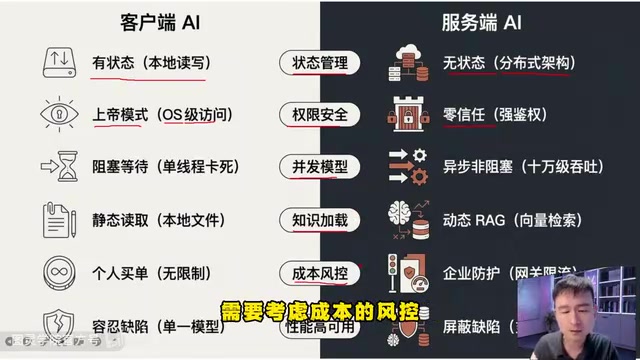
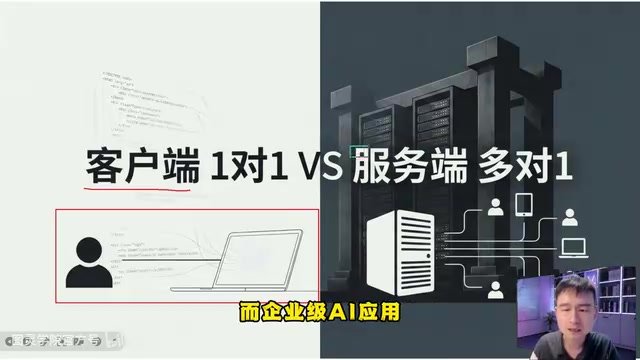
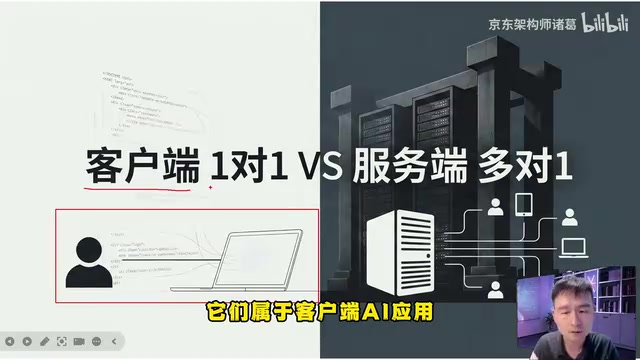
Ordinary AI SDKs are only responsible for making a single API call and returning text, whereas AgentScope Java turns model integration, sandbox environments, file workspaces, and state persistence into a complete production foundation natively adapted for Java. According to the creator's analysis, client-side AI applications (such as Codex) serve only a single user and are essentially OS-level access; enterprise-grade server-side AI applications, by contrast, face all internet users and must consider permission security, multi-user isolation, distributed state persistence, concurrency control, public knowledge loading, and cost allocation—exactly the areas where Java's years of accumulated high-concurrency, high-availability, performance tuning, and online monitoring solutions excel.
The difference between an Agent and an ordinary LLM call: A traditional API call is a stateless "question-and-answer," where the model generates a reply based only on the current prompt. An Agent, by contrast, is a decision-making system with a loop: the model first plans the task, then selects and invokes external tools (such as file read/write, database queries, or HTTP requests), observes the results, and continues reasoning until the task is complete or a termination condition is reached. This process generates a large amount of intermediate state—conversation history, tool-call records, workspace files, and breakpoints to be resumed—which needs to be managed uniformly by a framework. What AgentScope Java provides is precisely this "state machine + tool scheduling + persistence" runtime, rather than a mere model client.
Sandbox isolation: Enterprise-grade Agents often need to execute model-generated code or manipulate files. If they run directly within the service process, attackers could use prompt injection to induce them to access beyond their authority. Sandboxes use process-level or container-level isolation to restrict CPU, memory, network, and file system access, so that even if code execution fails, the main service is unaffected. AgentScope Java makes the sandbox environment a native framework capability, so developers can obtain a security boundary without setting up container orchestration themselves.
Core Capabilities Explained: From Model Integration to Multi-Agent Collaboration
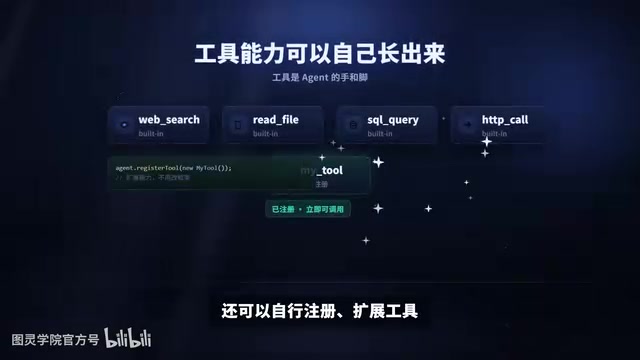
AgentScope Java's Builder pattern lets developers quickly assemble a workspace covering memory, drawing, persistence, Agent orchestration, and sandbox isolation. You only need JDK 17 plus a single Maven dependency, leaving the underlying dirty work to the framework and focusing on writing business logic. Hand it a business task, and it can break down the task, invoke tools, maintain state, and handle exceptions automatically, forming a closed loop. When the built-in tools are insufficient, you can register your own extensions.
The entire design fully takes online scenarios into account: it has four layers of built-in context compression strategies that distinguish ordinary messages from core task state; the Workspace can connect to multiple storage implementations such as Redis, GDC, MongoDB, and KBS for scaling up and down without losing drawing data; and it relies on Java 17 Record sealed classes and compile-time type checking to avoid the concurrency pitfalls caused by Python's dynamic typing.
Multi-Agent collaboration: A single Agent can easily fall into the dilemma of overly long context and mixed responsibilities in complex tasks. The multi-agent pattern divides tasks among multiple Agents with specialized roles—for example, one responsible for planning, one for retrieval, and one for code execution—and then coordinates them through a message bus or orchestrator. This division of labor reduces the context pressure on any single Agent and makes it easier to set permissions and models separately. AgentScope Java's Agent orchestration capability is used to define the invocation relationships and data flow among these roles.
Context compression: LLMs have limited context windows, and long conversations or multiple rounds of tool calls quickly fill them up. The four-layer context compression strategy typically degrades step by step in the order of "preserve core task state → summarize historical conversation → truncate low-value messages → discard intermediate results that can be rebuilt," saving tokens while ensuring the task is not interrupted. This is especially critical for cost-sensitive enterprise server-side services.
Java 17 Record sealed classes: Records are immutable data carriers, and sealed classes can restrict the set of subtypes. Combined, they constrain an Agent's message types and tool return structures at compile time, avoiding type errors that would otherwise surface only at runtime. This is also the technical basis for the article's comparison with the concurrency pitfalls of Python's dynamic typing.
From Demo to Production: Distributed Storage Selection and Rollout Path
Running the official Demo is simple—just connect an API Key and you can make calls—but when moving to production, key security, workspace isolation, hot model switching, streaming responses, and drawing breakpoint recovery can each become a stumbling block. The creator emphasizes that this course series skips no steps and piles on no empty theory; the configuration code and must-avoid pitfalls checklist are all organized, so you can type along while watching. The ultimate goal is not just to run the Demo, but to integrate Agents into existing Java business systems and build a self-developed Hanais agent workflow.
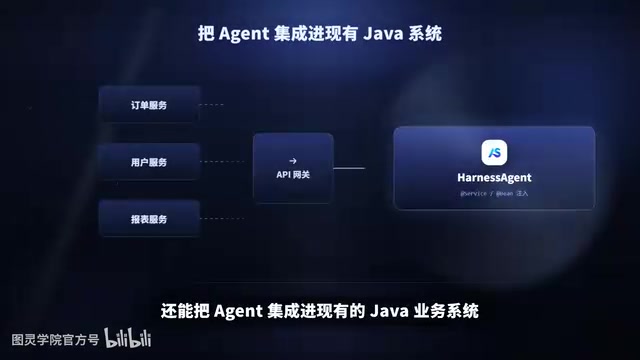
For teams that need to land enterprise-grade distributed AI backends, Java remains the first choice thanks to its complete set of solutions—microservices, distributed systems, multi-level caching, and traffic peak shaving—that have been validated in high-concurrency scenarios. And when it comes to landing Hanais in the Java ecosystem, AgentScope is an unavoidable entry point.
Workspace and state persistence selection: An Agent's workspace contains conversation history, temporary files, tool outputs, and breakpoint information. In the Demo stage, in-memory or local files are sufficient, but in production with multi-instance deployment, any instance may take over the same user's session, so state must be externalized to shared storage. Redis is suitable for high-frequency read/write session caching, MongoDB for flexible structured large objects, and object storage for file artifacts. When selecting, weigh read/write latency, consistency requirements, and cost, and ensure that the serialization format is compatible with the framework version; otherwise, state loss or deserialization failures may occur during scaling up or down.
One-line Summary
Alibaba's open-source AgentScope Java embeds production-grade Agent capabilities directly into SpringBoot projects.
Paragraph Summary
The article introduces Alibaba's open-source AgentScope Java framework, positioned as "the Agent nervous system of the Java ecosystem," with which developers need only JDK 17 plus a single Maven dependency to land agents in SpringBoot projects. It contrasts ordinary AI SDKs with enterprise-grade Agent foundations: the former only makes a single call and returns text, while the latter must handle production concerns such as sandbox isolation, file workspaces, and state persistence. The framework uses the Builder pattern to assemble memory, persistence, orchestration, and sandboxing, has built-in four-layer context compression, and its Workspace can connect to Redis, MongoDB, and others for elastic scaling. The article also notes that enterprise server-side AI applications face challenges in permissions, multi-user isolation, and concurrency—precisely Java's strengths—and points out that moving from Demo to production requires solving key issues such as key security, hot model switching, and breakpoint recovery.
Related articles

Multi-Agent Collaborative Development: Task Card-Driven Practices for Medium-to-Large AI Projects
A Bilibili creator shares a task card-driven, PM-orchestrated multi-Agent collaboration model with local-first repository state, so any Agent tool can take over a project anytime.

Cursor vs Copilot vs Claude Code: How Laravel Developers Should Choose
Compare Cursor, GitHub Copilot, and Claude Code for Laravel development: an AI-first editor, a plugin for existing editors, and a terminal agent for multi-file tasks and testing — plus workflow-based recommendations.
AgentScope Java Edition: A Practical Guide to Enterprise-Level Agent Frameworks
An in-depth analysis of Alibaba's AgentScope Java enterprise agent framework: contrasting client-side AI and server-side AI, explaining Java's natural advantages in high concurrency and distributed state management, and outlining a complete learning path from core principles to multi-agent collaboration.