AgentSky: One-Click Cloud AI Agent Deployment Supporting Any Framework and Model

AgentSky offers one-click cloud-hosted AI agents supporting any framework and any LLM.
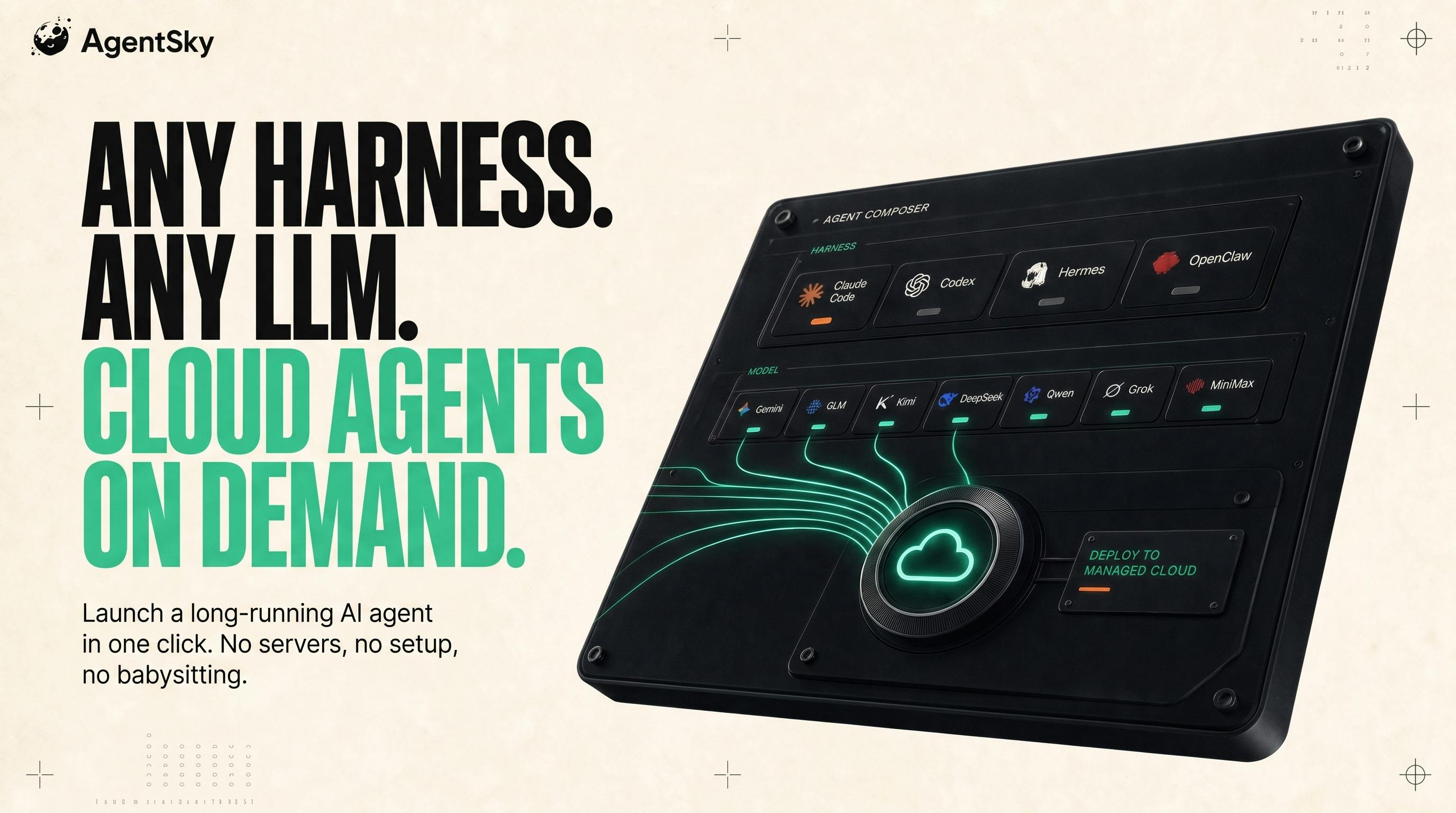
AgentSky topped the Product Hunt daily rankings by offering a managed AI agent service that lets developers launch long-horizon agents with one click. Supporting multiple frameworks (Claude Code, Codex, Hermes, OpenClaw) and any LLM, it provides complete execution history, managed recovery, and omnichannel access via WhatsApp, Telegram, Slack, API, and CLI — eliminating the need for teams to build complex agent infrastructure from scratch.
Introduction: A New Paradigm for Agent-as-a-Service
As AI agents move from concept to production, reducing the barrier for developers and everyday users to run long-horizon, autonomous agents has become a challenge the industry is racing to solve. AgentSky, which recently topped the Product Hunt daily rankings, offers a compelling answer — "Any harness, any LLM." In a nutshell: any runtime framework, any large language model, with on-demand cloud-hosted agents.
With 222 upvotes and 29 comments, AgentSky claimed the #1 spot for the day, categorized under SaaS, Developer Tools, and Artificial Intelligence. This reflects a clear trend: the market is generating strong demand for managed agent services that are "ready out of the box, no infrastructure required."
Core Positioning: Managed Agent as a Service
One-Click Launch of Long-Horizon Agents
AgentSky's core value proposition is "launch a long-horizon AI agent with one click." A long-horizon agent refers to an AI system capable of continuously executing tasks over extended time spans, maintaining context, and autonomously advancing toward goals — fundamentally different from chatbots that handle one-off Q&A sessions.
Long-horizon agents represent one of the core technical challenges in the AI Agent space. Unlike traditional single-turn dialogue or short-task agents, long-horizon agents need to maintain task state over hours or even days. This involves several key technologies: context window management (maintaining memory consistency across ultra-long execution chains), task decomposition and planning (breaking complex goals into executable sub-steps), and state persistence (safely storing intermediate results to handle interruptions). In engineering practice, developers typically need to implement checkpointing mechanisms, message queue scheduling, and DAG (Directed Acyclic Graph)-based task orchestration systems, all of which significantly raise the development barrier.
For developers, building such a system from scratch typically means dealing with runtime environments, task scheduling, state persistence, exception recovery, and a host of other tedious engineering problems. AgentSky encapsulates all this complexity into a cloud-hosted service — users simply click to get an agent instance ready on standby.
Flexible Multi-Framework, Multi-Model Combinations
The product's other key differentiator lies in its openness: "any harness, any LLM." AgentSky explicitly lists support for multiple mainstream agent runtime frameworks, including:
- Claude Code: Anthropic's agent framework for programming scenarios
- Codex: A code generation and execution-oriented framework
- Hermes
- OpenClawAd
The AI Agent framework ecosystem is currently in a period of rapid proliferation. Claude Code is Anthropic's agent for software engineering scenarios, capable of understanding codebases, executing terminal commands, and autonomously completing development tasks. Codex is OpenAI's code agent, emphasizing safe code execution in sandboxed environments. These frameworks each have different strengths: some excel at code generation, others focus on tool-call orchestration, and still others are strong in multi-step reasoning. The differences between frameworks extend beyond the underlying model to include prompting strategies, tool interface specifications, and execution sandbox design. AgentSky's "any harness" strategy essentially builds a unified runtime abstraction layer on top of these heterogeneous frameworks.
This "not locked to a single foundation" design means users can freely choose the most suitable runtime framework and underlying LLM combination based on specific task requirements. For teams that want managed convenience without vendor lock-in, this is particularly important.
Three Core Engineering Capabilities: History, Recovery, and Omnichannel Access
Complete History Records
AgentSky emphasizes providing "full history" — complete execution records. For long-horizon agents, every decision, API call, and result during task execution is worth tracing back. Complete history records facilitate not only debugging and auditing but also serve as a crucial foundation for ensuring agent behavior is explainable and reviewable. In enterprise applications, this traceability directly relates to compliance audit requirements — regulators may require organizations to reproduce every decision path of their AI systems, which is especially critical in regulated industries like finance and healthcare.
Managed Recovery Mechanism
"Managed recovery" is another prominently featured capability. Long-running agents inevitably encounter interruptions, crashes, or anomalies. Under traditional self-hosted approaches, developers need to implement their own checkpointing and state recovery fault-tolerance logic. AgentSky's managed recovery means that when an agent encounters unexpected issues during execution, the system can automatically take over and restore the task, reducing the cost of manual intervention. For production environments requiring high availability, this is a practical value-add.
From an engineering perspective, fault-tolerant design in distributed systems is a classic computer science topic, and applying it to AI agent scenarios introduces new complexity. Traditional microservice fault tolerance relies on idempotent design and transaction rollback, but agent execution is non-deterministic — the same input may produce different outputs due to model stochastic sampling. Therefore, agent recovery mechanisms need to preserve not just input state but also the complete execution trajectory and intermediate reasoning steps. Common implementation approaches include Event Sourcing-based state reconstruction, periodic snapshots with incremental logs, and human-in-the-loop breakpoint resumption. Managed versions of these mechanisms require the service provider to make fine-grained tradeoffs between performance overhead and recovery precision.
Broad Access Channels
AgentSky demonstrates ambitious scenario coverage in its access methods, supporting agent access through the following channels:
- Instant Messaging: WhatsApp, iMessage, Telegram, Slack
- Developer Interfaces: API, CLI
- Web
This design breaks the limitation of "agents only being usable within dedicated applications." Users can issue tasks to agents as casually as sending a message to a friend on WhatsApp or Telegram, or deeply integrate them into existing workflows via API and CLI. This "accessible anywhere" strategy significantly broadens the product's applicable audience — from technical developers to everyday end users, everyone can find a suitable entry point.
It's worth noting that accessing AI agents through instant messaging platforms requires adapting to each platform's API specifications and message format constraints. The WhatsApp Business API has strict rules on message templates, conversation window time limits (the 24-hour rule), and sending frequency. iMessage, due to Apple's closed ecosystem, typically requires third-party bridging solutions. On the compliance front, data protection regulations such as GDPR and CCPA have explicit requirements for processing personal data through communication channels, including data minimization principles, user consent mechanisms, and cross-border data transfer restrictions. Particularly when agents need to maintain long-term conversation context, message storage duration and encryption standards become questions that must be addressed.
Market Significance: The Managed Agent Track Continues to Heat Up
Judging from AgentSky's performance topping the Product Hunt daily rankings, "Agent-as-a-Service" is becoming a hot direction in the AI application layer. Over the past period, discussions around Agents have mostly focused on framework capabilities and model intelligence, while AgentSky's approach emphasizes "engineering and productization" — getting the dirty work of runtime environments, fault tolerance, and multi-channel access right, so users can focus on their tasks.
The heating up of the Agent-as-a-Service track closely parallels the cloud computing development path — the evolutionary logic from IaaS to PaaS to SaaS is replaying in the AI domain. In the current market, products with similar positioning include LangGraph Cloud for agent orchestration, Relevance AI for automated workflows, and Microsoft Copilot Studio for enterprise scenarios. AgentSky's differentiation lies in its "runtime framework-agnostic" neutral positioning, similar to how Kubernetes abstracts container orchestration — not binding to a specific runtime but providing a unified management plane. Whether this strategy succeeds depends critically on whether the standardization level of various frameworks is sufficient to support effective abstraction.
This positioning addresses a real pain point: many teams have clear agent usage needs but lack the resources to build and maintain infrastructure. The managed service model fills this gap perfectly. Meanwhile, its dual-dimension openness across frameworks and models also mitigates the risk of "betting on a single tech stack" to some extent.
Points to Evaluate Rationally Before Use
As a new product that just debuted on Product Hunt, AgentSky's publicly available information is still primarily marketing-level capability descriptions. Key details such as actual performance, pricing strategy, data security, and privacy protection mechanisms remain to be verified. Especially when agents operate through personal communication channels like WhatsApp and iMessage, sensitive data handling and compliance issues deserve careful evaluation by users.
Furthermore, "managed" means partially ceding operational control to the service provider. For enterprises with strict data sovereignty requirements, applicability needs to be assessed based on specific scenarios. Against the backdrop of increasingly stringent global data governance (such as the EU AI Act's transparency requirements for high-risk AI systems), managed agent service providers need to make explicit commitments on data residency, access permissions for model inference logs, and third-party audit capabilities to earn enterprise customer trust.
Conclusion
AgentSky represents a mature approach to making AI agents available "as a service" — rather than having users build from scratch, it encapsulates complex engineering into one-click cloud capabilities while providing flexibility through open design across multiple frameworks, models, and channels. For developers and teams looking to quickly validate agent applications without getting mired in infrastructure challenges, products like this are worth watching. Whether it can deliver on its promises, however, remains to be proven through actual use.
Related articles

Gaussian Process Bandit Optimization: Exploration Strategies and Inference Regret Guarantees
Cumulative regret guarantees in Bayesian optimization fail to reflect final recommendation quality. This article examines a new study that provides inference regret guarantees for Gaussian process bandit optimization through exploration query strategies and fill distance analysis, validated on hyperparameter optimization and control tasks.
The Most Detailed Codex Guide on Bilibili: From Installation to Real-World Practice
The most detailed Codex guide on Bilibili: from app store installation to daily work mode configuration, with a real coffee shop project demonstrating file organization, data extraction, dashboard creation, and other practical tasks. Learn to use Plan Mode and desktop pets to leverage Codex efficiently.

Appearance Compensation in Volume Rendering: Why RGB Accuracy Cannot Guarantee Density Correctness
Volume rendering research reveals that volumetric data perfectly reproducing external RGB views may still contain density errors: appearance compensation can double central density and keep external rays unchanged even when L2 error exceeds 14.52%. Density recovery depends on appearance capacity, spatial resolution, and measurement design.