Aggregator Platforms Strike Back at Streaming: JustWatch Launches Its Own Free Service

JustWatch transforms from a search aggregator into a streaming service provider, disrupting the market with a low-price strategy.
JustWatch, a streaming search platform with 50 million users, has launched its own streaming service with a free ad-supported tier and a $3.99/month ad-free subscription, plus movie rentals. This low pricing is well below mainstream platforms' ad-tier prices, targeting price-sensitive users. As an aggregator, JustWatch avoids massive original production costs, relying on licensed older films and ad revenue. However, operating its own content creates conflicts of interest with partners, and ranking rules remain unclear. The article argues that the streaming industry is seeing bidirectional penetration between aggregation and content, with JustWatch's data assets potentially a differentiator, but content depth and cost balance remain critical.
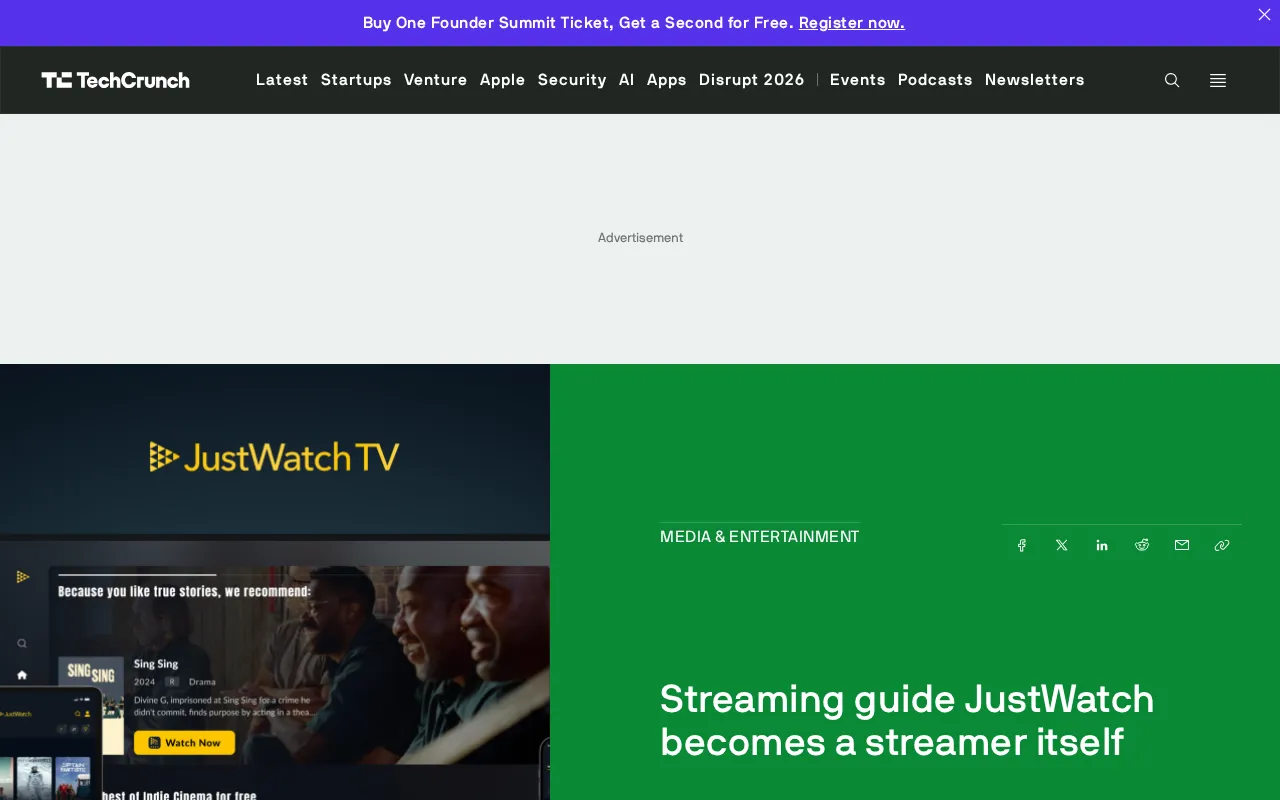
Streaming search guide JustWatch, with 50 million users, is no longer content to just be a "guide"—it's entering the arena with its own streaming service. This move signals that the boundary between aggregator platforms and content platforms is blurring, bringing new variables to the streaming market.
From Search Tool to Content Provider
JustWatch's core business is helping users find film and TV content across platforms. Users enter a title, and it tells them which platform has it—whether it's available to rent, buy, or stream via subscription. This "meta-search" model has accumulated massive user behavior data and given JustWatch unique insights into market demand.
Now, JustWatch is translating those insights into a direct content service. The newly launched streaming service has two tiers: a free, ad-supported content library, and an ad-free subscription tier at $3.99 per month. In addition, it offers movie rental services. This means JustWatch is transforming from a traffic gateway into a transaction endpoint, attempting to occupy a later position in the user decision chain.
According to foreign media reports, JustWatch's free tier will offer "curated movies and series," with ad formats similar to mainstream AVOD platforms. The $3.99 price point is significantly lower than subscription giants like Netflix and Disney+, and even lower than many ad-supported subscription tiers, showing its intent to pry open price-sensitive users with low prices.
Meta-search refers to a search model that does not directly own content or inventory, but aggregates information from multiple third-party platforms to provide users with cross-platform search and price comparison. In the streaming context, JustWatch itself does not hold film and TV copyrights; instead, it scrapes library data from platforms like Netflix, Disney+, and Apple TV to tell users which platform offers a given title for subscription, rental, or purchase. The advantage of this model is its asset-light nature, rapid coverage of massive content, and revenue from affiliate commissions or advertising through user click-throughs. Its limitation is that after users complete their decision, they often flow to the content platform, making it difficult for the aggregator to share in subsequent subscription or viewing value—which is precisely the motivation for JustWatch to extend toward the transaction endpoint.
The Logic Behind the Low-Price Strategy
The $3.99/month ad-free pricing is extremely aggressive in the current streaming market. Netflix's standard ad tier has risen to $6.99, Disney+'s ad-supported version is $7.99, and HBO Max's ad tier costs $9.99. JustWatch's ad-free tier is priced at only about half of these platforms' ad tiers.
This pricing doesn't come from nowhere. As an aggregator platform, JustWatch doesn't need to bear the massive original content production costs that traditional studios do. Its content library is most likely dominated by licensed older films and mid-to-low-budget works, supplemented by advertising revenue to subsidize the free tier. The low-price subscription tier's role is more about improving user stickiness and paid conversion rather than direct profitability.
From a business model perspective, JustWatch is attempting a hybrid "aggregation + distribution" model. It retains its original price-comparison search function while directly providing content consumption scenarios. Users can complete the "discover—compare—watch" loop within the same app, reducing drop-off from redirects.
AVOD (Advertising-based Video on Demand) is a business model where users access content for free by watching pre-roll or mid-roll ads, with representative platforms including Tubi, Pluto TV, and The Roku Channel. It contrasts with SVOD (subscription-based) and TVOD (transactional, i.e., per-title rental or purchase). AVOD's core economic logic is to trade low user acquisition costs for scale, then monetize through ad inventory, so content libraries typically consist of licensed older films, genre titles, and mid-to-low-budget productions rather than expensive exclusive originals. JustWatch's free tier adopts exactly this model, using ad revenue to subsidize content licensing costs while serving as a traffic funnel for the $3.99 paid tier.
Potential Impact on the Industry Landscape
JustWatch's entry could have a dual impact on small and mid-sized streaming platforms and the AVOD market. On one hand, the free ad tier will intensify competition for user attention; on the other hand, as an aggregator platform, there is an inherent conflict of interest between JustWatch's own content service and its recommendations of third-party platforms.
If JustWatch prioritizes its own content in search results, it could trigger dissatisfaction among partners. However, JustWatch has not yet disclosed specific recommendation ranking rules. Given its base of 50 million users, content providers still need to rely on this traffic gateway in the short term, and the bargaining chips between the two sides are not equal.
For users, having another low-price option is always good. But the key question is the depth and quality of the content library. If JustWatch's own content lacks appeal, low prices alone won't retain users. The essence of streaming competition remains content competition, and whether an aggregator platform's data advantage can translate into precision in content acquisition remains to be seen.
Conflict of Interest is particularly prominent when aggregator platforms operate their own content: the platform is both a distribution channel for third-party content providers and their direct competitor. When a user searches for a film on JustWatch, the platform faces tension between two ranking logics—ranking by affiliate commissions from third-party platforms or user preferences, or prioritizing traffic to its own library to boost its own viewing hours and ad revenue. This dual identity may undermine third-party content providers' trust in the platform, and may even prompt some platforms to restrict data interfaces or exit partnerships. At the regulatory level, laws such as the EU's Digital Markets Act have imposed constraints on "gatekeeper" platforms' self-preferencing behavior. If aggregator platforms scale further, their recommendation ranking rules may face stricter transparency requirements.
The Boundary Between Aggregation and Content Is Disappearing
JustWatch's transformation is not an isolated case. In recent years, platforms like Roku and Amazon have been extending from channels to content, while traditional content providers are also launching their own aggregation features. The entire streaming ecosystem is undergoing a round of "bidirectional penetration."
JustWatch's advantage is that it knows better than anyone what users are searching for, what they're watching, and how much they're willing to pay. If this data asset is used for content acquisition and precise ad targeting, it could form a differentiated competitive advantage. But the challenges are equally obvious: content acquisition requires continuous investment, and ad sales require building a team—neither of which are areas where aggregator platforms excel.
From search guide to streaming service, JustWatch has taken a key step. Whether this step can be taken steadily depends on whether it can find a balance between content costs and user experience. The next round of competition in the streaming market may no longer be a pure content arms race, but rather who can connect content and users more efficiently.
One-line Summary
JustWatch transforms from a search aggregator into a streaming service provider, shaking up the market with a low-price strategy.
Paragraph Summary
JustWatch, a streaming search platform with 50 million users, has announced the launch of its own streaming service, featuring a free ad-supported tier and an ad-free subscription tier at $3.99 per month, supplemented by a movie rental business. This low pricing is far below the ad-tier prices of mainstream platforms like Netflix and Disney+, indicating an intent to target price-sensitive users. As an aggregator platform, JustWatch doesn't need to bear massive original production costs, with a content library dominated by licensed older films, relying on ad revenue and paid conversion to achieve a business loop. However, an aggregator operating its own content creates conflicts of interest with third-party partners, and search result ranking rules remain unclear. The article argues that the streaming industry is experiencing bidirectional penetration between aggregation and content, and JustWatch's data assets may become a differentiated advantage, but content depth and cost balance remain the keys to success.
Related articles

DeepSeek Open-Sources DeepInfer: What Is an Inference Framework Actually For?
DeepSeek open-sources its inference framework DeepInfer under Apache 2.0, supporting DeepSeek V4.1 Flash offline inference. This article explains its request scheduling, FlashMLA/DeepGEMM compute optimization, DSPark speculative verification acceleration, and what it means for developers and ordinary users.
Open-Source AI Learning Agent: A Full Workflow Experience from Topology Graphs to Exam Generation
Explore an open-source AI learning agent: built on DeepSeek API, it constructs knowledge systems via topology graphs, with automatic document generation, notes, super documents, and exams. Learn about its Agent workflow and design highlights.

DeepSeek Whale Girl Open-Source MV Meme: AI Industry Coded Slang About Pivoting to Closed Source
Bilibili's DeepSeek Whale Girl rap MV uses fictional memes to tease the AI open-source vs. closed-source debate, with lyrics full of industry slang. This article explains the meme culture, the Whale Girl symbol, and the open/closed tension.