AI Accelerates Scientific Discovery: Claude Helps Solve the 3D Structure of Bacterial Vault Particles

A research team used Claude to determine the first 3D structure of bacterial vault particles, cutting months of work to days.
The article describes how a biology research team used the Claude model to determine, for the first time, the 3D structure of a vault particle from bacteria. Vault particles have remained functionally mysterious since their discovery in 1986 and had previously only been found in complex organisms such as animals and plants. The new study shows that similar proteins in bacteria and the viruses that infect them can also assemble into vault structures, providing a simpler model system for studying their evolutionary origin and function. The team said manual structure determination that would have taken weeks to months was shortened to a few days, reflecting AI's efficiency advantages in data processing and pattern recognition. But Claude also made simple errors that required researchers and machine learning experts to correct collaboratively. The article thus emphasizes that AI remains a supporting player in scientific discovery and that human-machine collaboration is the key paradigm for accelerating research.
Introduction: When AI Meets Structural Biology
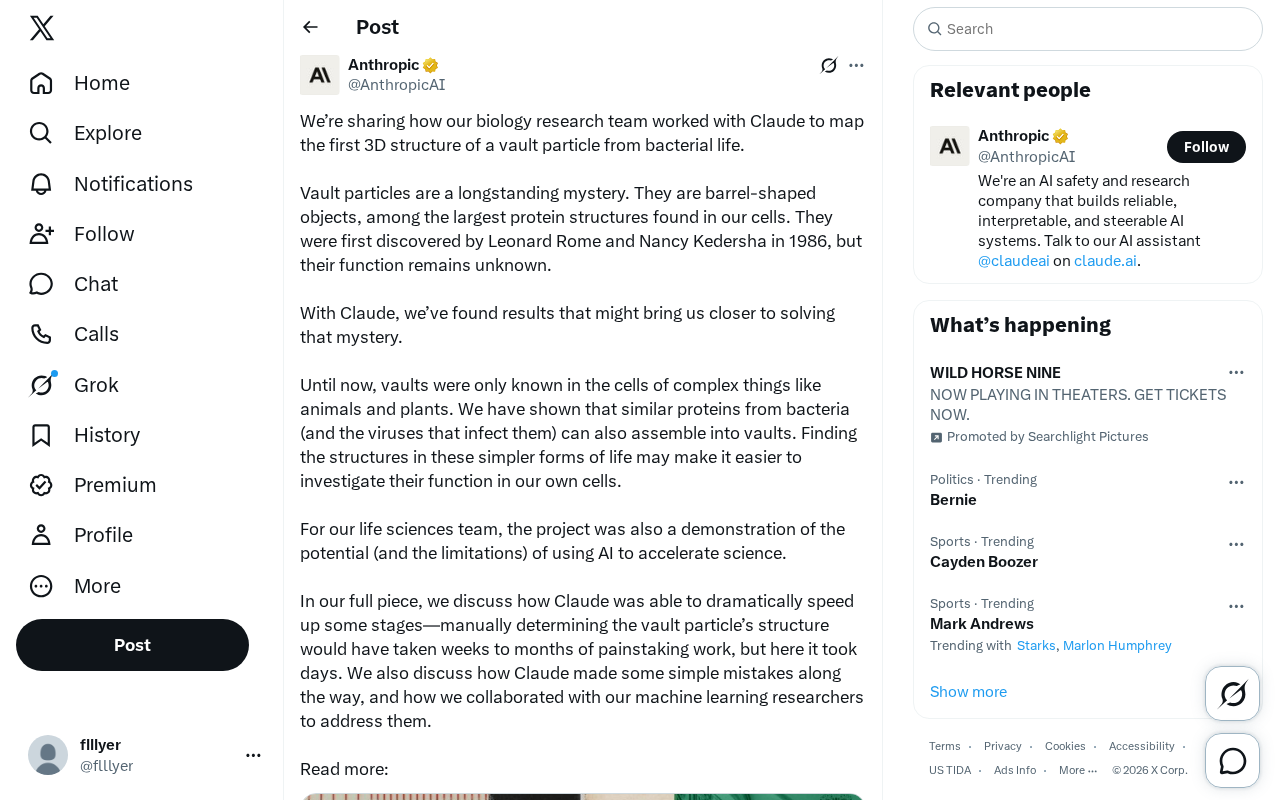
In the life sciences, protein structure determination has long been a time-consuming and arduous task. Today, artificial intelligence is gradually changing this. Recently, a biology research team shared their experience using the Claude model to determine, for the first time, the 3D structure of a vault particle from bacterial life. This achievement not only brings new clues to understanding these mysterious structures but also demonstrates both the potential and the limitations of AI in accelerating scientific discovery.
Since vault particles were discovered by Leonard Rome and Nancy Kedersha in 1986, their function has remained a mystery. They are among the largest protein structures in cells, shaped like barrels. Previously, vault particles had only been found in the cells of complex organisms such as animals and plants. This new study demonstrates that similar proteins from bacteria (and the viruses that infect them) can also assemble into vault structures. Finding these structures in simpler life forms may help researchers better investigate their function in human cells.
Vault particle is a giant ribonucleoprotein complex composed of the major vault protein (MVP) and a small amount of small RNA, with a molecular weight of about 13 MDa. It resembles a hollow barrel or dome, measuring approximately 70×40×40 nm, and is one of the largest protein complexes in cells. Since its discovery in rat liver cells in 1986, it has been found in almost all eukaryotes, but its physiological function has long been unclear. It is currently thought to be possibly involved in nucleocytoplasmic transport, innate immune signaling regulation, and cellular stress response. Previous research has mainly focused on mammalian cells, and its homologous structure in bacteria had not been previously confirmed, so the discovery of the bacterial vault structure in this study is of great significance for understanding its evolutionary conservation.
Cryo-EM single-particle analysis is the mainstream technique for determining the structures of such large, dynamic protein complexes that are difficult to crystallize: samples are rapidly frozen into vitreous ice, a large number of 2D projections are collected under the electron microscope, and then a 3D density map is reconstructed computationally. This workflow involves massive image screening, particle picking, 2D classification, and 3D refinement—exactly the steps where AI can significantly speed things up.
How AI Accelerates Structure Determination
According to the research team, manually determining the structure of vault particles typically requires weeks or even months of painstaking work. With Claude, this process was shortened to a few days. Claude's capabilities in data processing and pattern recognition significantly improved the efficiency of structure determination, enabling researchers to obtain candidate structural models faster.
This speedup is not an isolated case. In recent years, AI has made repeated breakthroughs in protein structure prediction, but most applications have focused on known protein families. This exploration of vault particles demonstrates the practical value of AI in determining unknown structures—especially in scenarios where samples are scarce and traditional methods struggle.
Protein structure prediction in recent years has been most notably represented by the AlphaFold series of models, which use deep learning to directly predict 3D structures from amino acid sequences, achieving accuracy close to experimental levels on known protein families. However, such methods rely on homologous information in existing structure databases, and their predictive power is limited for entirely new complexes without homologous templates (such as ultra-large, multi-copy assemblies like vault particles). Therefore, the value of AI in such projects is more reflected in assisting cryo-EM data processing, particle classification, model building and correction, rather than directly producing the final structure. This also explains why Claude's involvement could compress the timeline while still requiring human verification.
Limitations and Collaboration: AI Is Not Omnipotent
Despite the remarkable results, the research team also candidly pointed out Claude's limitations. During the project, Claude made some simple errors that required collaboration between researchers and machine learning experts to correct. This shows that current AI models still play a supporting role in scientific discovery rather than fully replacing the judgment of human experts.
The team emphasized that AI's potential lies in handling repetitive, computationally intensive tasks, thereby allowing scientists to focus on higher-level reasoning and verification. This human-machine collaboration model may be the standard paradigm for AI-driven scientific research in the future.
Typical limitations of large language models in scientific tasks include: unstable reasoning about numerical and geometric constraints, the possibility of generating plausible-sounding but factually incorrect "hallucinated" outputs, and a lack of judgment regarding the quality of experimental data. In structure determination, such errors may manifest as misreading features in density maps, providing unreasonable symmetry assumptions, or incorrect coordinate parameters. Therefore, the key to human-machine collaboration lies in establishing a closed loop of "AI proposes candidates, experts verify," with machine learning experts cross-checking model outputs to prevent errors from accumulating through the pipeline.
Scientific Significance and Future Outlook
The mystery of vault particle function has puzzled the scientific community for decades. The discovery of vault-like structures in bacteria provides a new model system for studying their evolutionary origin and function. Simpler organisms are easier to genetically manipulate and experimentally observe, which may accelerate functional research.
The research team stated that they hope sharing this case will promote more discussion about AI applications in the life sciences. The full article describes in detail Claude's specific performance in the project and how the team overcame the challenges brought by AI.
Conclusion
AI is becoming an accelerator for scientific discovery, but its role is more like a co-pilot than an autopilot. The structure determination of vault particles demonstrates both the enormous potential of AI in structural biology and reminds us that scientific breakthroughs still depend on human insight and collaboration. As AI models continue to evolve, we have reason to expect more such cross-disciplinary collaborations, pushing basic research to new heights.
One-line Summary
A research team used Claude to determine the 3D structure of bacterial vault particles for the first time, shortening months of work to days.
Paragraph Summary
The article describes how a biology research team used the Claude model to determine, for the first time, the 3D structure of a vault particle from bacteria. Since vault particles were discovered in 1986, their function has remained a mystery, and they had previously only been found in the cells of complex organisms such as animals and plants. The new study demonstrates that similar proteins in bacteria and the viruses that infect them can also assemble into vault structures, providing a simpler model system for investigating their evolutionary origin and function. The team said that what would have taken weeks to months of manual structure determination was shortened to a few days, reflecting AI's efficiency advantages in data processing and pattern recognition. However, Claude also made some simple errors that required collaboration between researchers and machine learning experts to correct. The article therefore emphasizes that AI remains a supporting player in scientific discovery and that human-machine collaboration is the key paradigm for accelerating research.
Related articles
 Tech Frontiers
Stylome Bot Slammed as Useless Junk: Why Do AI Detection Tools Keep Failing?
Reddit users test the Stylome AI detection bot: Gemini-rewritten text judged human-written, consistently low confidence. An analysis of AI text detection's technical dilemmas, privacy concerns, and credibility crisis in community governance.
 Tech Frontiers
When AI Becomes a Productivity Divide: Clarity or "AI Psychosis"?
A civil engineer's deep use of agentic AI boosted efficiency but bred contempt for peers who refuse to learn. Is this clarity or AI psychosis? An analysis of the cognitive and psychological challenges behind the AI productivity divide.
 Tech Frontiers
Opus 5.5 Benchmark Scores Climb, Community Says Its "Weights Are Blessed"
Reddit community discusses Opus 5.5's rising scores on the Benchmaxxing Bench, with users describing its performance as "weights are blessed." This article interprets the community reaction and cautions against conflating benchmark scores with real capability.