AI Agent 101: Understanding Perception, Decision-Making, and Action Through Team Collaboration

A beginner-friendly breakdown of AI Agents using a startup team analogy covering perception, decision-making, and action.
This article demystifies AI Agents by drawing a parallel to startup team dynamics. Using the analogy of scaling from a solo full-stack developer to a specialized team, it explains the three core agent capabilities — Perception (role and context awareness), Decision-Making (LLM-powered reasoning), and Action (automated execution) — along with key technical concepts like the ReAct loop, System Prompts, and multi-agent frameworks.
What Is an AI Agent? A Better Translation: "Delegate"
Many beginners get tripped up by the term "AI Agent." In the industry, two labels are commonly used: "intelligent agent" (智能体) and "delegate" (代理). The latter is actually more intuitive — think of it as a trusted representative who can handle specific tasks on your behalf, equipped with the ability to understand, reason, and act.
Background: The Origins of AI Agent The concept of AI Agent traces back to the Multi-Agent Systems (MAS) research field of the 1990s. Early agent theory was pioneered by computer scientists such as Minsky and McCarthy, with the core idea of decomposing complex tasks into independent units possessing Autonomy, Reactivity, Proactivity, and Social Ability. The arrival of large language models (LLMs) marked a quantum leap — foundation models like GPT-4 and Claude gave agents genuine natural language understanding and reasoning capabilities, evolving them from rule-driven scripts into intelligent systems capable of handling open-ended tasks.
To truly appreciate the value of AI Agents, let's start with a scenario everyone can relate to: the organizational evolution of a startup.
The Analogy: From "Solo Full-Stack" to "Team Specialization"
Imagine you're at an early-stage startup where you're the only developer. Front-end, back-end, testing, design — you handle everything yourself. At this stage, you're essentially a "full-capability Agent" — independently managing the entire pipeline from requirements to delivery.
As the business grows and user numbers climb from thousands to tens of thousands, demand explodes and one person simply can't keep up. The company starts hiring, and with that comes a new challenge: division of labor.
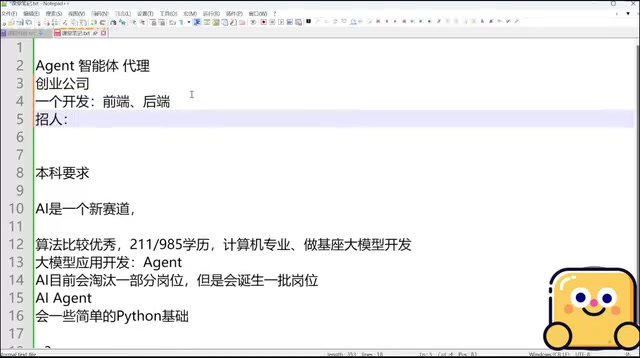
Work that one person used to own now gets split across different roles — front-end, back-end, design, QA. For this to work efficiently, two prerequisites must be in place: clearly defined roles and a shared language for collaboration. Humans communicate through natural language, and AI Agents happen to understand natural language semantics as well, while also being capable of planning and decision-making. This makes them remarkably similar to how humans work.
Deep Dive: Multi-Agent Collaboration Frameworks Multi-Agent Collaboration is one of the most active areas in AI engineering today. Open-source frameworks like LangChain, AutoGen, and CrewAI provide core capabilities including agent orchestration, Tool Use, and Memory Management. In a typical multi-agent system, an Orchestrator Agent handles task decomposition and scheduling, while multiple Executor Agents each take on subtasks. Agents communicate via structured message passing (typically JSON) and interact with external systems through Function Calling or Tool Calling interfaces — enabling database queries, API requests, code execution, and more.
The Three Core Capabilities of an AI Agent
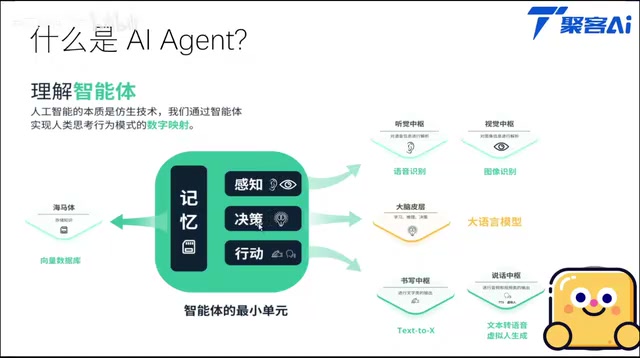
Breaking down how an AI Agent works, its mechanisms map to three key stages in human collaboration: Perception, Decision-Making, and Action. Grasp these three, and you've captured the essence of intelligent agents.
The Underlying Paradigm: The ReAct Loop The decision-making cycle of an AI Agent typically follows the "ReAct" paradigm — an iterative alternation between Reasoning and Acting. Formally introduced by Google Research in 2022, the core idea is to have the model output a "thought process" (Chain-of-Thought) before each action, then select a tool or generate a response based on that reasoning. The execution result is then fed back to the model as a new Observation, forming a closed loop. This "Think → Act → Observe" cycle enables agents to handle complex multi-step reasoning tasks and self-correct when errors occur — rather than linearly executing fixed instructions like traditional scripts. The three capabilities of Perception, Decision-Making, and Action are a direct practical mapping of the ReAct paradigm.
Perception: Self-Awareness and Environmental Context
Perception is where an agent's operation begins. Just like a new developer joining a team first needs to figure out "who am I" — am I on front-end or back-end? Where do my responsibilities end?
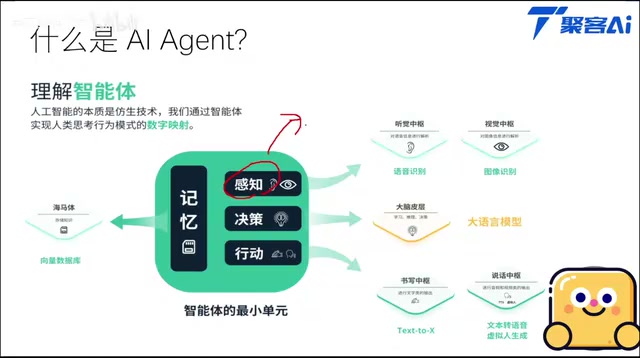
Beyond self-positioning, the agent also needs to perceive its current environmental context. Is the project in a crunch sprint? Does the team need to ship a version in three days? This contextual information shapes everything that follows. The dual awareness of one's own role and the external environment forms the agent's "perception layer" — and is precisely what sets it apart from a simple script tool.
At the technical implementation level, the perception layer is typically composed of a System Prompt and a Context Window. The system prompt injects role definitions and behavioral constraints, while the context window carries dynamic information such as conversation history, tool return values, and external documents. The context windows of modern frontier LLMs have expanded from the early 4K tokens to 128K or beyond, directly determining how much environmental information an agent can "perceive."
Decision-Making: Leveraging LLMs for Intelligent Judgment
Perception is followed by decision-making. In a real development scenario: during front-end/back-end integration, you need to coordinate through API interfaces; when communicating with a product manager, you first read the requirements doc, then assess whether the requirement is actually reasonable.
There's a classic joke in the industry about a product requirement for a "phone case that automatically changes color based on the environment." Sounds cool, but it's completely impractical. An experienced developer can spot the problem instantly and tell the PM "this can't be done." That ability to evaluate the reasonableness of a requirement and judge its feasibility — that's decision-making.
An AI Agent's decision-making relies on calling a large language model. Today's mainstream LLMs are pre-trained on massive human knowledge and text corpora. When an agent sends a requirement to the LLM in natural language (e.g., "Please analyze whether this requirement is feasible"), the model understands the semantics and delivers a judgment.
How Pre-Training Works The pre-training mechanism used by modern LLMs is key to understanding an AI Agent's decision-making capability. Models like the GPT series and Claude typically undergo self-supervised learning on hundreds of billions to trillions of tokens of text, internalizing human knowledge by predicting the next token (Next Token Prediction). After pre-training, models go through an RLHF (Reinforcement Learning from Human Feedback) fine-tuning phase to align their outputs more closely with human intentions and values. This mechanism endows LLMs with powerful semantic understanding, logical reasoning, and knowledge transfer capabilities — enabling them to serve as the "brain" of an agent, receiving natural language instructions and outputting structured decisions or executable code.
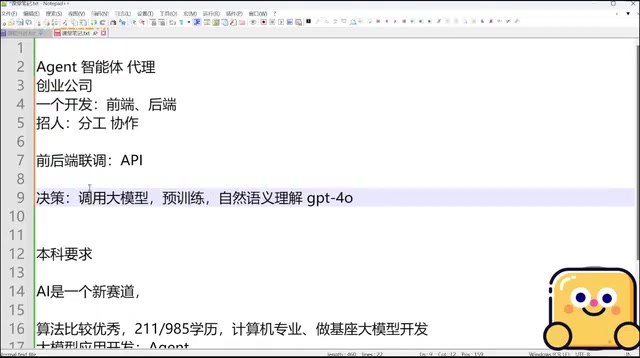
Going further, models like GPT-4o can even detect emotional tone — determining whether a piece of text is positive, negative, or neutral in sentiment. It's precisely through the LLM's semantic understanding and reasoning capabilities that agents can handle complex intelligent decision-making.
Action: From Code Generation to Automated Testing
Once a decision is made, the agent moves into the action phase. For a developer role, action means writing code; for a designer, it means producing UI/UX proposals. For an AI Agent, action means driving the AI to execute specific tasks — automatically generating code, running automated tests, and so on.
This philosophy is already embedded in many products. AI coding tools like Cursor and GitHub Copilot are built on agent principles under the hood. They understand developer intent, generate code, and assist with testing — essentially reimplementing the human development collaboration workflow with AI.
Architectural Differences: Cursor vs. GitHub Copilot Although Cursor and GitHub Copilot are both AI coding tools, their underlying architectures differ significantly. Early GitHub Copilot was primarily based on a Code Completion model, using OpenAI Codex to predict code at the cursor position — a relatively passive, two-stage "Perception → Action" agent. Cursor, by contrast, introduces a more complete Agentic Loop: users can describe requirements in natural language, and Cursor will automatically read project context, plan the scope of changes, execute cross-file edits, and run terminal commands to verify results. This more closely resembles the full three-stage "Perception → Decision-Making → Action" architecture. This difference also reflects the industry trend of AI coding tools evolving from "code completion assistants" to "autonomous coding agents."
The Best Mental Model for AI Agents: Think of Human Team Collaboration
Looking back at the full picture, the most effective way to understand AI Agents is to map them onto human team collaboration:
- Single Agent → "Solo full-stack" — independently handles all tasks
- Multi-Agent collaboration → "Team specialization" — different roles, each with defined responsibilities, working in concert
- Perception, Decision-Making, Action → "Cognitive positioning, reasoning and judgment, hands-on execution" in human workflows
Once you map these abstract concepts onto everyday work scenarios, AI Agents stop being a mystical black box and become a clear, decomposable system. For developers looking to build enterprise-grade AI Agents from scratch, establishing this mental model is far more important than rushing into frameworks and code.
Only by truly understanding why AI Agents are designed the way they are can you make sound architectural choices in real projects — and enable intelligent agents to collaborate like a genuinely high-performing team.
Key Takeaways
Related articles

The Truth Behind Codex 'Build a Website in 5 Minutes': AI Isn't Creating Sites—It's Helping You Copy Them
Exposing the truth behind viral Codex 5-minute website videos: creators aren't building original sites with AI—they're copying shared prompts or scraping others' work. Learn AI coding tools' real limits.

Getting Started with AI Agent Development: A Complete Guide from Concept to Practice
A comprehensive guide to AI Agent architecture and development, covering automated marketing, intelligent customer service, and investment analysis scenarios with single and multi-agent collaboration.

The Truth Behind Codex 'Build a Website in 5 Minutes': AI Isn't Creating Sites — It's Helping You Copy Them
Exposing the truth behind viral Codex 5-minute website videos: creators aren't building original sites with AI — they're copying shared prompts or scraping others' work.