AI Agent Automated Vulnerability Discovery Workflow: From Environment Setup to Report Generation

AI Agents restructure the vulnerability discovery workflow, but human decision-making and verification remain the final gate.
The article compares traditional vulnerability discovery with the workflow after introducing AI Agents. Traditional methods rely on manual site reconnaissance, packet capture analysis, and vulnerability verification, with efficiency strongly tied to personal experience and a three-to-six-month learning curve for beginners. With AI Agents, information gathering becomes structured asset inventorying, intelligent analysis filters massive scan false positives and focuses on high-risk vulnerabilities, and the four essential report elements can be drafted by the Agent with tool invocation. However, verification remains human-led: vulnerability authenticity and reproduction steps must be manually checked to avoid false positives or bans. The article stresses that what truly works is an intelligent agent capable of continuous judgment and tool invocation, not a Q&A-style chat AI; AI lowers the threshold and boosts efficiency, while the human role shifts toward decision-making and quality control.
Traditional vulnerability discovery relies on personal experience and manual operations, and beginners often need three to six months just to get started. With the introduction of AI Agents, this workflow is being restructured. Based on practical tutorial content, this article outlines how AI intervenes in the three major stages of information gathering, vulnerability verification, and report writing, while clarifying the boundaries of its capabilities.
Why the Traditional Three-Step Vulnerability Discovery Method Is Inefficient
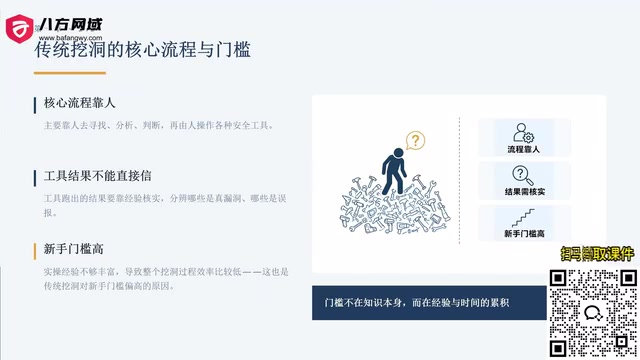
Traditional vulnerability discovery usually follows a fixed path: first, thoroughly visit the target site to understand its functional structure, tech stack, and data interfaces; second, analyze access paths and parameters through packet capture, look for potential risk points, and attempt tampered submissions; finally, verify whether the vulnerability exists and write a vulnerability report containing the four essential elements.
This process is entirely driven by manual work, and efficiency is strongly correlated with experience. Results produced by tools such as Nmap and Burp Suite require human judgment to determine authenticity; an open port is not necessarily a real vulnerability. When beginners lack hands-on accumulation, trial-and-error costs are high and getting started is difficult. Even after completing courses, they may still struggle to enter an effective vulnerability discovery state. The barrier is not knowledge itself, but the investment of experience and time.
The four essential elements of a vulnerability report are the industry-standard report structure, usually referring to: the affected URL/interface address, reproducible operation steps (including parameters and requests), the potential harm the vulnerability may cause (such as data leakage or privilege escalation), and remediation recommendations (such as input filtering or permission checks). Only a report with all four elements can enable vendors to quickly locate and fix the issue, and it is also the main basis for vulnerability platforms to judge report quality and issue rewards. Reports lacking reproduction steps or with vague harm descriptions are often marked as "insufficient information" and rejected.
How AI Agents Change the Information Gathering Stage
With the introduction of AI Agents, the target reconnaissance phase shifts from manual site browsing to intelligent inventorying. The Agent can first visit the site, identify the web server backend architecture, frontend form, authentication method, and database type, and output a structured asset list marking each functional module's route entry, business attributes, and parameter forms.
Humans only need to review the list rather than collect everything from scratch. This greatly reduces dependence on familiarity with the target and makes subsequent testing more targeted.
Tech stack fingerprinting is a key method in information gathering for determining the target's underlying components. Agents usually infer the web server, development framework, CMS, and database type through response headers (such as Server and X-Powered-By), cookie names, HTML characteristics, default pages at specific paths, and error messages. Fingerprint results directly determine the direction of subsequent testing: for example, after identifying a certain version of a CMS, public vulnerabilities for that version can be prioritized; after identifying a specific framework, test cases can be designed around its routing and parameter parsing characteristics. The more accurate the fingerprinting, the more targeted the subsequent packet capture analysis and vulnerability verification will be.
Collaborative Model of Intelligent Analysis and Vulnerability Verification
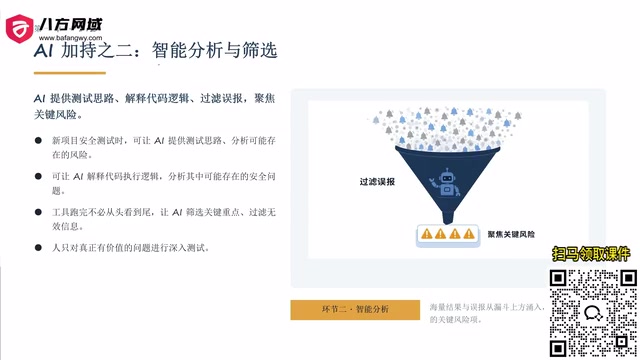
During the packet capture analysis and parameter tampering stage, AI Agents can provide testing ideas, explain code logic, and filter false positives from massive scan results, focusing attention on high-risk and critical vulnerabilities. Alerts that previously required manual confirmation one by one can be preliminarily screened by the Agent, with humans only conducting in-depth testing on truly valuable issues.
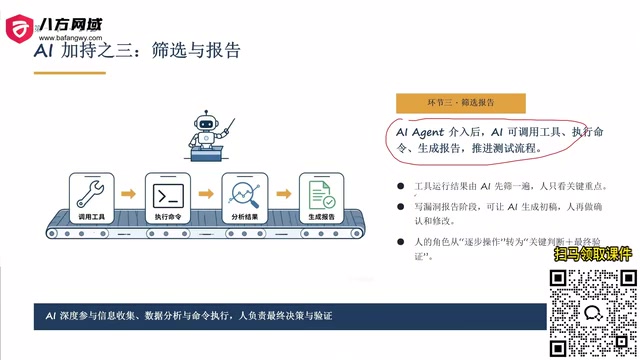
The verification stage is still led by humans. The Agent can invoke tools to execute probing commands, but the final confirmation of whether a vulnerability exists and whether the reproduction process is accurate must be checked by humans. Handing report submission entirely to AI may lead to false positives or even being blacklisted by the target platform.
False positive filtering is one of the most labor-intensive stages in vulnerability discovery. Scanners and fuzzing generate a large number of alerts, many of which are false positives caused by environmental differences, WAF blocking, or logical misjudgments. The AI Agent approach is to make secondary judgments based on response content, status codes, page echoes, and request context, remove clearly harmless alerts, and sort them by severity. It should be noted that the Agent's filtering basis is still pattern matching and semantic inference, and its judgment is limited for scenarios requiring business understanding, such as logic flaws and privilege escalation. Therefore, high-risk conclusions should still be manually reviewed to avoid "missed detections being filtered out" or "false positives being allowed through."
Automation of Report Generation and Tool Invocation
A vulnerability report contains four essential elements: URL, reproduction process, harmfulness, and remediation recommendations. AI Agents can generate a draft according to this structure and invoke security tools to execute commands and analyze results, reducing the cost of humans switching between multiple tools. However, the draft must be manually verified for reproduction steps and harm descriptions before submission.
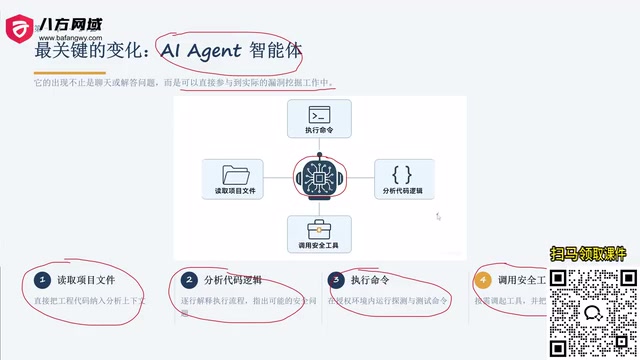
It should be emphasized that the AI here is not a web-based question-and-answer chat tool, but an intelligent agent (Agent) capable of continuous judgment, tool execution, and step advancement. Only such tools can deeply participate in the vulnerability discovery workflow.
Core Value and Capability Boundaries
AI Agent vulnerability discovery has two core values: first, lowering the learning threshold and breaking down the barriers created by comprehensive cybersecurity knowledge; second, significantly improving efficiency. According to tutorial sharing, some people have used Agents to submit dozens of times or even more vulnerabilities in a year compared with traditional methods.
But this does not mean Agents replace humans. The human role shifts toward decision-making and verification: confirming the authenticity of vulnerabilities and checking report quality. AI handles large-scale screening and repetitive labor, while humans make the final judgment. Understanding this division of labor is the key to using AI for vulnerability discovery well.
One-line Summary
AI Agents restructure the vulnerability discovery workflow, but human decision-making and verification remain the final gate.
Paragraph Summary
The article compares the differences between traditional vulnerability discovery and the workflow after introducing AI Agents. Traditional methods rely on humans to complete site reconnaissance, packet capture analysis, and vulnerability verification, and efficiency is strongly correlated with personal experience; beginners need three to six months to get started. After AI Agents intervene, information gathering becomes structured asset inventorying, intelligent analysis can filter massive scan false positives and focus on high-risk vulnerabilities, and the four essential report elements can also be drafted by the Agent with tool invocation for command execution. However, the verification stage is still led by humans; the authenticity of vulnerabilities and reproduction steps must be manually checked, otherwise false positives or even bans may easily occur. The article emphasizes that what truly works is an intelligent agent capable of continuous judgment and tool invocation, not a Q&A-style chat AI; AI lowers the threshold and improves efficiency, while the human role shifts toward decision-making and quality control.
Related articles

AI Tools Quietly Altering Settings: Postman Silently Installs Plugin, Codex Sharing Option Auto-Resets
AI Daily reports: Postman silently installs a Mac plugin and self-approves startup hooks, logged as auto-existing upgrade; Hacker News developers say Codex data-sharing opt-out flips back. Plus Simon Willison's raw float weight experiment with QEN 3.8-27B.

AI Learns to Rewrite AI: MIT's "Weightspace Programming" Redraws the Path to Recursive Self-Improvement
MIT team proposes weightspace programming: GPT-6 Astra reads and edits AI model weights directly. Math scores jump several-fold, hand-written networks beat trained models. Eight experiments analyzed, plus Anthropic's same-day warning and the real boundaries of recursive self-improvement.

Running Qwen 3.8 on a Laptop to Read Raw Weights: 46 Minutes Per Answer
Simon Willison reproduced weight space programming with Qwen 3.8 27B on a laptop: a 17GB model file, 46 minutes per answer, 43,506 reasoning tokens, Pong over an hour, Freeway failed. Suited for interpretability researchers.