AI Agent Beginner's Guide: Core Architecture and How Intelligent Agents Work
A systematic breakdown of AI Agent architecture: perception, planning, action, and memory explained for beginners.
This article provides a complete knowledge framework for AI Agents. An agent is a system that autonomously perceives its environment, plans tasks, and calls tools to achieve goals — no step-by-step human guidance needed. Its architecture consists of three modules: perception (multimodal inputs), brain (Chain of Thought and Reflection-based planning), and action (tools like calculator, search, and code interpreter). Memory management is equally critical — short-term memory relies on context windows, System Prompts, and conversation compression, while long-term memory is handled via RAG (Retrieval-Augmented Generation) and Markdown file storage. Understanding this framework is the essential first step into AI Agent development.
AI Agent (intelligent agent) has become one of the hottest technical concepts today. As more and more people can direct AI to autonomously complete complex tasks with a single instruction, those still at the stage of simple text chatting with AI might want to reconsider what intelligent agents actually mean. This article, based on tutorial content from Bilibili, systematically covers the definition of AI Agents, the evolution of large model capabilities, the three core architectural components, and memory management mechanisms — helping beginners build a complete knowledge framework.
What Exactly Is an AI Agent
Many people, upon first hearing the word "Agent," instinctively think of it as a "proxy" or "representative." In the Chinese context, it is translated as "智能体" (intelligent agent), with the emphasis placed on its independence and autonomy.
The standard definition of an intelligent agent is: a system that can observe its surrounding environment and take actions to achieve goals. The biggest difference from traditional conversational AI is that you only need to give the agent a single instruction, and it will autonomously plan the entire task workflow without requiring humans to intervene step by step. More critically, when it finds it lacks the knowledge needed to complete a task, it can proactively call tools or search the web to fill the gap.
Recently viral products (such as the icon-generating AI app mentioned in the tutorial) are all essentially implementations of this concept — an AI that claims it "can do anything" is powered by an agent architecture working behind the scenes.
The Evolution of Large Models: From Text Tools to Super-Brains
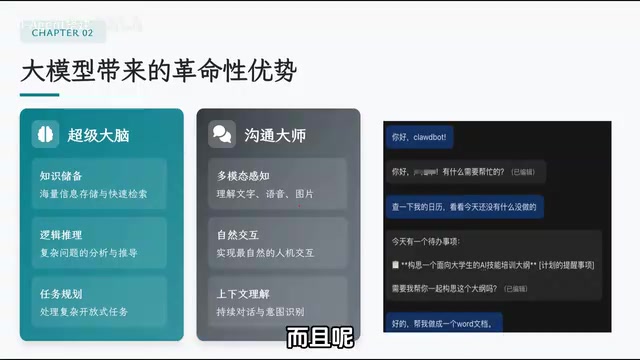
The first prerequisite for agents to work is that the underlying large model must be sufficiently intelligent. The tutorial refers to today's large models as "super-brains," with capability improvements across several dimensions.
Knowledge capacity and response speed have improved dramatically. Early AI was primarily used for text creation and code writing, and often made mistakes on complex math problems. Today's large models can automatically decompose tasks, breaking them into simple steps to complete incrementally — even mathematical calculations can now yield reliable answers.
Multimodal perception is another decisive breakthrough. Traditional AI conversations could only send and receive text, which struggled to meet real-world needs. Multimodal models allow users to provide information through text, voice, video, and more, while AI can in turn generate images, audio, and even video.
This capability enables a far more natural interaction experience. When faced with a problem that's hard to describe in words, users can simply take a screenshot and send it to the AI — no need to painstakingly describe it in text. The AI can "read" the image and provide a direct answer. This mode of interaction is transforming AI from a tool into a collaborative partner you can actually converse with.
The Three Core Components of Agent Architecture
Going from "a smart large model" to "a usable intelligent agent" requires a complete architectural framework. The tutorial breaks this down into three core modules.
Perception Module
For an agent to independently complete tasks, it must be able to perceive the external environment. This function is primarily handled by multimodal capabilities, enabling the agent to read text, voice, video, and even the real-time state of a computer desktop.
Brain Module
After receiving information, the agent needs to think, make decisions, and plan — corresponding to the Planning section in the architecture diagram. This includes several key mechanisms: Reflection enables self-critique; Chain of Thought (CoT) is the logic behind the "deep thinking" button — it decomposes a task into a step-by-step execution sequence, making clear what to do first and what comes next.
Chain of Thought (CoT) was formally introduced by Google researchers in 2022. The core finding was that when prompts include step-by-step reasoning examples, large models show significantly higher accuracy on complex reasoning tasks. Intuitively, since a model can only "look forward" when generating each token, forcing it to write out intermediate steps effectively externalizes working memory into the context, giving subsequent reasoning a solid foundation. The "deep thinking" or "extended thinking" modes now found in major model products are essentially implementations of this: the model outputs an internal reasoning process before delivering a final answer — CoT in engineering form. The Reflection mechanism goes a step further: after completing a round of actions, the agent compares the execution results against the intended goal. If a discrepancy is found, it replans the next steps, forming a "plan → execute → reflect → replan" loop. This is the key reason agents can continuously improve output quality without human supervision.
Action Module
Thinking inside a chat window isn't enough to actually complete tasks. The action module brings the agent to life by calling tools. The tutorial highlights several typical tools: calculator for complex computations; search for web browsing to fill knowledge gaps; and code interpreter to run and validate code.
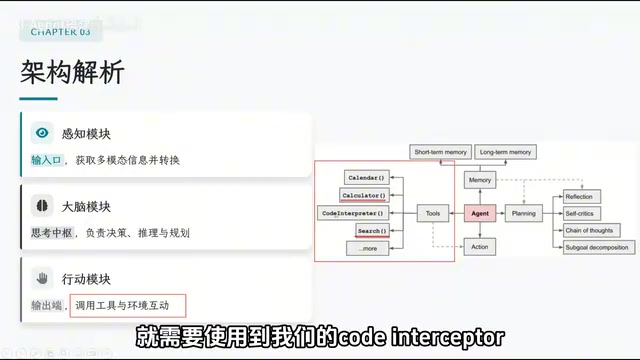
Take "ordering a cup of coffee" as an example: the agent first thinks about the user's preferences (their preferred coffee type), and once decided, calls a payment API tool to complete the order. This complete loop of "perceive → think → act" is what gives AI the foundational form of an autonomous intelligent agent.
Memory Mechanisms: How AI "Remembers" You
Beyond the three main modules, there is one often-overlooked key component — the memory module.
First, let's dispel a misconception: there is no dedicated AI that has been continuously serving you. In reality, every new conversation starts with an AI that is completely fresh and unfamiliar with you — it cannot see previous conversations on its own. The reason it feels like the AI always "remembers" you is due to conversation management mechanisms.
Short-Term Memory: The Context Window
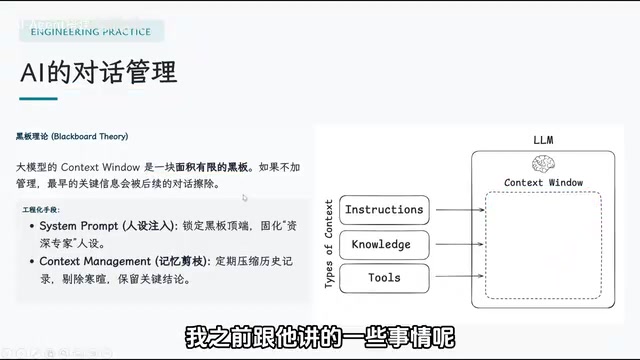
All conversations are stored in a context window. Model providers also inject hidden instructions into it (e.g., "You are the AI for Company X; your core task is to answer user questions"). Think of it as a chalkboard with a limited surface area.
When a conversation reaches tens of thousands or even hundreds of thousands of words and the window fills up, the AI begins to forget early content. There are two engineering approaches to handle this:
- System Prompt (persona injection): The core task is written as a concise instruction and locked at the top of the window, so it is never removed as the conversation progresses, ensuring the AI always remembers its role.
- Memory summarization (conversation compression): When the conversation grows too long and the window is nearly full, the entire conversation is handed to another AI to summarize — stripping out small talk and irrelevant content, keeping only key information like the user's name and preferences, freeing up space to continue.
Long-Term Memory: RAG and File Storage
Short-term memory is inherently limited; long-term memory requires a different approach. RAG (Retrieval-Augmented Generation) is the mainstream method for managing long-term memory today, and it also addresses the problem of insufficient AI knowledge.
The principle is straightforward: store the user's history, purchase records, conversation logs, and enterprise private knowledge in a knowledge base. When a user asks a question, the question is converted into a vector, relevant passages are retrieved from the vector knowledge base, and the retrieved material is concatenated with the user's question before being passed to the large model for an answer — giving every response a solid factual basis.
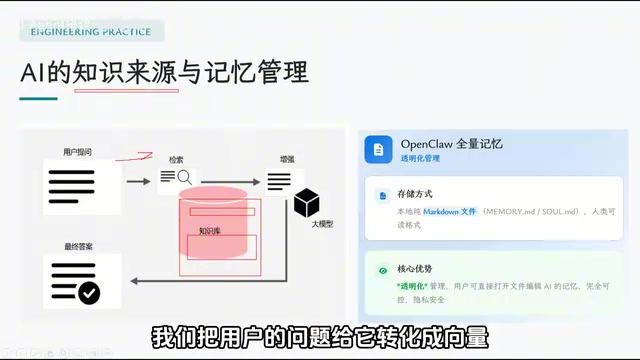
The tutorial also mentions another more intuitive memory approach — storing memories as Markdown files. These are no different from ordinary text notes; the advantage is that humans can directly read what the AI has remembered and manually edit it. For privacy concerns, simply edit the relevant section. The transparency and controllability are much higher.
RAG (Retrieval-Augmented Generation) was introduced by Meta AI in 2020, originally to address two major pain points of large models: the "knowledge cutoff date" and "hallucinations." Its technical workflow consists of two phases: the offline indexing phase splits documents into text chunks, converts each chunk into a high-dimensional vector using an embedding model, and stores them in a vector database; the online retrieval phase vectorizes the user's question, finds the most relevant chunks using metrics like cosine similarity, appends them as context to the prompt, and passes everything to the large model to generate an answer. Vector similarity search works because semantically similar texts are closer together in high-dimensional space, enabling "semantic retrieval" rather than simple keyword matching. RAG's advantage over direct model fine-tuning is that the knowledge base can be updated in real time without retraining the model — the cost is extremely low, and answers are traceable and verifiable.
Core Characteristics of Agents and Where to Learn Next
In summary, a mature AI Agent has four core characteristics:
- Autonomous independence: Can act without step-by-step human guidance;
- Goal-oriented behavior: All actions ultimately point toward task completion;
- Environmental perception: Can read sensors, voice, video, and even desktop environments and respond accordingly;
- Tool-use capability: Can call upon code tools, web search, and more to extend its own abilities.
As AI Agents develop rapidly, they are beginning to deliver high-quality content and services for humans. For those hoping to enter this field, mastering RAG technology and developing a deep understanding of how AI works will become skills that companies highly value. Building on this foundation, learning related technologies like MCP will be what it takes to truly build your own AI workflows.
MCP (Model Context Protocol) is an open protocol released by Anthropic in late 2024, designed to standardize how large models connect with external tools and data sources. Before MCP, every AI application had to write separate integration code for each tool — an extremely high maintenance cost. MCP's design philosophy is similar to that of a USB port: as long as a tool provider implements an MCP Server, any MCP-compatible AI client can call that tool plug-and-play, without needing to understand the underlying implementation. For developers looking to build AI workflows, understanding MCP means being able to quickly combine modules like search, database queries, code execution, and file I/O, keeping focus on business logic rather than low-level interface adaptation. Most mainstream AI editors and agent frameworks have already announced MCP support, and it is becoming one of the de facto standards for the tool-calling layer of intelligent agents.
Summary of Core Agent Characteristics
Putting it all together, a complete AI Agent framework consists of:
- Perception Module: Multimodal inputs including text, image, voice, and video
- Brain Module: Planning via Chain of Thought and Reflection mechanisms
- Action Module: Tool calls including calculator, search, and code interpreter
- Memory Module: Short-term (context window, System Prompt, compression) and long-term (RAG, Markdown file storage)
Mastering this framework is the necessary foundation for entering AI Agent development.
Related articles
Building an AI-Powered E-Commerce Business from Scratch: A Real-World Account of Multi-Agent Architecture for Print-on-Demand
A blogger builds a print-on-demand e-commerce company from scratch using AI agents — documenting specialized Agent profiles, GPT-5.6 vs Claude Fable multi-model orchestration, and reusable skill accumulation.

AI Agent Earns $10K in One Week: 3 Key Upgrades Explained
A blogger shares how he earned $10K in a week with an AI Agent — not by adding more skills, but through verification, approval gates, and subagents to raise trust and enable true automation.
Getting Started with OpenClaw: Multi-Channel AI Agent Gateway and Automated Workflow Guide
OpenClaw is an open-source multi-channel AI agent gateway. This guide covers its three core components — gateway, agents, and channels — plus tool integration and memory mechanisms.