AI Agent Core Principles Fully Explained: Decision Loops and the Three Key Components in Practice

A complete breakdown of AI Agent architecture: decision loops and the three core components.
This article systematically deconstructs AI Agent core principles, covering the essential differences between LLMs and Agents, the Perceive-Plan-Act-Observe decision loop, and deep dives into the three key components — Planning (from Chain of Thought to Tree of Thoughts), Memory (layered architecture with vector databases), and Tools (Function Calling for real-time data and precise computation). A smart home scenario illustrates the full workflow.
In today's workplace, almost everyone uses large language models to write copy and answer questions. But when it comes to complex tasks, AI still frequently falls flat. The reason is simple — most people are just using AI as a glorified search engine or Q&A machine. The real differentiator lies with those who know how to build AI Agents: they've given LLMs "hands and feet," transforming them from passive responders into proactive "digital employees."
This article systematically breaks down the core principles of AI Agents — from concept clarification and decision loops to the three key components — helping you build a complete cognitive framework for intelligent agents.
LLMs vs. Agents: What's the Real Difference?
Many people struggle to distinguish between large language models and Agents. Put simply, an Agent quantifies human thinking habits into a structured program.
Traditional LLMs work in a very straightforward way: you provide an input, the model "thinks" internally, then outputs a piece of text. The entire process is one-directional and one-shot. A true AI Agent, however, is fundamentally different — it not only perceives the external environment but also reviews past memories, plans tasks, invokes external tools, and ultimately translates thinking into real action.
Here's a vivid analogy: suppose the task is "hammer a nail into the wall." A pure LLM would obsessively calculate the perfect angle and force, but no matter how perfect its reasoning, the nail never goes in — because it has no hands. An Agent, on the other hand, thinks like a human: first plan (I need a hammer), then execute step by step (hold the nail with the left hand, swing the hammer with the right), and finally verify the result.
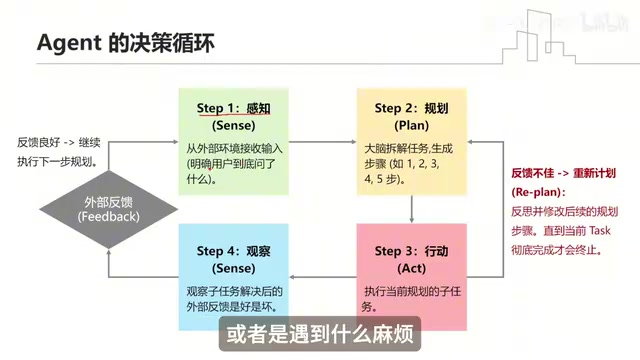
The Core Decision Loop: Perceive → Plan → Act → Observe
Building a truly effective AI Agent relies on the coordinated interplay of four foundational components:
- Tools: Calendars, calculators, code executors, search engines, etc. — essentially giving the LLM a connected smartphone
- Memory: Divided into short-term and long-term memory, enabling the Agent to remember context and historical preferences
- Planning: Includes chain-of-thought reasoning, task decomposition, and self-reflection — so it doesn't try to bite off more than it can chew when facing big problems
- Action: All thinking ultimately materializes into concrete operations
These four components revolve around a core closed loop: Perceive → Plan → Act → Observe → (Replan if necessary). This cycle keeps running until the task is completed satisfactorily. The key differentiating capability lies in the branching judgment after "Observe" — if feedback is positive, continue executing; if feedback is poor, trigger a Replan (re-planning), pausing to reflect and revise the approach. This ability to "recognize mistakes and self-correct" is what makes AI Agents truly fascinating.
Practical Walkthrough: How an Agent Operates in a Smart Home Scenario
To make these abstract concepts concrete, let's walk through a complete Agent workflow using a smart home scenario.
Task: Adjust indoor temperature based on family members' needs.
Step 1: Perceive (Sense)
You come home from work and say, "I'm a bit cold, turn up the temperature." A basic system would only recognize the voice command, but an advanced Agent can also perform sentiment analysis — if you angrily shout, "Can you turn up the temperature already? I'm freezing to death!" the system detects strong anger and immediately prepares for a rapid response, possibly even with a soothing reply.
Step 2: Plan
The Agent doesn't blindly adjust the temperature. Instead, it combines memory for a comprehensive assessment:
- Read current room temperature: 20°C
- Retrieve historical preference data: Last winter, when you weighed 60kg, you typically set it to 29°C
- Factor in latest data: This year your weight increased to 72kg, so you're likely more heat-sensitive now -综合判断: Setting it directly to 29°C might cause sweating; compromise at 26°C
Step 3: Act
Control the AC to raise the temperature to 26°C, while announcing via voice: "I've raised the temperature to 26 degrees. Please wait a moment as the room gradually warms up."
Step 4: Observe & Replan
An ordinary smart speaker would stop here, but an Agent continues monitoring. If five minutes later you say, "It's still a bit cold," the Replan mechanism triggers immediately — reflecting that "26 degrees was too conservative," then adjusting the strategy: either incrementally raising the temperature one degree at a time, or jumping straight to 29°C based on your tone. The cycle continues until it receives satisfactory feedback.
Core Component 1: The Technical Evolution of Planning
Planning boils down to two things: how to break big tasks into small ones, and how to reflect and adjust when things go wrong.

From a technical evolution perspective, LLM planning capabilities have gone through four stages:
1. Basic Input-Output
The most primitive approach — given an input, directly produce an output. Fine for simple problems, guaranteed to fail on complex tasks.
2. Chain of Thought (COT)
Introduces "think step by step" prompting, making the model reason incrementally. Accuracy improves dramatically, but the fatal flaw is that it's a one-way street — if any intermediate step goes wrong, everything downstream collapses.
3. Self-Consistency
Generates multiple chains of thought simultaneously and takes the "majority vote" as the final answer. It's like having four experts solve the same problem independently and picking the most common answer. But there's a "herd mentality" risk — if three chains all arrive at the wrong answer of 200 and only one gets the correct answer of 100, the model blindly follows the majority and picks 200.
4. Tree of Thoughts (TOT)
Currently the most powerful planning technique. At each step, it generates multiple branches and self-scores them. If it predicts a path is a dead end (extremely low score), it triggers a backtracking mechanism, returning to the previous node to choose a different path. This technique, which combines breadth, depth, and forward-looking vision, represents truly advanced planning capability — at the cost of massive computation and heavy token consumption.
Core Component 2: The Layered Architecture of Memory
To understand an AI Agent's memory mechanism, it helps to first review how human memory is layered:
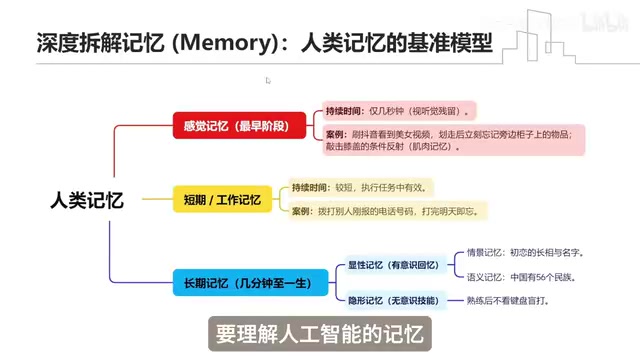
Human Memory Layers:
- Sensory Memory: Lasts only a few seconds — like the fleeting visual details when scrolling through short videos
- Short-term/Working Memory: Active during the current task — like remembering a package pickup code for a dozen seconds
- Long-term Memory: Divided into explicit memory (conscious recall, like your first love's name) and implicit memory (unconscious skills, like riding a bicycle)
Agent Memory Equivalents:
- Innate Memory: The massive internet data "force-fed" to the LLM during training, stored across billions of parameters — never forgotten as long as there are no bugs
- Short-term Memory (Context): Contextual information during a conversation, stored in temporary variables. Once the task ends or the program closes, memory is released and cleared
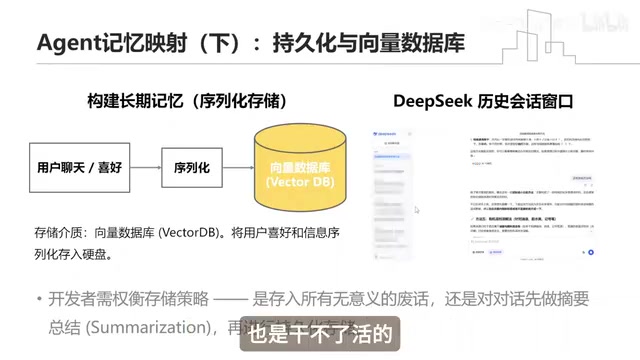
- Long-term Memory (Persistent): Implemented through vector databases (VectorDB). Chat histories and personal preferences are converted into vector encodings via serialization and persistently stored on disk
Take DeepSeek as an example: if you asked yesterday "How do I remove oil stains from clothes?" and open the same conversation today to follow up, it can seamlessly continue — because the backend "retrieved" yesterday's memory from the vector database.
In actual development, there's also an important strategic trade-off: you can't store every user utterance (including filler like "hello" or "are you there?") in the database. The common approach is to have the LLM perform a summary extraction before storage, retaining only core information. This saves storage space while improving retrieval precision.
Core Component 3: Tools — Giving the Agent Hands and Feet
Even the smartest brain can't get anything done if its hands and feet are tied. Tool usage is the final critical piece of the AI Agent architecture puzzle.
Three Categories of Tools
- Pre-built Tools: Ready-made capabilities officially packaged by the LLM provider, such as web search and code interpreters — ready to use out of the box
- Custom Tools: Tailored for internal enterprise needs, such as API interfaces connecting to company ERP systems or employee attendance queries
- Tool Collections: "All-in-one" suites provided through development frameworks like LangChain or cloud service platforms — connect once and gain access to dozens or even hundreds of tool capabilities
Why LLMs Must Rely on External Tools
Once an LLM ships, its parameter weights are frozen. Through Function Calling technology, external tools are integrated to compensate for three critical shortcomings:
- No real-time information: Model knowledge may be frozen at the training cutoff date, unable to answer "Will it rain today?" — but it can query a weather API for live results
- Inability to compute precisely: LLMs are essentially "liberal arts students" that rely on probabilistic prediction. Complex calculus or financial calculations are prone to "confidently hallucinated" answers. With tools, the model smartly writes a Python script, hands it to an executor, and gets absolutely precise results
- No access to proprietary information: The model can't possibly know your bank account balance or confidential enterprise data. Only by mounting private databases as tools can it become a truly personal assistant
Conclusion: An Agent Is a Digital Replica of Human Thinking
An AI Agent is far more than a pile of cold code. At its core, it's a faithful replication of how humans solve problems — perceiving the external environment, planning and decomposing in the mind, executing hands-on, observing and reflecting, and correcting course when wrong. This closed loop allows LLMs to truly break free from the passive "poke it to make it move" chatbox paradigm, evolving into intelligent agents capable of autonomously handling complex tasks.
Once you understand this underlying framework, no matter what flashy new AI concepts or products emerge in the future, you'll be able to see right through to the skeleton: How deep is its planning capability? Is its memory mechanism robust? Is its tool ecosystem rich? These three dimensions are the core yardstick for evaluating any Agent product.
Related articles

Disaster and Glory of the Apollo Program: The History We Must Revisit Before Returning to the Moon
From the fatal Apollo 1 fire to Apollo 8's daring lunar orbit to Apollo 11's successful landing—revisiting the disasters, fears, and compromises of the Apollo program and their lessons for today's return to the Moon.

Netflix Trust Exercise Turns Into Firing Trap: Where Are the Boundaries of Corporate Trust?
A Netflix employee was fired after sharing private info in a trust exercise. We analyze the risks of corporate trust exercises and how employees can protect themselves.

AMD CDNA5 Architecture Deep Dive: Technical Evolution and the AI Computing Competition Landscape
Deep analysis of AMD's CDNA5 architecture covering Chiplet packaging upgrades, HBM memory evolution, and low-precision compute optimization, examining how AMD challenges NVIDIA's AI chip dominance.