AI Agent Deep Dive: From Core Concepts to Enterprise Applications

Agents bridge LLM limitations through four roles: interpreting, tool use, memory, and task planning.
Raw LLMs share three key limitations: no persistent memory, a knowledge cutoff date, and no ability to access the internet or external tools. Agents are the orchestration layer built to address these gaps, acting as an interpreter between users and models. They translate natural language into executable instructions, call external tools to enable action, maintain multi-turn conversation context, and decompose complex tasks into executable steps. Products like Doubao, DeepSeek, and Claude Code are all Agent-based applications. In enterprise settings, Agents combine with RAG, fine-tuning, multimodal processing, and prompt engineering to power complete production-grade systems.
Why the LLM Era Can't Do Without Agents
Agent (intelligent agent) technology is one of the most talked-about topics in the large language model (LLM) space today. A common question among newcomers is: if LLMs are already so powerful on their own, why do we need to wrap them in an Agent layer?
The answer lies in a few inherent limitations of raw LLMs. Models like Qwen and DeepSeekAd represent massive investments — trained at costs running into the tens of millions — and their capabilities are largely fixed at training time. But they share three significant constraints:
- No memory: Every conversation starts from scratch. The model has no recollection of previous exchanges.
- Knowledge cutoff: The model only knows what it was trained on. Ask it about events after its training date, and it may confidently fabricate answers.
- No internet access or tool use: Ask it about tomorrow's weather or the latest stock market regulations, and it's helpless. It also can't access files or tools on your computer.
These limitations are precisely why Agents have become the critical bridge between users and LLMs.
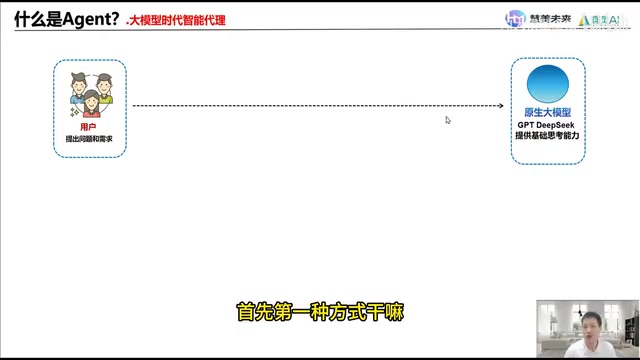
What Exactly Is an Agent?
The most intuitive way to understand an Agent is to think of it as an interpreter for the LLM era. Just as a Chinese speaker and an English speaker need a translator to communicate, an Agent plays that same bridging role between users and LLMs.
For everyday users, interacting with a raw LLM isn't straightforward — you typically either write code or call it through an API. Either way, the model's inherent knowledge limitations remain. The value of an Agent is that when a user poses a question, the Agent first interprets the need, invokes the right tools, aggregates the results, and then delivers a final answer back to the user.
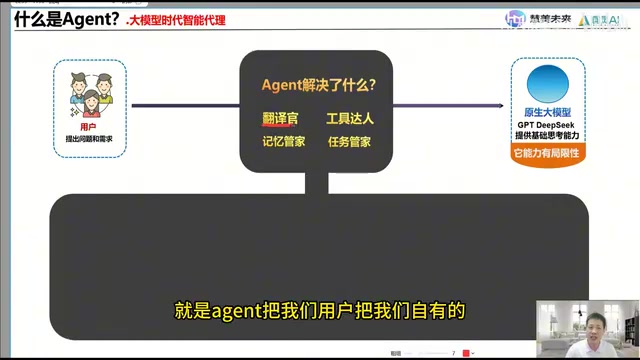
In other words, when you send a message to a product like Doubao or DeepSeek, it doesn't go directly to the underlying model. It first passes through an Agent layer — which orchestrates the LLM through multiple processing steps before returning a more accurate result.
The Four Core Problems Agents Solve
From an industry practice standpoint, Agents address four distinct categories of problems — which is exactly why they've become standard in LLM-based applications.
The Interpreter: Translating Needs into Instructions
An Agent translates what users express in natural language into instructions the LLM can understand and execute, then converts the model's output back into something the user can read. This is the most fundamental layer of capability.
The Tool Expert: From Talking to Doing
Agents enable LLMs to call external tools and APIs — enabling web access, data queries, and more. With this capability, an LLM is no longer just a conversational system that "talks" — it becomes an executor that can genuinely "get things done."
The underlying mechanism for Agents calling external tools typically relies on Function Calling capabilities provided by LLM vendors. When generating a response, if the model determines it needs to query data or perform an action, it outputs a structured "tool invocation instruction" (rather than a direct answer). The Agent framework parses this and executes the corresponding function, then passes the result back to the model for further reasoning. This mechanism allows tool sets to be extended like plugins at any time — from search engines and database queries to code executors and email senders — dramatically expanding the action space of LLMs.
The Memory Keeper: Maintaining Conversational Continuity
Agents can remember context, user preferences, and the content of previous exchanges, giving LLMs the continuity needed for genuine multi-turn interactions — rather than "forgetting everything" at the start of each session.
The Task Manager: Breaking Down and Planning Complex Tasks
Facing a complex problem, an Agent behaves like a human professional — decomposing a large task into smaller steps, planning the execution flow, and proactively trying alternative approaches when something goes wrong. This capacity for autonomous planning and execution is what sets Agents apart from simple question-answering tools.

Agents in Everyday Products and Dev Tools
Agents have already permeated the products we use daily. Applications like Doubao and DeepSeek are, at their core, Agent products. When a user asks a question, it first enters the Agent layer, which orchestrates the underlying LLM to process it before returning a response.
In development contexts, Agents are even more prominent. Take AI coding tools like Claude Code: they can remember an entire project's structure, automatically invoke the right approaches to debug code, and iteratively verify results. This entire workflow is a concrete manifestation of the Agent's "Tool Expert" and "Task Manager" capabilities.
The Advanced Tech Stack Beyond Agents
The technical ecosystem built around Agents is extensive. Mastering enterprise-grade applications requires a complementary set of capabilities:
- RAG (Retrieval-Augmented Generation): Supplements model knowledge limitations by connecting to external knowledge bases — a core technology for enterprise use cases like intelligent customer service.
- Fine-tuning: Adapting models for specific business domains such as e-commerce or healthcare.
- Multimodal capabilities: Enabling Agents to process images, video, and other data types beyond text.
- Prompt engineering and system prompts: Designing carefully crafted prompts to guide the model toward more reliable outputs.
- Knowledge graphs and evaluation frameworks: Used for enterprise knowledge management and model performance assessment.
In real enterprise projects, these technologies typically appear in combination. An enterprise intelligent customer service system, for example, often involves multimodal support, RAG retrieval, and high-concurrency optimization. An e-commerce Agent might combine multimodal processing, fine-tuning, and microservice architecture. No single technique is sufficient to support a full production-grade application — understanding how they work together is the key to advancing in this field.
The core idea behind RAG (Retrieval-Augmented Generation) is: rather than modifying the model's parameters, you dynamically retrieve relevant excerpts from an external knowledge base at inference time and inject them into the prompt, letting the model "see" up-to-date or proprietary information before generating an answer. The typical flow is: user query → vector-based retrieval → recall relevant document chunks → feed them along with the question into the LLM → generate response. Fine-tuning, by contrast, directly adjusts the model's weights so it performs better on a specific domain's language style, terminology, and task format — at the cost of requiring labeled data and compute resources. The two are not mutually exclusive: RAG supplements real-time or private knowledge, while fine-tuning embeds domain-specific capabilities into the model. Enterprise applications often use both in combination.
Summary
At its core, an Agent is an orchestration and execution layer built on top of an LLM's native capabilities. Through its four roles — Interpreter, Tool Expert, Memory Keeper, and Task Manager — it transforms the "limitations" of raw LLMs into fully usable functionality, upgrading AI from a pure conversational system into an intelligent agent capable of autonomous planning, tool invocation, and contextual memory. For anyone looking to go deep in the LLM space, understanding how Agents work is the essential first step toward building real-world enterprise applications.
Related articles

Chain of Thought Isn't Just for AI: How Humans Can Use CoT to Improve Thinking Quality
Chain of Thought isn't just a prompt trick for large models. Starting from a Hacker News discussion, this article analyzes why CoT works for human thinking too, breaks down actionable ways to transfer it, and highlights the key differences between human CoT and machine CoT.
Cloudflare Teams Up with OpenAI: Closi…
Cloudflare Teams Up with OpenAI: Closing the Loop from Vulnerability Discovery to Defense with AI
Cloudflare uses OpenAI Daybreak to investigate security vulnerabilities and generate reviewable remediation plans, while developers use Codex to boost coding efficiency and quality.

Orca Multi-Agent Orchestration in Practice: A Guide to Parallel Collaboration with Claude and Codex
Orca is Stable AI's free open-source agent workbench supporting 34 agents like Claude Code and Codex in parallel. Learn its Git worktree isolation, multi-model orchestration, and mobile management.