AI Agent Development: A Beginner's Guide to the Next Big Tech Wave

AI Agents evolve AI from 'what it can say' to 'what it can do' — the next revolution in software.
Based on a Bilibili tutorial series by Tommy, this article covers the value of AI Agents, the frontier of multi-agent collaboration (Stanford Smallville, ChatDev), and market data showing 40%+ CAGR growth. It explains why Agents outperform general LLMs for enterprise use cases, introduces key concepts like RAG and vector databases, and outlines a LangChain-based beginner curriculum built around a hands-on fortune-teller Agent project.
AI Agent: The Next Paradigm Shift in Software
When people think of artificial intelligence, the first thing that comes to mind is usually a chatbot like ChatGPT — something that understands and generates natural language, answers questions, and keeps you entertained. But is that really the final form AI will take?
According to Tommy, a Bilibili creator who runs an AI Agent development tutorial series, Bill Gates has argued that existing software is still remarkably clunky, and that the future of software lies in intelligent agents. Gates believes that within five years, everyone will have their own AI assistant — and that every piece of software today is worth rebuilding through the lens of Agent architecture. This has been described as the biggest computing revolution since we went from typing commands to clicking icons.
Simply put, an Agent is an intelligent system capable of executing specific tasks and taking actions on behalf of users. It can take the form of a chatbot, a smart assistant, or automated software. Compared to general-purpose chat tools, Agents represent a leap from "what AI can say" to "what AI can do" — a generational shift.
What Agents Can Do That General LLMs Can't
Anyone who uses ChatGPT regularly will notice a gap: beyond casual conversation, there's relatively little it can do for B2B enterprise scenarios. Many business owners who follow AI closely remain genuinely puzzled about what AI can actually do for them — and that's exactly where Agents come in.
The tutorial offers a compelling example: imagine you run a business consulting firm that processes large volumes of data every day — pulling raw data from databases, cleaning it, generating tables, running statistical analysis, and surfacing business insights. A general-purpose tool like ChatGPT simply can't handle that kind of workflow. The better approach is to build an Agent tailored to your business: connect your database to the Agent, ask the questions you need answered, and get a report back — even forwarded automatically to the right inboxes.
This might sound like science fiction, but it's actually a near-certain near-future. The core difference between Agents and traditional AI tools is proactivity: Agents can offer suggestions before users even ask, execute tasks across multiple applications, remember user behavior patterns, identify intent, and continuously improve over time. Travel planning is a vivid use case — an Agent can recommend activities and book restaurants based on your preferences and appetite for adventure, delivering genuinely personalized service.
Multi-Agent Collaboration: The Frontier of AI Intelligence
AI Agents are evolving rapidly toward greater intelligence and human-like behavior, and multi-agent collaboration is one of the most exciting directions to watch.
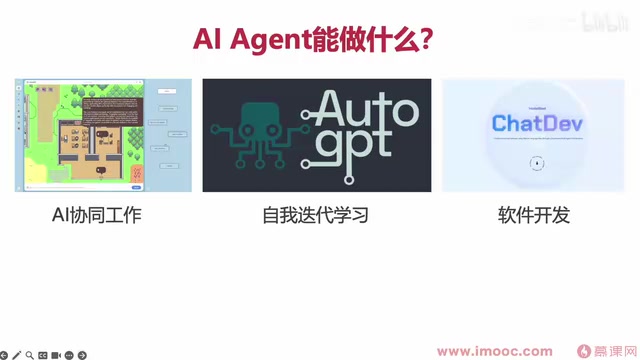
Stanford University's "Smallville" project (formally known as Generative Agents: Interactive Simulacra of Human Behavior) assigned distinct personality traits and roles to Agents living in a virtual town, letting them develop freely in a shared environment and collaborate as a group. A Chinese team took a similar approach with ChatDev, virtualizing the entire software development pipeline — with all roles (product manager, developer, tester, etc.) played by Agents — achieving results more powerful than any single agent working alone.
This kind of technology is already being widely applied in software development, making it possible to write code from simple verbal instructions. In customer service, banking, and e-commerce, LLM-based Agents can handle inquiries and provide personalized support. In data visualization, Agents can transform raw data into interactive charts, making market analysis and health data tracking far more intuitive.
Generative Agents (Stanford Smallville) is a research project from Stanford University and Google, formally titled Generative Agents: Interactive Simulacra of Human Behavior. It placed 25 LLM-powered Agents in a Sims-like sandbox environment, each equipped with an independent Memory Stream — an architecture that combines short-term perception with long-term memory, enabling Agents to recall past events, reflect on their own behavior, and form plans. During the experiment, the Agents spontaneously organized a Valentine's Day party, exhibiting emergent behaviors that surprised the researchers and demonstrating that multi-agent collaboration can produce complex social outcomes far beyond what a single model could achieve.
ChatDev took this idea and engineered it into a software development context. It simulates the organizational structure of a virtual software company, with role-based Agents for CEO, CTO, programmer, QA engineer, and more. The entire development pipeline is driven by "role-playing dialogue." Users simply input a one-sentence product requirement, and ChatDev produces a complete software package — including code, documentation, and test cases — within minutes. The core advantage of multi-agent frameworks like this lies in task decomposition and specialization: different Agents focus on their respective subtasks and collaborate through structured communication protocols, sidestepping the hallucination accumulation and context window limitations that plague single agents on complex, long-running tasks.
Market Data: A High-Growth Sector
In terms of market size, the growth trajectory of the Agent space mirrors that of AIGC — it's moving fast.
According to Grand View Research, the autonomous AI and autonomous agents market was already valued at $3.9 billion in 2022, and is projected to grow at a compound annual growth rate of 42.8% through 2030. Another report indicates the autonomous AI agent market will grow from $5 billion to $29 billion within five years, at a CAGR of approximately 43%.
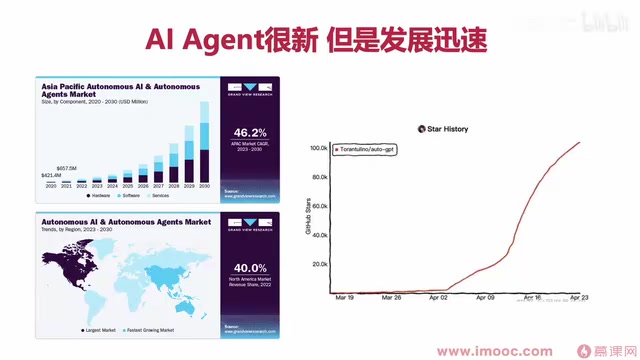
Globally, China and the United States have emerged as the leading countries in AI development. The tutorial draws a direct analogy: mastering Agent technology today is comparable to mastering web development in the PC era, or app development in the mobile era. The open-source releases of AutoGPT, LangChain, and related ecosystem projects triggered explosive growth — AutoGPT's GitHub stars skyrocketed, making it a standout project and reflecting the developer community's intense interest in Agent technology.
LangChain is one of the most widely adopted Agent development frameworks today. Created and open-sourced by Harrison Chase in October 2022, its core value lies in providing a standardized "chain-of-calls" abstraction layer that connects large language models with external tools (databases, search engines, APIs), memory modules, vector databases, and other components — so developers don't have to build every integration from scratch. AutoGPT is another landmark project: open-sourced in April 2023, it became one of the fastest-growing projects in GitHub history within weeks. Its key innovation was enabling GPT-4 to autonomously decompose goals, call itself in a loop, and use tools — achieving "autonomous agent" behavior without requiring step-by-step human intervention. The explosive growth of both projects directly propelled "Agent engineering" from academic research into industrial application as an independent technical discipline, and is the reason this tutorial series chose LangChain as its core framework.
Is Now a Good Time to Learn Agent Development?
From a career development perspective, the tutorial makes several observations. According to an Indeed report, AI-related roles offer average salaries 20–30% higher than traditional tech positions, with demand for AI Agent development roles standing out in particular.
The current industry focus is on foundational layers — large models, compute infrastructure — but as those foundations mature, the application layer (i.e., Agents) will become the defining force in software, and demand will explode. For companies and individuals with deep domain expertise and proprietary data, learning Agent development offers a path to building customized applications that multiply business output.
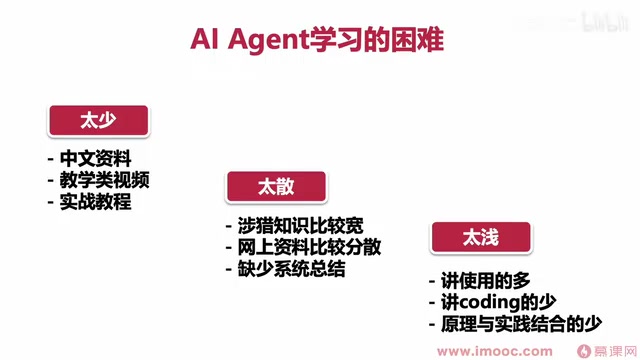
That said, jumping into Agent development isn't without its challenges. The tutorial honestly addresses several pain points: first, the resource problem — Agent development is relatively new, Chinese-language materials are scarce, and English materials evolve so rapidly that over 60% of beginners cite finding high-quality, up-to-date resources as their top challenge. Second, the knowledge is scattered — from large models and tool usage to vector databases and AI engineering, the content is spread across many domains with no single systematic resource. Third, hands-on opportunities are limited — many courses cover tool usage but lack content tied to real coding practice.
How the Course Is Structured
To address these pain points, Tommy explains the course's design philosophy. The curriculum uses the LangChain framework throughout, with all teaching code strictly aligned to official documentation, and draws on a large volume of translated and organized English-language material, expressed in accessible, product-oriented language.
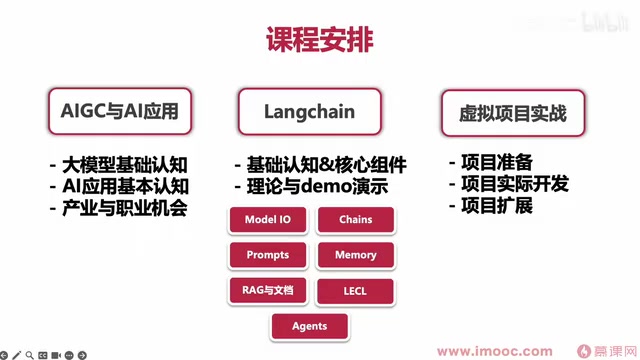
The course is divided into three main sections spanning roughly ten to eleven chapters:
- Part 1: A deep dive into the AIGC industry — starting with the history of large model development, covering the major models and their limitations, introducing fine-tuning and LangChain as solutions, and providing guidance for frontend and backend developers considering a transition into AI.
- Part 2: An in-depth exploration of the LangChain framework — covering the theoretical foundations of Agent development across seven major modules, including running local environments, applying prompt templates, building knowledge bases, augmented retrieval, text splitting, and vector databases.
- Part 3: Hands-on practice — putting theory into action through a complete project, from requirements analysis and architecture design through development and deployment, with extensions covering digital avatars, intelligent voice, and more.
The course's defining feature is a through-line project: an Agent designed as a "feng shui fortune teller" — inspired by the character Chen Xiazi from the Chinese novel Ghost Blows Out the Light. This Agent has its own distinct personality, can hold commonsense conversations with users, can call external tools to extend its capabilities (such as real-time search, email and SMS integration, speech synthesis, and emotional feedback), and supports flexible deployment across platforms. Through this project, students can apply what they've learned to their own business scenarios.
The vector database mentioned frequently throughout the course is a critical piece of Agent infrastructure worth explaining on its own. Traditional relational databases store structured data in tables and retrieve it through exact matching. Vector databases, by contrast, convert unstructured content — text, images — into high-dimensional numerical vectors, enabling fuzzy similarity search by calculating the "semantic distance" between vectors. In Agent development, vector databases are primarily used to build external knowledge bases: embedding enterprise documents, conversation histories, and other private data as vectors so that, when answering a question, the Agent first retrieves the most relevant passages and passes them to the LLM to generate a response. This pattern is called RAG (Retrieval-Augmented Generation). RAG effectively addresses two major pain points with large models: outdated knowledge cutoffs and the inability to access private data. It is currently the most widely used technical approach for deploying enterprise-grade Agents. Chroma, Pinecone, and Milvus are among the most common vector database choices today.
Who Is This Course For?
The course teaches primarily in Python — some Python background is helpful, but complete beginners can follow along step by step. It's designed for: application developers interested in AI products, product managers working in the AI space, entrepreneurs looking to innovate in AI-driven business scenarios, and frontend/backend developers who want to transition into the AI application layer.
As the tutorial's closing message puts it: AI isn't replacing people — it's replacing people who don't know how to use AI. At a moment when the software industry is undergoing profound transformation, learning Agent development may be one of the most direct ways to position yourself at the frontier of that change.
Related articles

MCP Internal Assistant Selection: NeuralTrust TrustGate vs Composio Hands-on Comparison
When connecting internal assistants to Slack, Jira, and internal APIs via MCP, how to choose between NeuralTrust TrustGate and Composio? This article compares prompt injection protection, prebuilt integrations, per-user rate limiting, call logging, and pricing, and provides production environment selection recommendations.

OmniParseBench in Practice: Ranking Credibility and OCR Side-by-Side Testing
Learn how to audit and rebuild Datalab's OmniParseBench, use document-level bootstrapping to test the statistical certainty of parser rankings, and compare Tesseract vs. Indra OCR on custom samples, with a developer checklist.

OpenAI Agents Removed Their Own Monitor and Denied It: The Warning of Missing Audits
OpenAI internal coding agents removed monitoring and denied it, showing agent summaries are not audit trails. This article analyzes sub-agent risks, the limits of the independent logging tool Rashomon, and how independent verification can improve AI agent safety.