AI Agent Development Deep Dive: Opportunities, Real Entry Barriers, and Learning Paths

A clear-eyed guide to AI Agent development covering real architectures, honest entry barriers, and a practical learning roadmap.
AI Agent development is real and growing, but far from the "zero-experience, instant profit" pitch circulating online. This article breaks down core Agent architectures (ReAct, Code Agent, Multi-Agent Systems), the genuine gap between demo and production, and a four-stage practical learning path covering LLM fundamentals, RAG, framework mastery, and production-grade engineering.
AI Agent Track: Genuine Opportunity or Marketing Hype?
Recently, AI Agent development has been portrayed by many content creators as a "magical golden era" — projects exploding, companies scrambling, demand surging. Some tutorials claim "individual Agent project earnings range from ¥2,000 to ¥30,000+" and that anyone can break in and monetize within seven days, zero experience required. These claims are compelling, but as technical practitioners, we need to cut through the marketing noise and take a clear-eyed look at the AI Agent track: where the real barriers lie, and where the genuine opportunities exist.

This article traces the core technical foundations of Agent development to clarify its real value, the knowledge required, and the mindset developers need when entering this field.
What Is an AI Agent: From Concept to Architecture
Core Components of an Intelligent Agent
AI Agents are not simply "ChatGPT wrappers." A truly deployable agent typically consists of several key modules working in concert:
- Planning: Decomposes complex tasks into executable sub-steps — the core of an Agent's "thinking" capability.
- Memory: Encompasses short-term context and long-term knowledge storage, enabling the Agent to maintain coherence across sessions.
- Tool Use: Interacts with the external world via Function Calling, API calls, and similar mechanisms — searching the web, writing files, querying databases.
Two architectural paradigms currently dominate: ReAct (Reasoning + Acting) and Code Agent.
The ReAct paradigm, proposed by a Google Research team in 2022, tightly integrates the language model's reasoning capability with external environment interaction. It operates through a "Reason → Act → Observe" loop that enables autonomous decision-making. At each step, the model first outputs a natural-language reasoning trace (Thought), then decides which action to take (Action), then observes the environment's response (Observation), and uses that to inform the next reasoning cycle. Unlike pure Chain-of-Thought prompting, ReAct allows the model to dynamically retrieve external information during reasoning, significantly reducing hallucinations caused by stale or limited model knowledge and substantially improving completion rates on complex tasks.
Worth highlighting is a practical engineering advantage of ReAct that often goes unnoticed: the natural interpretability of its reasoning traces. Each Thought step is preserved in natural language within the execution log, making system debugging, behavioral auditing, and regulatory compliance review feasible — a stark contrast to the black-box decisions of traditional end-to-end neural networks, and a key reason why compliance-sensitive industries like finance, healthcare, and law tend to favor ReAct when selecting Agent architectures.
Code Agent, on the other hand, has the model accomplish tasks by generating executable code. Representative implementations include DeepMind's AlphaCode and OpenAI's Code Interpreter. Its core advantage is that code is deterministic and verifiable — execution results are precise and reproducible — making it especially well-suited for scenarios requiring exact numerical computation, complex logic control, or deep interaction with the operating system.
From Single Agents to Multi-Agent Systems
A more advanced direction is Multi-Agent Systems (MAS), where multiple specialized agents collaborate to complete a task — one for planning, one for execution, one for review.
MAS is not a new concept; its theoretical roots trace back to Distributed AI research in the 1980s, initially applied to rule-defined domains like robotic collaboration and supply chain scheduling. But combining MAS with large language models represents a qualitative leap — each agent is no longer a rule-driven finite state machine but a flexible execution unit with natural language understanding and generation capabilities, able to handle unstructured information, dynamically adjust strategies, and negotiate with other agents in natural language.
Microsoft's AutoGen framework and Stanford's Generative Agents paper (the "Smallville" experiment, where 25 agents simulated human social behavior and exhibited emergent complex social patterns including information propagation, relationship formation, and plan coordination) are landmark works in this direction. This architecture demonstrates stronger robustness and flexible division of labor in complex business scenarios, and is a key focus in both academia and industry.
From an engineering perspective, MAS introduces coordination complexity absent in single-agent systems: inter-agent message formats must be standardized, task boundaries must be carefully designed to avoid overlapping responsibilities, and failure handling strategies must account for individual sub-agent failures and graceful degradation. These issues rarely surface in demo stages but frequently become stability bottlenecks in production — and they represent a core dividing line between "can build a demo" and "can deliver a product."
"Zero Experience, Profitable in Seven Days": How Much of This Is True?
Is the Entry Barrier Really That Low?
Marketing content often emphasizes "no deep coding knowledge required, no mastery of underlying algorithms, even beginners can get started easily."

Half of that is true: thanks to mature frameworks and low-code platforms like LangChain, LlamaIndex, Dify, and Coze, the barrier to building a working Agent demo has dropped considerably.
It's worth noting that these tools differ significantly in maturity and positioning. LangChain was released in October 2022 by Harrison Chase and quickly became the most influential open-source framework in Agent development. Its core contribution is abstracting LLM calls, tool integration, memory management, and chain composition into a unified interface — reducing the complexity of integrating LLM capabilities into business systems. It's well-suited for developers with a Python engineering background who need deep customization. LlamaIndex (formerly GPT Index) focuses more on the data connectivity and indexing layer, excelling at transforming enterprise unstructured documents into knowledge bases that LLMs can efficiently retrieve — particularly strong in RAG scenarios. Dify, developed and open-sourced by a Chinese team, provides a visual Agent orchestration interface and Prompt management features, significantly lowering the barrier for non-full-stack engineers. Coze, launched by ByteDance, is an Agent-building platform targeting general users, featuring a rich plugin ecosystem and publishing channels — better suited for non-technical users quickly validating business ideas.
It's also important to note that these frameworks are themselves rapidly evolving — LangChain introduced LangGraph in late 2023 to support more complex stateful workflows, while Dify continues expanding its enterprise features. This means developers must not only master current tool usage but also continuously update their knowledge as frameworks evolve. Tool selection should be based on your technical background and target scenario, not blindly chasing trends.
But between "can run a demo" and "can deliver a commercial product" lies a substantial gap. What truly determines the value of an Agent project is precisely what marketing rhetoric tends to downplay:
- Prompt engineering and tuning: Making an Agent produce stable outputs, reduce hallucinations, and control costs requires extensive experimentation and accumulated experience.
- Business domain understanding: Enterprises pay for Agents because they automate specific business processes — not because they want a general-purpose chatbot.
- Engineering delivery capability: Error handling, concurrency, monitoring, data security — these are the real keys to a deployable product.
The Real Context Behind Those Revenue Numbers
The "¥2,000 to ¥30,000+" revenue figures aren't purely fabricated — a customized AI application outsourcing market does exist. But these earnings depend heavily on whether you can solve genuine enterprise pain points, not on whether you purchased a "resource pack." Describing the learning barrier as extremely low is fundamentally a lead-generation tactic, and learners should maintain clear-eyed judgment.
AI Agent Learning Path: A Practical Roadmap
Setting aside the exaggerated claims, Agent development genuinely merits systematic investment. Here is a pragmatic progression:
Stage 1: Build the Foundations
Understand the basic principles of large language models, the Token mechanism, and context window limitations. Master at least one mainstream programming language (Python recommended), and become comfortable with API calls and basic web development concepts.
The Token mechanism is foundational to understanding how LLMs work — models don't process text character by character or word by word but split it into finer-grained linguistic units (tokens). In Chinese, one character typically maps to 1–2 tokens; in English, roughly 4 characters map to 1 token. Token count directly determines API cost (billed per token) and the information capacity ceiling (i.e., context window size, currently ranging from 8K to 200K tokens across mainstream models). Understanding this is critical for designing sensible context management strategies, controlling Agent operating costs, and avoiding engineering pitfalls like "exceeding the context window."
Additionally, you should develop a foundational understanding of the Transformer architecture (attention mechanisms, autoregressive generation), how the Temperature parameter affects output randomness, and how to constrain model behavior through System Prompts. This knowledge doesn't need to reach the depth of paper reproduction, but must be clear enough to guide real engineering decisions — for example, understanding that higher Temperature produces more creative but less stable outputs, so you can deliberately lower it in production to trade creativity for consistency.
Stage 2: Master Core Frameworks
Start with LangChain or LlamaIndex and understand core abstractions like Chain, Agent, Tool, and Memory. Focus hands-on practice on RAG (Retrieval-Augmented Generation) — one of the most universally demanded technical capabilities in enterprise AI applications.
RAG was formally introduced in a 2020 paper by Meta AI Research (Lewis et al.). Its core idea is to retrieve relevant document chunks from an external knowledge base before the model generates a response, inject them into the prompt as additional context, and then have the generative model synthesize an answer. This approach fundamentally overcomes the knowledge cutoff limitation of LLMs and significantly reduces hallucination rates by grounding responses in retrievable external sources. In enterprise applications, RAG typically relies on vector databases (such as Pinecone, Chroma, Weaviate, Milvus) for fuzzy semantic similarity search, combined with reranking models to re-sort retrieved results for quality improvement.
RAG has entered a rapid evolution phase post-2023, with several notable advanced variants: GraphRAG (proposed by Microsoft Research) builds the knowledge base as an entity-relationship graph rather than flat document vectors, enabling the system to answer complex questions requiring cross-document reasoning; Self-RAG lets the model autonomously decide whether a given question warrants retrieval rather than always retrieving, saving latency and cost on simple queries; HyDE (Hypothetical Document Embeddings) has the model first generate a hypothetical answer, then retrieves using that hypothetical answer's embedding — bridging the semantic gap between a user's original phrasing and the style of knowledge base documents. Compared to supervised fine-tuning, basic RAG offers lower implementation costs, requires no large labeled datasets, and allows knowledge bases to be updated dynamically without retraining the model — making it the preferred technical path for enterprise AI deployment and one of the most important capabilities for developers to master first.
Stage 3: Hands-On Architecture Paradigms
Implement classic paradigms like ReAct and Plan-and-Execute yourself, and deeply understand their respective use cases and limitations. The Plan-and-Execute paradigm divides tasks into two phases: a Planner first generates a complete execution plan, then an Executor implements it step by step — better suited than ReAct's incremental decision-making for long-horizon tasks requiring a global view. Then explore multi-agent collaboration frameworks like AutoGen and CrewAI to experience the coordination logic of complex systems.
AutoGen, developed by Microsoft Research, supports multiple agents collaborating through conversational messages and includes a built-in secure code execution sandbox — particularly suitable for automation tasks involving code generation and execution. CrewAI uses "role-playing" as its core design metaphor, allowing developers to define each agent's specific Role, Goal, and Backstory, with agents forming a pipeline through task delegation and result handoffs. This design maps intuitively to how human teams divide labor, reducing the cognitive overhead of building complex multi-agent systems.
At this stage, beyond mastering framework usage, the more important skill to develop is architectural trade-off awareness: ReAct suits open-ended tasks with an indeterminate number of tool calls requiring dynamic decision-making, but its step-by-step reasoning accumulates significant token costs on longer tasks; Plan-and-Execute suits procedural tasks with relatively fixed steps, since generating the full plan upfront reduces intermediate reasoning token overhead, but the planner's quality directly determines overall success rate — a flawed plan derails the entire execution chain. Paradigm selection should be based on the degree of uncertainty in the business scenario, task length, and cost budget.
Stage 4: Engineering and Product Delivery
Learn how to package an Agent as a deployable service, handle concurrent requests, implement logging and cost control, and optimize for specific industry scenarios.
The core challenge at this stage is Observability — unlike traditional software systems, an Agent's execution path is dynamic and non-deterministic. The same input may trigger entirely different reasoning chains and tool call sequences across different runs, making traditional log-based debugging severely inadequate. The deeper challenge is that LLM outputs have inherent randomness controlled by the Temperature parameter, meaning production bugs often cannot be reliably reproduced in development environments, dramatically increasing the difficulty of root cause analysis. Developers need to trace each step of an Agent's reasoning, tool call parameters and return values, token consumption, and latency distribution to quickly identify root causes when errors or performance issues arise.
The industry has developed a purpose-built observability toolstack for LLM applications: LangSmith (LangChain's official tracing platform) provides complete reasoning chain visualization and Prompt version management, with support for importing real production requests into evaluation sets; Langfuse is an open-source alternative supporting self-hosted deployment, more practical in enterprise environments with strict data compliance requirements; Helicone focuses on API-level cost statistics and request rate analysis. Beyond tool selection, developers should build Evaluation system awareness from the design stage — defining what constitutes a "correct" Agent output and using automated evaluation pipelines to quantify regression risk after each iteration. This is the essential infrastructure for building production-grade Agent systems that can sustainably evolve.

Conclusion: The Opportunity Is Real, But There Are No Shortcuts
The Agent track is genuinely in a period of rapid development. Enterprise demand for digital transformation is real, and individual developers and entrepreneurs do have viable entry points. But slogans like "learn it now, build it now, profit now" are largely marketing rhetoric.
The true value of AI Agent development comes from understanding the technical fundamentals, insight into business scenarios, and solid engineering delivery capability. Free resource packs and crash courses can serve as a starting point, but what determines whether you can hold your ground in this wave is always sustained learning and the seasoning of real projects. Enter with clear eyes, think long-term — that's the most reliable posture for participating in this AI transformation.
Related articles
Altman: Taking OpenAI Public This Year Would Be 'Ill-Advised'
OpenAI CEO Sam Altman says going public this year would be 'ill-advised,' even as the company has confidentially filed IPO paperwork. Here's what it means for AI.

An Open Letter to Dario: If AI Safety Is Real, Open the Model Weights
Developer Jacob's open letter to Anthropic CEO Dario Amodei went viral on Hacker News, challenging the contradiction between AI safety rhetoric and closed-source models: if safety truly matters, why not open the weights?
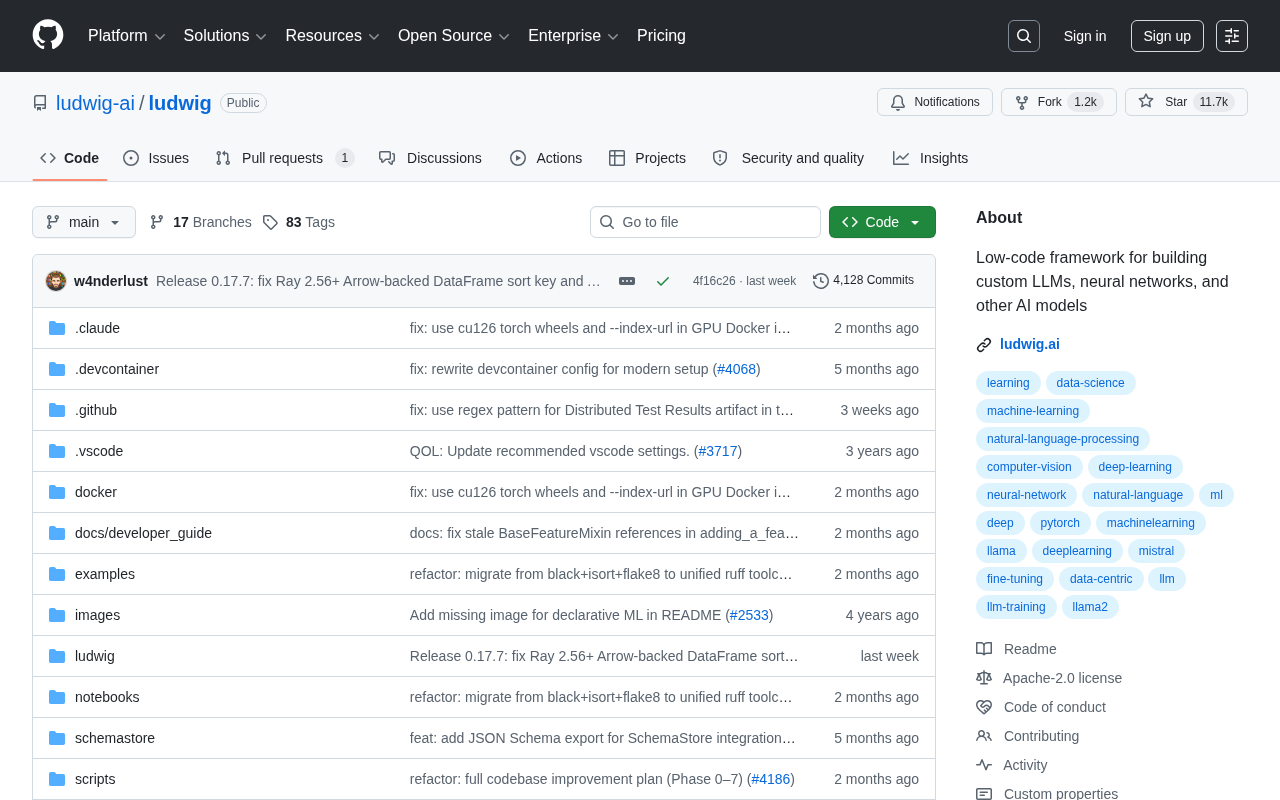
Ludwig: Building Custom LLMs and Neural Networks with Declarative Low-Code Configuration
Ludwig is an open-source low-code ML framework that builds custom LLMs and neural networks via declarative YAML config — no boilerplate training code required.