AI Agent Development for Absolute Beginners: Complete Knowledge Framework & Learning Path

A complete beginner's guide to AI Agent development, from LLM fundamentals to multi-agent systems.
This article provides a systematic learning path for AI Agent development, covering LLM fundamentals, Prompt Engineering, RAG knowledge base retrieval, LangChain/LangGraph frameworks, task automation Agents, model fine-tuning, and multi-agent collaboration. Designed for zero-experience developers, it establishes a progressive curriculum to build comprehensive understanding and avoid common pitfalls.
Introduction: Why You Should Learn AI Agent Development Now
AI Agents are becoming the core paradigm for putting large language models into production. Unlike simple conversational AI, Agents can autonomously plan tasks, invoke tools, retrieve knowledge, and execute complex workflows—serving as the critical bridge between LLM capabilities and real business scenarios.
From a technology evolution perspective, since 2023, large models have rapidly evolved from "able to chat" to "able to act." OpenAI's Function Calling, Google's Gemini Agent, and the various Agent frameworks emerging from the open-source community are all driving this trend. The industry consensus is clear: Future AI applications won't be simple Q&A interfaces, but intelligent systems capable of autonomously completing complex workflows. This means mastering Agent development has shifted from a "nice-to-have" to a "must-have" skill for AI engineers.
This article is based on a widely popular AI Agent beginner tutorial series on Bilibili, distilling a complete learning path. Whether you want to build a Q&A agent, a task automation agent, or a private knowledge base chatbot, understanding this knowledge framework will help you avoid common pitfalls and quickly build systematic understanding.
The Complete Knowledge Map for AI Agent Development
Agent development isn't a single technology—it's a combination of an entire skill stack. Based on the tutorial's content structure, a complete learning path should cover the following modules: LLM fundamentals, Prompt Engineering, Agent architecture, RAG (Retrieval-Augmented Generation), development frameworks like LangChain/LangGraph, model fine-tuning, and multi-agent collaboration and orchestration logic.
The design logic of this path is "progressive, building layer by layer." Beginners often fall into the trap of jumping straight into complex frameworks without understanding the underlying principles. The correct sequence should be to first solidify LLM and prompt engineering fundamentals, then gradually transition to engineering-grade Agent construction. This is similar to learning web development—first understanding HTTP protocols and HTML/CSS/JS basics before using frameworks like React/Vue. Skipping the fundamentals and jumping straight to frameworks might seem fast on the surface, but when problems arise, you'll have no idea how to troubleshoot.
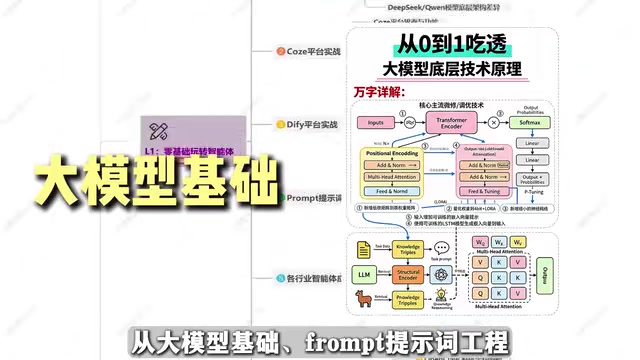
LLM Fundamentals & Prompt Engineering
All Agent capabilities originate from large language models. Understanding the model's input/output mechanisms, context windows, token pricing, and other foundational concepts is a prerequisite for everything that follows.
The core working principle of large language models is autoregressive text generation based on the Transformer architecture. Simply put, the model receives a text input (prompt), then predicts the next most likely token one at a time until a complete response is generated. A "token" is the basic unit the model uses to process text—in Chinese, roughly 1.5-2 characters correspond to one token, while in English, approximately 4 characters equal one token. Understanding the token mechanism is crucial because it directly affects API call costs and context window limitations.
Context Window is the maximum text length a model can "see" at once. GPT-4 Turbo supports 128K tokens, Claude 3.5 supports 200K tokens, and domestic models like DeepSeekAd and Qwen are continuously expanding their windows. The context window size determines how much reference material, conversation history, and instructions you can feed the model—directly impacting the Agent's "memory" and its ability to handle complex tasks. When conversations exceed the window limit, earlier information gets truncated, which is why Agent development requires dedicated memory management mechanisms.
Prompt Engineering is the most direct and lowest-cost method for tuning model capabilities. Through carefully designed instructions, examples (few-shot), and role assignments, you can significantly improve output quality without modifying the model itself. This step may seem simple, but it's actually the first checkpoint for Agent behavior controllability.
Several core techniques in Prompt Engineering are worth understanding deeply:
- Zero-shot Prompting: No examples provided—just a task description, relying on the model's general capabilities to complete the task. Suitable for simple, clear instructions.
- Few-shot Prompting: Providing 2-5 input-output examples in the prompt, letting the model understand the expected output format and style through "pattern matching." This is especially effective for formatted outputs (JSON, tables, etc.).
- Chain-of-Thought (CoT): Guiding the model to "think step by step," breaking complex reasoning into intermediate steps. Research shows that adding phrases like "Let's think step by step" can significantly improve model performance on math and logical reasoning tasks.
- Role Prompting: Setting an identity for the model through System Prompt (e.g., "You are a senior Python developer"), guiding the model to respond from a specific professional perspective and language style.
In Agent development, prompts are used not only for generating responses but also for controlling the Agent's decision-making behavior—such as when to call tools, how to format tool call parameters, and how to determine if a task is complete. Therefore, Prompt Engineering is the "programming language" for the Agent's "brain."
RAG: Retrieval-Augmented Generation & Private Knowledge Base Construction
Relying solely on an LLM's "memory" has two major problems: outdated knowledge and hallucination. RAG (Retrieval-Augmented Generation) retrieves from external knowledge bases before generation, enabling the Agent to answer based on real, up-to-date information.
Hallucination is an inherent flaw of large models. Since models are essentially doing probability prediction rather than "truly understanding" knowledge, they will confidently generate content that appears correct but is completely fabricated—inventing non-existent paper citations, making up company policies, or providing incorrect data. In enterprise applications, this unreliability is fatal. RAG uses a "retrieve first, then generate" approach, ensuring the model's answers are evidence-based, significantly reducing hallucination rates.

Building an intelligent retrieval Agent typically requires completing the following technical pipeline:
1. Document Chunking: Splitting long documents into appropriately sized text chunks. The chunking strategy directly affects retrieval quality—chunks too large reduce precision (mixing in irrelevant information), while chunks too small lose contextual semantics. Common strategies include fixed-length splitting (e.g., 512 tokens), semantic paragraph splitting, and recursive character splitting. In practice, setting appropriate overlap (typically 50-100 tokens) prevents critical information from being cut off.
2. Embedding (Vectorization): Converting text chunks into high-dimensional mathematical vectors (typically 768 or 1536 dimensions). The core idea is mapping semantically similar texts to nearby positions in vector space. Mainstream embedding models include OpenAI's text-embedding-3-small/large, the open-source BGE series, and proprietary models from various providers. When choosing an embedding model, consider: language support, vector dimensions, retrieval accuracy, and inference cost.
3. Vector Database Storage: Storing generated vectors and their corresponding text in a specialized database. Current mainstream vector databases include: Pinecone (cloud-hosted, easy to start), Milvus (open-source, suitable for large-scale deployment), Chroma (lightweight, ideal for prototyping), Weaviate (supports hybrid search), and FAISS (Meta's open-source vector index library, suitable for embedding into applications). The choice depends on data scale, deployment method, and performance requirements.
4. Similarity Search: When a user asks a question, the query is first vectorized, then the most similar text chunks are found in the vector database (typically Top-K, such as Top-3 or Top-5). Common similarity metrics include Cosine Similarity and Dot Product.
5. Context Injection & Generation: The retrieved text chunks are injected as context into the prompt, sent along with the user's question to the LLM to generate the final answer.
This is also the most common production scenario in enterprise applications—private knowledge base chatbots are built on exactly this pipeline. Mastering RAG means you can make Agents "understand" internal company documents, product manuals, or professional materials. It's worth noting that RAG's actual effectiveness is highly dependent on chunking strategy and retrieval quality. In practice, optimizations like reranking, query rewriting, and hybrid retrieval (combining keyword search with semantic search) are commonly employed.
Engineering Implementation: Development Frameworks & Task Automation
With foundational capabilities and knowledge retrieval in place, the next step is organizing these capabilities into runnable applications. The core of this stage is choosing the right development framework and implementing task automation.
LangChain & LangGraph Framework in Practice
LangChain is currently one of the most mainstream AI Agent development frameworks. It abstracts components like LLM calls, tool invocation, memory management, and retrieval pipelines into composable modules, significantly lowering the development barrier.
LangChain's core design philosophy is "composition over inheritance." It abstracts common components in Agent development into several core concepts:
- Model (Model Layer): Unified wrapper for different LLM API calls (OpenAI, Anthropic, local models, etc.), allowing model switching with a single line of code.
- Prompt Template: Parameterizes prompts with support for dynamic variable injection, enabling reuse and management.
- Chain: Connects multiple processing steps into a pipeline, such as "format input → call model → parse output."
- Tool: Wraps external capabilities (search engines, calculators, database queries, API calls) into functions callable by the model.
- Memory: Manages conversation history and context state, supporting multiple memory strategies (full history, summary memory, sliding window, etc.).
- Agent: Integrates all the above components, enabling the model to autonomously decide which tools to call and in what order.
LangGraph further introduces graph-structured workflow orchestration capabilities, making complex multi-step Agent logic with loops and conditional branches controllable and visualizable. LangGraph's core concept is a "stateful directed graph"—each node represents a processing step (e.g., call model, execute tool, check condition), and edges define execution flow, which can include conditional logic for branching and looping. This graph structure is particularly suitable for Agents that require iteration, retries, human-in-the-loop confirmation, and other complex workflows. For example, a code generation Agent's flow might be: "generate code → run tests → if failed, return to code modification node → until tests pass"—this kind of loop logic can be expressed very naturally in LangGraph.
For developers, the value of mastering such frameworks lies in "not reinventing the wheel." Tool invocation and state management that would otherwise require extensive boilerplate code can be rapidly prototyped through frameworks. At the same time, it's important to note that while frameworks lower the entry barrier, over-reliance on frameworks without understanding the underlying mechanisms (such as Function Calling's JSON Schema format or streaming response handling from model APIs) will leave you helpless when encountering scenarios the framework doesn't support.
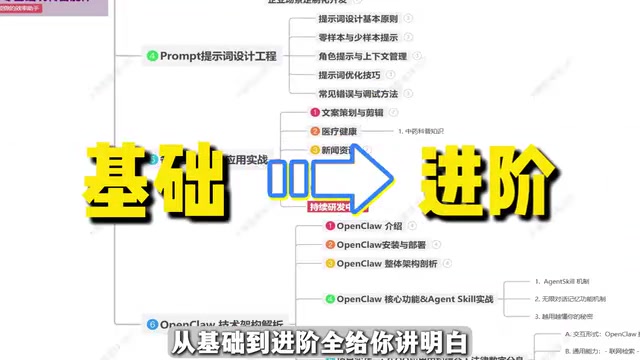
Building Logic for Task Automation Agents
Task automation Agents represent the most productivity-valuable application direction of Agent technology. They can autonomously decompose tasks based on user goals, invoke different tools (such as search, code execution, API calls), evaluate results, and iterate until the objective is achieved.
The core operating mechanism of task-oriented Agents typically follows the "ReAct" (Reasoning + Acting) paradigm or its variants. The basic loop is:
- Reasoning: Analyze the current state and goal, decide what to do next
- Acting: Invoke the selected tool or execute an operation
- Observation: Receive the tool's returned results
- Reflection & Iteration: Evaluate whether the results satisfy the goal; if not complete, return to step 1
This loop continues running until the Agent determines the task is complete, reaches the maximum iteration count, or encounters an unrecoverable error.
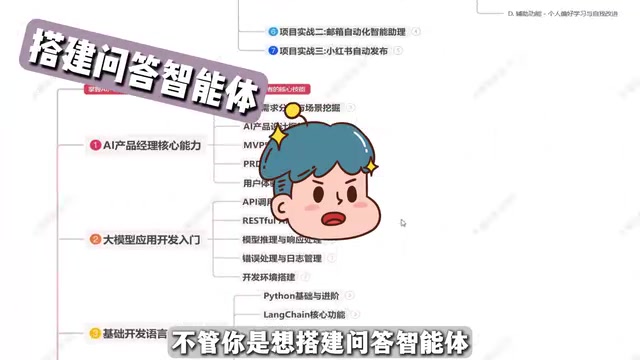
From simple auto-replies and data organization to complex automated workflow orchestration, task-oriented Agents are reshaping how many repetitive tasks are executed. Understanding the Agent's orchestration logic—when to call tools, how to determine task completion, how to handle error retries—is key to building reliable automation systems.
In real-world engineering, reliable automation Agents also need to consider: Cost control (every tool call and model inference has a cost—set reasonable iteration limits), Safety boundaries (Agents shouldn't execute destructive operations—implement permission controls and human confirmation mechanisms), Observability (log every decision and tool call for debugging and auditing), and Graceful degradation (when an Agent can't complete a task, how to inform the user and provide alternatives).
Advanced Topics: Model Fine-tuning & Multi-Agent Collaboration
When general capabilities can't meet specific domain requirements, model fine-tuning becomes necessary. By training on specific datasets, you can make models better align with professional scenarios' language styles and knowledge requirements. However, fine-tuning costs are relatively high, and it's generally recommended only after prompt engineering and RAG prove insufficient.
Current technical paths for model fine-tuning mainly include: Full Fine-tuning (extremely high computational cost, typically requiring multiple high-end GPUs), LoRA/QLoRA (low-rank adaptation, training only a small number of parameters, significantly reducing VRAM and compute requirements—currently the most mainstream fine-tuning approach), and lightweight methods like Prefix Tuning/P-tuning. For most developers, fine-tuning 7B-13B parameter models on consumer GPUs (like RTX 4090) using QLoRA is the most practical choice. Data quality matters far more than quantity—typically a few hundred to a few thousand high-quality instruction-response pairs can produce noticeable improvements.
When to choose fine-tuning over RAG? They solve problems at different levels. RAG solves the "knowledge access" problem—letting models access information they don't know; fine-tuning solves the "capability adaptation" problem—making models speak in specific ways, follow specific format conventions, or master domain-specific reasoning patterns. For example, answering company product questions is better suited for RAG; but generating contract clauses in legal document format and terminology might be more effective with fine-tuning.
Multi-Agent collaboration represents a more advanced architectural approach. Complex tasks are divided among multiple specialized Agents—for example, one responsible for planning, one for retrieval, one for execution, and one for review—completing complex work through collaboration and orchestration that a single Agent couldn't handle alone. This "division of labor" pattern is becoming an important paradigm for building powerful AI systems.
Mainstream architecture patterns for multi-agent systems include:
- Hierarchical: A "manager" Agent handles task decomposition and scheduling, assigning subtasks to "executor" Agents. Similar to a company's hierarchical management structure. The AutoGen framework adopts this pattern.
- Collaborative: Multiple Agents participate equally in discussion and decision-making, reaching consensus through "conversation." CrewAI supports this pattern, allowing Agents to question, challenge, and supplement each other.
- Competitive: Multiple Agents independently generate solutions, with a judge Agent selecting the best result. Suitable for creative tasks requiring multi-angle exploration.
- Pipeline: Agents process sequentially in a fixed order, with each Agent's output serving as the next Agent's input. Suitable for workflows with clearly defined stages.
Current mainstream multi-agent frameworks include Microsoft's AutoGen (emphasizing conversation-driven collaboration), CrewAI (emphasizing role division and process orchestration), and LangGraph itself (orchestrating multiple Agent nodes through graph structures). Which architecture to choose depends on task complexity, inter-Agent dependencies, and requirements for determinism and controllability.
Learning Recommendations & Path Summary for AI Agent Development
For absolute beginners, follow the progressive path of "Fundamentals → Retrieval → Frameworks → Advanced"—avoid jumping straight to complex multi-agent systems. Each stage should be accompanied by hands-on practice, starting from building your first simple Agent and gradually adding RAG, tool calling, and other capabilities.
Specific milestone-based learning checkpoints:
- Week 1: Familiarize yourself with LLM API calls; be able to interact with GPT/Claude/DeepSeek models through Python scripts
- Week 2: Master core Prompt Engineering techniques; be able to control model output format and behavior through System Prompts
- Weeks 3-4: Build a complete RAG system; be able to perform Q&A on local PDFs/documents
- Weeks 5-6: Build Agents with tool calling using LangChain/LangGraph; implement search + code execution capabilities
- Week 7 onward: Experiment with multi-Agent collaboration, or fine-tune models for specific scenarios
Key takeaways from this knowledge framework:
- Build a solid foundation: LLM principles and Prompt Engineering are the bedrock of all Agent capabilities.
- RAG is essential: Nearly all enterprise-grade Agent applications depend on knowledge base retrieval.
- Leverage frameworks wisely: LangChain/LangGraph let you focus on business logic rather than low-level implementation.
- Progress step by step: From single Agent to multi-Agent, from simple Q&A to automated tasks—level up gradually.
AI Agent development has a clear learning path but also requires continuous hands-on practice. Thoroughly understand the principles of each module, then connect them through projects—only then can you truly progress from "knowing how to call APIs" to "knowing how to design systems." This field is still evolving rapidly—new frameworks, new model capabilities, and new architecture patterns keep emerging. While staying current with learning, building your own knowledge framework is what maintains competitiveness amid change.
Related articles

Chain of Thought Isn't Just for AI: How Humans Can Use CoT to Improve Thinking Quality
Chain of Thought isn't just a prompt trick for large models. Starting from a Hacker News discussion, this article analyzes why CoT works for human thinking too, breaks down actionable ways to transfer it, and highlights the key differences between human CoT and machine CoT.
Cloudflare Teams Up with OpenAI: Closi…
Cloudflare Teams Up with OpenAI: Closing the Loop from Vulnerability Discovery to Defense with AI
Cloudflare uses OpenAI Daybreak to investigate security vulnerabilities and generate reviewable remediation plans, while developers use Codex to boost coding efficiency and quality.

Orca Multi-Agent Orchestration in Practice: A Guide to Parallel Collaboration with Claude and Codex
Orca is Stable AI's free open-source agent workbench supporting 34 agents like Claude Code and Codex in parallel. Learn its Git worktree isolation, multi-model orchestration, and mobile management.