AI Agent Development for Beginners: A Three-Phase Learning Roadmap

A practical three-phase roadmap to go from zero to building production-ready AI Agents.
This article outlines a structured three-phase learning roadmap for AI Agent development. Phase 1 builds Python and LLM fundamentals. Phase 2 covers the five core Agent capabilities — planning, tool use, memory, reflection, and context optimization — using LangChain and LangGraph. Phase 3 applies everything through hands-on RAG knowledge base projects for real-world deployment.
Why Do Some Developers Ship AI Agent Projects Fast While Others Keep Stumbling?
As large language models continue to mature, AI Agents have become one of the hottest technical directions today. More and more developers and career-switchers want to break into the AI space by mastering Agent development. But a common frustration persists: given the same amount of time invested, why do some people quickly build production-ready projects while others keep hitting walls and wasting energy?
The problem usually isn't intelligence or effort — it's the lack of a well-planned learning path. Without a clear roadmap, it's easy to fall into traps: blindly learning framework APIs, skipping foundational concepts, or diving straight into complex projects. This article lays out a systematic, zero-to-one learning roadmap for Agent development to help beginners avoid the most common pitfalls.
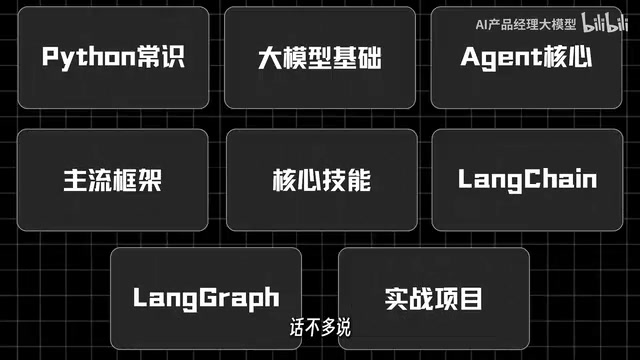
Phase 1: Build a Solid Foundation
Python and Large Language Model Basics
Every AI Agent project is built on solid programming skills. The core focus of this phase is Python fundamentals — you don't need to become an algorithm expert, but you should be comfortable with functions, classes, async programming, and common data structures, since virtually all mainstream Agent frameworks are Python-based.
You also need to understand core LLM concepts: how large language models work, the token mechanism, context window limitations, and how prompts influence output quality. These concepts may seem basic, but they form the underlying logic behind every Agent capability you'll design later.
Large language models (LLMs) are essentially deep neural networks based on the Transformer architecture. They learn statistical patterns in language through autoregressive pretraining on massive text datasets. Tokens are the basic units LLMs use to process text — typically corresponding to a word or word fragment (in Chinese, roughly 1–2 tokens per character). The context window determines the maximum number of tokens a model can "see" in a single pass, which directly affects an Agent's ability to handle long documents and multi-turn conversations — for example, GPT-4 has a 128K token context window, while early models were limited to just 4K. Understanding how tokens are billed and how context limits work is a critical prerequisite for avoiding issues like input truncation or runaway costs in Agent development.
Get Comfortable with Core Agent Terminology and Characteristics
Before writing any code, it's essential to understand the core characteristics of Agents. Unlike simply calling an LLM API, an Agent is autonomous — it can perceive its environment, reason about it, call tools, and continuously adjust its behavior based on feedback.
An AI Agent's autonomy stems from its core reasoning framework — the most representative of which is the ReAct (Reasoning + Acting) paradigm. ReAct has the model perform chain-of-thought reasoning before taking action, creating a closed-loop cycle of "think → act → observe." Unlike traditional fixed-script workflows, Agents can dynamically adjust their next step based on what tools return, giving them the ability to handle open-ended tasks. Early open-source projects like BabyAGI and AutoGPT validated the feasibility of Agents autonomously decomposing goals, accelerating the rapid evolution of the entire Agent engineering ecosystem. Understanding this underlying mechanism helps developers quickly identify the root cause of "why did the Agent go off track" during debugging.
You should also get an early sense of the positioning differences between mainstream frameworks: LangChain leans toward rapid prototyping, while LangGraph is better suited for complex state-flow control. The stronger your foundation, the smoother your path to real enterprise deployment.
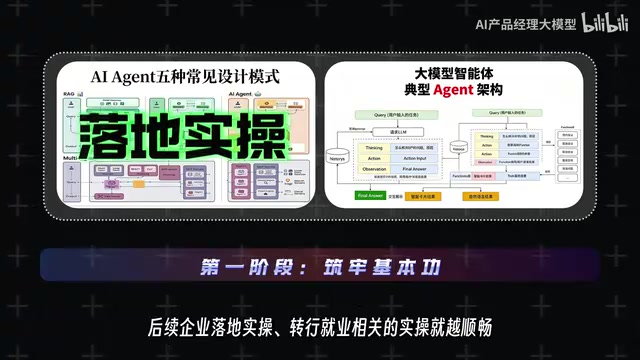
Phase 2: Master the Five Core Capabilities and Mainstream Frameworks
The Five Core Capabilities of an AI Agent
Phase 2 is the critical leap from "understanding" to "being able to build." A complete Agent needs to possess the following five core capabilities:
- Planning: Breaking down complex goals into executable subtasks
- Tool Use: Extending capabilities by calling external APIs, search engines, code execution environments, and more
- Memory Management: Maintaining short-term and long-term memory to enable coherent context
- Reflection: Evaluating execution results and self-correcting
- Context Optimization: Efficiently organizing information within a limited context window
These five capabilities are what fundamentally distinguish an Agent from an ordinary chatbot. Truly understanding them is what lets you grasp why an Agent can complete tasks autonomously.
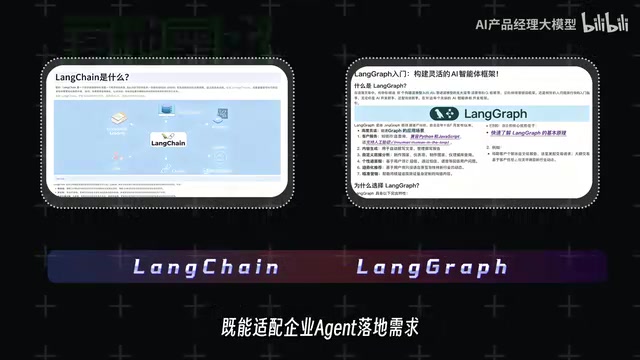
Hands-On Practice with LangChain and LangGraph
With the conceptual foundation in place, the next step is practical development using mainstream frameworks like LangChain and LangGraph.
LangChain was open-sourced in late 2022 and quickly became the de facto standard in the Agent development ecosystem. Its core value lies in providing a standardized "Chain" abstraction — connecting LLM calls, tool integrations, memory modules, and output parsers into reusable pipelines. However, as Agent complexity grew, the linear chain structure revealed its limitations in handling branching, loops, and parallel control flows. LangGraph was built to address exactly this: it models Agent state transitions as a directed acyclic graph (DAG), where each node is a processing step and edges represent state transition conditions, naturally supporting complex scenarios like multi-round reflection and conditional branching. The two are not replacements for each other but complementary layers — LangChain handles the component layer, LangGraph handles the orchestration layer. Used together, they cover the full spectrum of Agent needs from simple to complex.
Proficiency in both frameworks will meet enterprise Agent deployment requirements and build genuinely marketable skills for your job search.
Phase 3: Hands-On Practice and Advanced Projects
A Progressive Path from Demo to Full Project
The biggest trap in learning Agent development is biting off more than you can chew — studying the theory and then immediately tackling complex projects, only to get stuck at every turn. The right approach is to follow an incremental progression:
- Start with simple demos — for example, build a Q&A Agent that can call a weather API
- Gradually move to full end-to-end projects to accumulate complete development experience
- Then tackle advanced projects — independently build applications with real business value
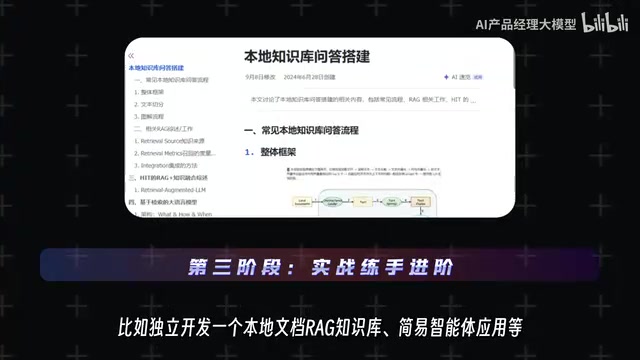
Building a RAG Knowledge Base Agent
One classic, high-value advanced project is a local document RAG knowledge base agent. RAG (Retrieval-Augmented Generation) vectorizes and stores documents so that an Agent first retrieves relevant content before generating an answer, effectively solving two major pain points of LLMs: outdated knowledge and hallucinations.
RAG works in two phases: the offline phase chunks documents and converts them into high-dimensional vectors using an embedding model (such as text-embedding-ada-002), which are then stored in a vector database (such as Chroma, Pinecone, or Milvus); the online phase vectorizes the user's question, retrieves the Top-K most relevant chunks via cosine similarity, and injects them into the prompt as context for the LLM to generate an answer. Enterprise-grade RAG also involves engineering details like document parsing quality, chunking strategy, and re-ranking — which is precisely why this direction continues to have substantial technical depth.
This type of project is both directly applicable to real enterprise use cases (such as internal document Q&A and intelligent customer service knowledge bases) and makes for a highly compelling portfolio item when job hunting. Mastering RAG development means you're ready to deploy Agents in real-world scenarios.
Conclusion: A Clear Roadmap Leads to Efficient Progress
AI Agent development is not out of reach — the key is following a structured learning path. To recap the three phases:
- Phase 1: Build a solid Python and LLM foundation; understand core Agent concepts
- Phase 2: Master the five core capabilities; become proficient with LangChain/LangGraph
- Phase 3: Progress from demos to a RAG knowledge base agent; accumulate deployable project experience
One note of caution: claims like "complete this and you're ready for a career switch" carry a degree of marketing spin — real job prospects depend on market demand and the quality of your individual projects. That said, as a starting reference for planning your learning journey, this three-phase roadmap has solid practical value. For beginners looking to break into AI Agent development, having a clear direction and methodically working through each phase is far more valuable than blindly hoarding learning materials.
Key Takeaways
Related articles
Deep Dive into vLLM Worker-Side GPU KV Cache Initialization
Deep dive into vLLM's Worker-side KV Cache GPU memory allocation, covering the full pipeline from KVCacheConfig generation to physical memory binding via ModelRunner.
Zepto Builds AI Customer Service with MLflow: An Evaluation-Driven Practice Guide
Deep dive into how Zepto built an evaluation-driven AI customer service system using MLflow and Databricks, achieving 60% faster responses and 40% less manual handling. From technical architecture to practical insights.

Iran Captures U.S. Underwater Drone in Strait of Hormuz: A Comprehensive Analysis
Iran announces capture of U.S. Navy underwater drone in Strait of Hormuz. In-depth analysis of the incident, strategic value of UUVs, U.S.-Iran geopolitical competition, and implications for global energy security and military dynamics.