AI Agent Development Learning Roadmap: A Four-Stage Guide from Beginner to Real-World Projects

A four-stage roadmap to take you from AI Agent basics to real-world project deployment.
The article argues that Agent development is now a core hard skill for AI practitioners and presents a four-stage learning roadmap. Stage 1 builds conceptual foundations around planning, memory, and tool use. Stage 2 dives into principles like the ReAct and Code Agent paradigms. Stage 3 focuses on multi-agent collaboration and Prompt tuning to move systems from "usable" to "genuinely good." Stage 4 ties everything together through complete real-world projects. The article also cautions that the roadmap is directional guidance — true mastery still requires extensive hands-on practice.
Why Agent Development Has Become a Core Hard Skill for AI Practitioners
The technical bar for AI roles is quietly rising. Many people once assumed that mastering large language models meant building knowledge base retrieval pipelines, calling a few APIs, and getting a basic RAG workflow running — but that mindset has long fallen behind the pace of the industry. What truly separates top practitioners is the ability to independently develop intelligent Agents.
The fundamental difference between an Agent and a traditional API call lies in autonomy. An Agent can think independently, plan tasks, invoke various tools, and close the loop across multiple steps to accomplish complex objectives. Whether your goal is landing a new job, getting a raise, or building your own AI-powered products, Agent development is an unavoidable core skill.
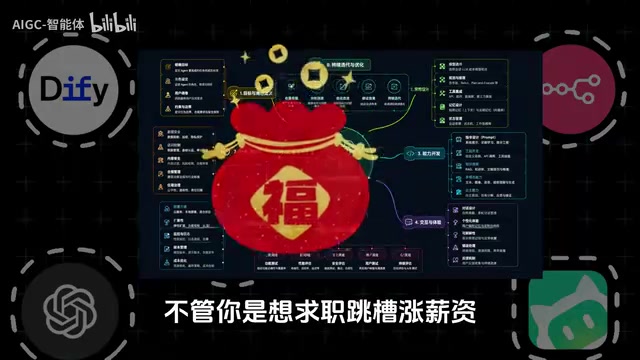
This article lays out a relatively complete four-stage learning roadmap. The core goal is to help beginners find their footing and avoid common pitfalls. Let's break it down stage by stage.
Stage 1: Foundations — Master the Core Concepts
Without a solid foundation, everything you learn afterward will feel increasingly chaotic. The focus at this stage is not to rush into writing code, but to thoroughly internalize the underlying theory of Agents and understand what components they are made of.
Start by building up your foundational knowledge of large language models — understand their capabilities and how they work. From there, focus on three core modules:
- Planning: How an Agent breaks a complex goal down into executable subtasks and decides the order in which to carry them out.
- Memory: How an Agent stores context and maintains state so that multi-step tasks remain coherent.
- Tool Use: How an Agent identifies what it needs and selects the right external tools or APIs to take action.
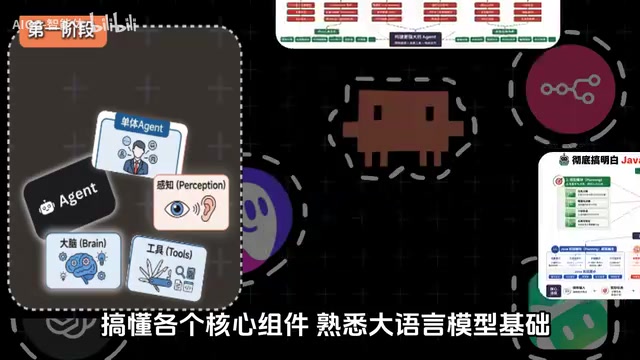
Only by fully understanding these concepts can you appreciate why an Agent is not simply a "question-answering bot," but a system capable of making decisions autonomously. This step is the prerequisite for all subsequent learning.
At the implementation level, the memory module typically falls into four categories: In-context Memory (the current conversation window's context); External Memory (long-term storage persisted via vector databases and similar systems); Procedural Memory (the Agent's system prompts and behavioral rules); and Episodic Memory (records of past interactions available for retrieval). Because large language models have limited context windows, the tradeoff between "placing information in context" and "retrieving from external storage" directly affects an Agent's performance on long-horizon tasks. Understanding the classification and limitations of the memory module is also a prerequisite for learning advanced techniques like RAG augmentation and state compression.
Stage 2: Core Advancement — Deeply Understand the Principles and Paradigms
Moving from "understanding concepts" to "understanding principles" is the most critical leap on this learning path. Many people get stuck here because they stop at knowing how to use frameworks without being able to explain why an Agent takes each step it does.
This stage is about truly grasping how Agents operate under the hood and mastering several classic paradigms. The most representative among them are ReAct (Reasoning + Acting — alternating between reasoning and action) and Code Agent (driving task execution through code generation). Understanding the underlying logic of these paradigms means you can trace every step in the Agent's Think → Act → Observe → Re-Think loop.
There is another direct benefit to internalizing these principles: you can identify and debug problems far more efficiently. When an Agent behaves unexpectedly, someone who understands the principles knows whether the issue lies in planning, a failed tool call, or a memory management problem — rather than just trial-and-erroring blindly.
The ReAct paradigm, proposed by Princeton University in 2022, stands for Reasoning and Acting. Its core idea is to have the language model alternately generate a "thought trace" (Thought) and an "action command" (Action) within a single inference pass, then feed the environment's returned observation (Observation) back into the model — forming a Thought → Action → Observation cycle. Compared to pure reasoning chains (Chain-of-Thought), ReAct adds interaction with external tools, enabling the model to dynamically correct errors and supplement information. Compared to pure action sequences, the thought traces provide an interpretable reasoning process that makes debugging easier. Code Agent is another mainstream paradigm, where the Agent converts tasks into executable code snippets (typically Python), runs them through a code interpreter, obtains results, and then decides on the next step. This approach outperforms pure text generation in scenarios requiring precise execution — such as mathematical computation, data analysis, and file operations — because code itself is a deterministic "tool." Understanding the design tradeoffs between these two paradigms helps you choose the right Agent architecture for real-world projects.
Stage 3: Advanced Refinement — Polish Output Quality
Getting a single Agent to complete a task is the bare minimum. A truly production-ready system typically requires going one level deeper.
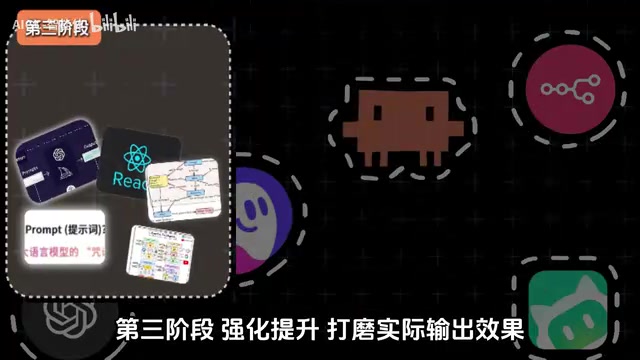
This stage focuses on two core directions. The first is multi-agent collaboration: how multiple Agents divide responsibilities and work together — for example, one Agent handles planning, another handles execution, and a third handles verification — using role specialization to improve overall task quality. The second is Prompt tuning: using carefully crafted prompt design to make Agent outputs more precise and controllable, reducing hallucinations and off-target responses.
Multi-agent collaboration and state management are especially important in enterprise settings. As task chains grow longer and more Agents are involved, maintaining shared state and avoiding information inconsistencies directly determines whether the system can actually be deployed. The goal at this stage is to transform your Agent from "usable" to "genuinely good."
The two most common communication and coordination patterns in multi-agent systems are centralized orchestration (the Orchestrator pattern) and decentralized peer-to-peer collaboration (the Peer-to-Peer pattern). In the former, a primary Agent handles task distribution, result aggregation, and exception handling — the structure is clean but introduces a single point of failure. In the latter, Agents communicate via a message bus or shared memory, offering greater flexibility at the cost of more complex state management. State management is the primary challenge in deploying multi-agent systems: when multiple Agents concurrently read and write shared context, you need to account for idempotency, conflict resolution, and rollback mechanisms — otherwise, the longer the task chain, the more likely information inconsistencies become. Current mainstream frameworks such as LangGraph, AutoGen, and CrewAI offer varying levels of abstraction for these problems, but developers still need to understand the underlying logic to effectively debug and extend them.
Stage 4: Real-World Implementation — Connecting to Actual Business Problems
Technology ultimately has to be proven through projects. All the knowledge accumulated across the first three stages must be integrated and validated in practice.

The recommendation is to build two to three complete end-to-end projects, putting all the skills you've learned — planning, memory, tool use, and multi-agent collaboration — to work. Some project directions worth considering:
- Intelligent Decision Assistant: Combines external data and reasoning capabilities to help users make informed judgments.
- Automated Office Agent: Automatically handles repetitive tasks such as document processing, email management, and scheduling.
- Multi-Agent Collaboration System: Multiple Agents divide responsibilities and work together to complete complex end-to-end business processes.
Only by going through the complete lifecycle — from requirements analysis and architecture design all the way to deployment — can you transform fragmented knowledge into genuine engineering ability.
The Value and Limitations of This Learning Roadmap
This four-stage roadmap has a clear logic: first build conceptual foundations, then go deep on principles, then strengthen collaboration and tuning, and finally wrap up with projects. For anyone looking to systematically break into Agent development, it provides a useful progressive framework.
That said, it's worth being clear-eyed about its limitations. A learning roadmap like this is primarily directional guidance. The real difficulty lies in the specific implementation details at each stage — the mechanics of ReAct, the communication protocols in multi-agent systems, and state management in enterprise-scale scenarios all require substantial hands-on practice to truly master. A roadmap can help you avoid wrong turns, but it cannot replace the experience of writing code yourself, hitting walls, and debugging your way through.
For anyone looking to build a stronger technical edge in the AI field, Agent development is genuinely worth sustained investment. Work through these four stages seriously, and both your engineering capabilities and your professional value will see meaningful, tangible growth.
Related articles

Chain of Thought Isn't Just for AI: How Humans Can Use CoT to Improve Thinking Quality
Chain of Thought isn't just a prompt trick for large models. Starting from a Hacker News discussion, this article analyzes why CoT works for human thinking too, breaks down actionable ways to transfer it, and highlights the key differences between human CoT and machine CoT.
Cloudflare Teams Up with OpenAI: Closi…
Cloudflare Teams Up with OpenAI: Closing the Loop from Vulnerability Discovery to Defense with AI
Cloudflare uses OpenAI Daybreak to investigate security vulnerabilities and generate reviewable remediation plans, while developers use Codex to boost coding efficiency and quality.

Orca Multi-Agent Orchestration in Practice: A Guide to Parallel Collaboration with Claude and Codex
Orca is Stable AI's free open-source agent workbench supporting 34 agents like Claude Code and Codex in parallel. Learn its Git worktree isolation, multi-model orchestration, and mobile management.