AI Agent for Beginners: What's the Real Difference Between Agents and Chatbots?

A clear beginner's breakdown of AI Agents vs. chatbots, their core components, and how to choose the right product.
This article systematically distinguishes three commonly confused concepts for beginners — chatbots, tool platforms, and AI Agents — using the analogy of an "AI consultant vs. AI employee" to explain why Agents can work autonomously. It breaks down the three essential components (Brain for decision-making, Memory for tracking progress, Tools for real-world execution), categorizes products into specialized, general-purpose, and platform-built agents, and recommends general-purpose agents as the best entry point for everyday users.
Many people hear the terms "Agent," "intelligent agent," and "chatbot" every day but never quite grasp what sets them apart. In this wave of AI agent hype, conceptual confusion is often the very first hurdle to entry. This article is based on a beginner-friendly AI Agent tutorial and cuts through the three most commonly confused concepts, explains the core principles behind Agents, and maps out the product landscape — so you can find your footing without wasting time.
Chatbots, Tool Platforms, and Agents: Stop Lumping Them Together
To understand Agents, you first need to draw a clear line between three things.
The AI you chat with every day — like Doubao or DeepSeekAd — is a chatbot, not an Agent. The tools and platforms used to build agents are also not Agents themselves. A true Agent is an autonomous entity that can independently run tasks and get things done.
Simply put, an Agent is an "intelligent, capable worker." It's not a program that just goes back and forth with you in conversation — it's a computer application that can call on various tools on your machine and independently complete complex, multi-step tasks.
This distinction matters because many people conflate "a large model you can talk to" with an Agent, only to find in practice that it can't actually do anything — leading to disappointment. Understanding the boundaries sets the right expectations for what intelligent agents can actually deliver.
Consultant vs. Employee: The Most Intuitive Example
No amount of conceptual explanation beats a concrete example you can feel immediately.
Imagine you want to turn a pile of materials into a PowerPoint presentation.
With a regular conversational AI (like Doubao or DeepSeek), you'd have to upload each file one by one, wait for it to generate content on remote servers, and follow along step by step. It acts more like a "you ask, it answers" consultant.

An Agent works differently: you simply hand it the task, and it reads the files itself, figures out the formats, builds the PowerPoint directly on your local machine, proactively notifies you when it's done, and can even check the content for errors.
One-line takeaway: Products like Doubao and DeepSeek are more like your AI consultant — you ask, they answer. An Agent is your AI employee — it rolls up its sleeves and does the work for you.
This shift from "consultant" to "employee" is the fundamental force driving the ongoing surge in agent interest heading into 2026 — people are no longer satisfied with getting answers; they want AI to deliver finished results.
How Agents Actually Work Autonomously: Three Core Components
An Agent's ability to complete tasks independently rests on three indispensable parts: Brain, Memory, and Tools.
Brain: The Decision-Making Core
The "brain" is simply the large language model we're already familiar with. Doubao, DeepSeek — either can serve as an Agent's brain. It's responsible for understanding your requirements, breaking tasks into steps, and deciding what to do at each stage. It's the command center of the entire agent.
Memory: The Task Anchor
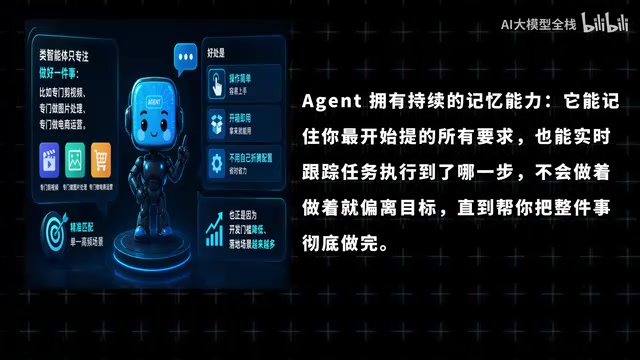
The memory module keeps track of all the requirements you specified at the start and monitors progress in real time, preventing the agent from drifting off course midway through — until the entire job is done. For complex, multi-step tasks, memory is the key to keeping execution on track.
Tools: The Execution Engine
This is the most fundamental difference between an Agent and a regular conversational AI. An Agent can call on tools and software on your computer just like a real person: browsing the web to look things up, managing local files, editing Excel spreadsheets and PowerPoints, even writing and running code.
An AI without tools can only talk a good game; an Agent with tools can actually deliver. This also explains why technologies like MCP (tool-calling protocol) and RAG (retrieval-augmented generation) have become hot topics in the agent ecosystem — at their core, they're both about extending an Agent's "hands and feet" and "memory."
MCP (Model Context Protocol) is an open standard introduced by Anthropic in late 2024, designed to standardize how AI models communicate with external tools. Think of it as the "USB port" of the agent world — before MCP, every agent platform needed a custom adapter for each tool it connected to. MCP makes those integrations standardized and reusable. RAG (Retrieval-Augmented Generation) is a technique that has AI retrieve relevant content from an external knowledge base before generating a response — essentially giving the Agent a continuously updated "long-term memory warehouse," solving the problems of model knowledge cutoffs and inaccessible private data. One extends "hands and feet," the other extends "memory" — together they form the foundational infrastructure of today's agent ecosystem.
Three Types of Agent Products: Which One Should You Start With?
The agent product landscape is growing fast, but it breaks down into three broad categories — pick based on your needs.
Specialized Agents
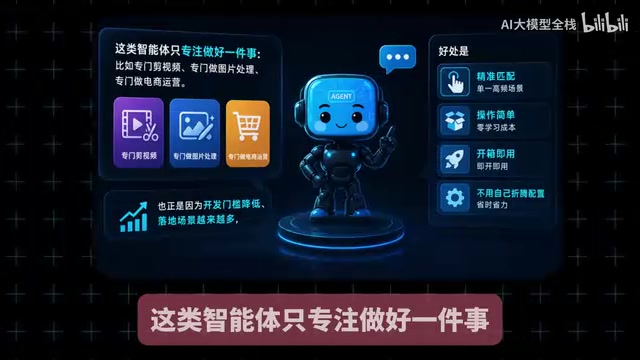
These agents focus on doing one thing exceptionally well — dedicated video editing, image processing, e-commerce operations, and so on. Their strength is precise fit for a single high-frequency use case: simple to use, ready out of the box, no setup required. As development barriers have dropped, the range of these products has expanded dramatically.
General-Purpose Agents
Mostly mature products from major tech companies — think Claude Code, Codex, or desktop agents like Work Buddy. These have broad capability coverage and are suited for a wide variety of tasks.
Platform-Built Agents
Generated by agent-building platforms, these typically follow a fixed workflow with AI involvement only at key nodes. Most are custom-built by businesses to fit their own operations.
For everyday users looking to boost productivity with AI, general-purpose agents are the best place to start — no workflow to build yourself, ready to use immediately, and the broadest coverage of scenarios.
Claude Code is a coding-focused Agent from Anthropic that can autonomously read and write code files and execute commands in a local terminal environment. Codex is OpenAI's comparable product — both represent the direction of "letting AI directly operate a development environment" as general-purpose agents. Work Buddy broadly refers to desktop agents built for office productivity, with deep integration into local file systems, calendars, email, and more. It's worth noting that the line between general-purpose and specialized agents is blurring — leading general-purpose agents can rapidly expand into vertical use cases through plugin or Skills marketplace mechanisms. For everyday users, starting with a general-purpose agent typically offers the widest coverage at the lowest learning cost.
Closing Thoughts
The core shift from chatbot to Agent is AI moving from "outputting answers" to "delivering results." Understand the three core components — Brain, Memory, and Tools — then choose among the three product categories (specialized, general-purpose, or platform-built) based on your needs, and you've already cleared the first hurdle of getting started. The deeper concepts you'll encounter next — MCP, RAG, Skills — are all, at their core, extensions of capabilities built around these same three components.
Related articles

Chain of Thought Isn't Just for AI: How Humans Can Use CoT to Improve Thinking Quality
Chain of Thought isn't just a prompt trick for large models. Starting from a Hacker News discussion, this article analyzes why CoT works for human thinking too, breaks down actionable ways to transfer it, and highlights the key differences between human CoT and machine CoT.
Cloudflare Teams Up with OpenAI: Closi…
Cloudflare Teams Up with OpenAI: Closing the Loop from Vulnerability Discovery to Defense with AI
Cloudflare uses OpenAI Daybreak to investigate security vulnerabilities and generate reviewable remediation plans, while developers use Codex to boost coding efficiency and quality.

Orca Multi-Agent Orchestration in Practice: A Guide to Parallel Collaboration with Claude and Codex
Orca is Stable AI's free open-source agent workbench supporting 34 agents like Claude Code and Codex in parallel. Learn its Git worktree isolation, multi-model orchestration, and mobile management.