AI Agent for Java Developers: A Practical Guide to Spring AI Alibaba Framework
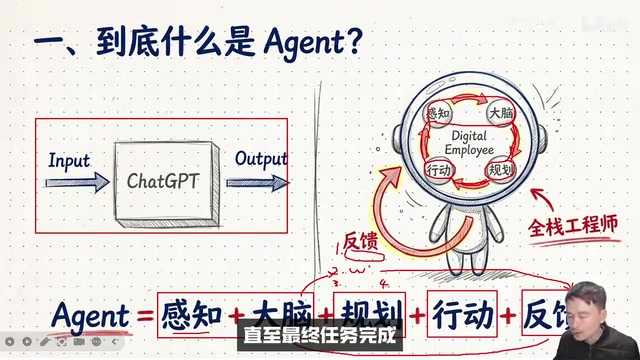
A Java developer's guide to AI Agent concepts, technical paradigms, and Spring AI Alibaba in practice.
This article systematically covers AI Agent fundamentals and the broader technical landscape, explaining that modern Agents operate on a Perceive→Plan→Act→Reflect loop rather than simple conversation. It breaks down the market from two angles — product (general-purpose vs. vertical) and technical (Workflow vs. Agentic) — emphasizing that vertical Agents dominate 80–90% of enterprise use cases and are the prime direction for Java developers to highlight on their résumé. For deep integration with existing systems, manual development is essential, and Spring AI Alibaba's Graph-based orchestration — supporting ReAct Agent, Flow Agent, Workflow, and A2A — provides a clear, practical path for Java engineers to deliver production-grade Agent applications.
In AI application development interviews, simply knowing how to integrate large language models and build chatbots is no longer enough. Interviewers are increasingly asking one key question: have you built an Agent? As AI Agent technology matures, more and more companies are integrating it into core business workflows — for automated pipelines, real-time data analysis, and intelligent alerting. For Java developers, mastering Agent development is quickly becoming a must-have line on your résumé.
This article draws on relevant technical course content from Bilibili to outline the core concepts of AI Agents, how to categorize the technical landscape, and how Spring AI Alibaba Agent Framework fits into real enterprise deployments.
What Exactly Is an Agent: From Conversation to Autonomous Execution
Many people still have a fuzzy understanding of what an Agent actually is. In the early days, simply connecting to a large model to enable basic intelligent conversation was enough to call something an Agent. But as the technology has evolved, a clearer standard has emerged: an Agent perceives a user's task, plans and decomposes it, calls specific tools to take action, then feeds the results back to the model to determine whether the task is complete — and if not, performs reflection, repeating the loop until the task is ultimately accomplished.
Here's a concrete example: suppose the task is "Search Baidu for imaginary numbers and summarize in 100 words." The model first reasons through its perception to determine whether it has enough information to complete the task. If not, it breaks the task into steps — open a browser, navigate to Baidu, search for imaginary numbers, write a 100-word summary. Each step invokes a corresponding tool, the results are fed back to the model, and through reflective judgment, the cycle continues until the task is done.
This closed loop of Perceive → Plan → Act → Reflect is precisely what distinguishes modern Agents from simple chatbots.
Two Dimensions for Understanding the Agent Landscape
The market is crowded with products and frameworks — Manus, OpenClaude, Coze, Dify, Spring AI, Spring AI Alibaba Agent Framework, LangGraph, LangChain… How do you make sense of them all? Two dimensions help cut through the noise.
Product Dimension: General-Purpose vs. Vertical
From a product manager's perspective, Agents fall into two categories: general-purpose and vertical. General-purpose Agents handle open-ended tasks with fuzzy boundaries — they're all-rounders. Examples include Manus and OpenClaude, which can tackle almost any task. For developers, however, these products are hard to present on a résumé in a meaningful way — unless you've actually built a simplified version from scratch.
Vertical Agents focus on a single business process — tools dedicated to code assistance, DeepTrip's complex flight itinerary optimization, or Agents that automate internal enterprise workflows. Vertical products account for 80–90% of real enterprise deployments and revenue-generating use cases, making them the highest-demand direction for AI application development.
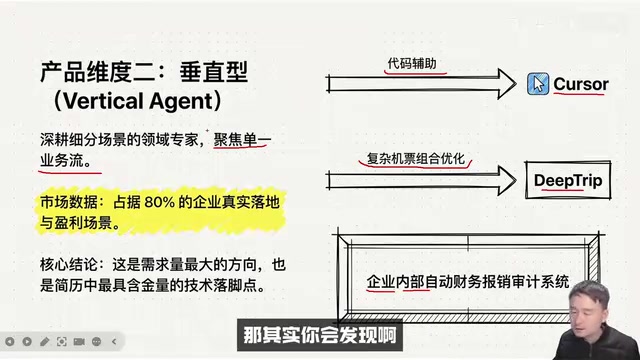
This means Java developers should focus on packaging projects from a vertical perspective. In finance, you could build a commercial credit risk review Agent to assist relationship managers. In manufacturing, develop a fault diagnosis Agent to support equipment engineers. In HR, create an intelligent talent-matching and recruitment Agent. These directions are grounded in real business needs and carry strong weight in interviews.
Technical Dimension: Workflow Paradigm vs. Agentic Paradigm
From an architect's perspective, the technical landscape splits into two main schools of thought.
The Workflow paradigm has developers define a strict execution process. Take an automated coding Agent as an example: Step 1 is requirements analysis — if the requirement is infeasible, exit immediately; if feasible, proceed to architecture design, then code implementation. Every step is deterministic and controllable. In business environments that demand strong control, Workflow is almost the only viable option — no business can afford to let a model hallucinate and deviate from a defined process.
The Agentic paradigm doesn't prescribe fixed steps. Instead, it provides a goal and a toolset, letting the model autonomously decide which tools to call, evaluate results, reflect when things go wrong, and repeat until completion. This approach is extremely flexible, but the entire execution is a black box — unpredictable, potentially falling into infinite loops, or consuming excessive tokens.
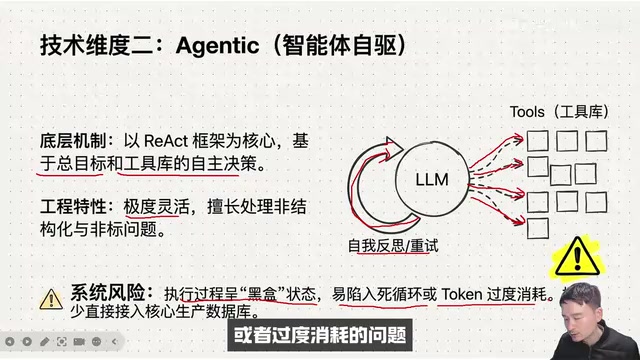
In practice, the Agentic approach is rarely used for direct integration with core production systems. Its flexibility makes it better suited for general-purpose applications — after all, you can't write a custom SOP for every possible task. The determinism of Workflow, on the other hand, makes it a better fit for enterprise vertical applications. Notably, mainstream frameworks like LangChain, Spring AI, and Spring AI Alibaba support both paradigms, and you can even build a hybrid Agentic + Workflow architecture to balance control with flexibility.
These frameworks occupy clearly distinct layers: Coze and Dify are low-code platforms aimed at non-technical users; LangChain and LangGraph are Python-ecosystem development frameworks, with LangGraph specifically targeting stateful, multi-step Agent orchestration; Spring AI is the official Spring abstraction layer for AI integration; Spring AI Alibaba is Alibaba's extension on top of Spring AI, enhanced for China's LLM ecosystem (e.g., Qwen) and Java enterprise scenarios; Manus and OpenClaude are general-purpose Agent products for end users. Understanding this layering helps avoid the common confusion between "which product to use" and "which framework to develop with."
ReAct (Reasoning + Acting) is the most representative implementation pattern in the Agentic paradigm, proposed by Princeton University in 2022. Its core idea is to have the model alternate between three steps — Thought → Action → Observation — feeding the tool's returned results back into the model as new observations to drive the next round of reasoning, until the model determines the task is complete and outputs a final answer. This maps closely to the Perceive → Plan → Act → Reflect loop described above. ReAct's strength is that the reasoning process is transparent and traceable, but its critical weakness is equally apparent: it relies entirely on the model's reasoning capability. If the model hallucinates or goes down a wrong path, the entire chain keeps consuming tokens without self-correction — which is why production environments typically require Human-in-the-Loop checkpoints or maximum step limits.
Development Approach: Low-Code Platforms vs. Manual Development
When choosing a technical approach, there are two main paths for building Agents.
The first is low-code SaaS platforms like Coze, Dify, and FastGPT. These allow you to configure nodes and plugins through drag-and-drop, attach knowledge bases, and invoke MCP and other integrations. These platforms are great for personal productivity assistants or quickly launching non-critical AI-assisted features, and developers are encouraged to get familiar with them.
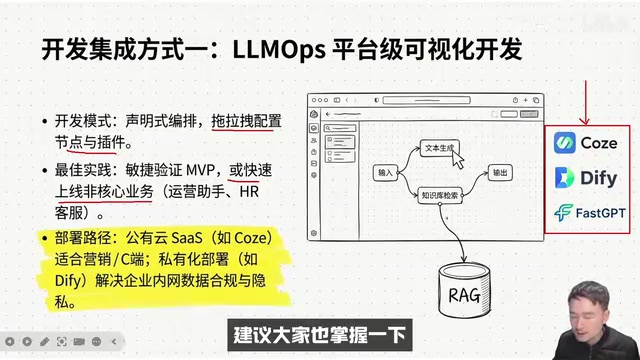
However, low-code platforms fall short in deep integration scenarios with existing systems: when an Agent needs to complete distributed transactions across microservices, plug into existing user permission systems, handle fine-grained concurrency control, or integrate with components like Nacos, Redis, or MQ — low-code platforms simply can't do it.
The second path is building Agent applications by hand, which enables true deep integration with existing business systems.
Spring AI Alibaba: The Agent Solution for the Java Ecosystem
For Java developers, Spring AI Alibaba provides a complete Agent development toolkit. It supports Graph-based orchestration, making it straightforward to build ReAct Agents, Flow Agents, and Workflow pipelines. Alibaba has invested heavily in the Agent ecosystem, offering a rich set of open-source frameworks and products.
The associated course walks developers through building a simplified version of Manus from scratch and integrating Agent workflows across different industries, covering the full feature set of Spring AI Alibaba Agent Framework: Skills, Flow Agents, Workflow orchestration, A2A (Agent to Agent), and Human-in-the-Loop capabilities.
For Java engineers looking to showcase Agent development skills on their résumé, mastering Spring AI Alibaba Agent Framework and Spring AI Alibaba Graph — then packaging a vertical business project from your company around these capabilities — is a clear and actionable path forward. With Graph-based orchestration, Spring AI Alibaba is fully capable of supporting AI agent application development across all paradigms.
A2A (Agent to Agent) is an open standard proposed by Google in 2025 to address how Agents built by different vendors and frameworks can communicate and collaborate. In complex business scenarios, a single Agent often has limited capability — multiple specialized Agents need to divide and conquer. For example, a master scheduling Agent dispatches tasks to a sub-Agent responsible for data queries and another for report generation, then aggregates the results. The A2A protocol provides standardized mechanisms for discovery, invocation, and result exchange in these multi-Agent systems, enabling cross-framework, cross-service Agent collaboration. Spring AI Alibaba's support for A2A means that Agents built on it can interoperate with any other Agent following the same protocol, laying the groundwork for large-scale distributed Agent networks.
Related articles

How Big Can Stars Really Get? The Physical Limits of the Largest Stars
Red supergiants are the largest stars by volume, with radii up to 2,000 times the Sun, engulfing the inner solar system. But there is no precise upper limit on stellar size—models predict up to 15,000 solar radii. The most massive blue stars are far smaller than red supergiants—biggest and heaviest are two different things.

Apple HomeView Smart Display Full Feature Breakdown: Wall-Mount or Desktop, $299
Apple launches HomeView, a $299 smart display with wall-mount and desktop options, 12MP camera for facial recognition, smart home control, music playback, and recipe step-by-step cooking. Full breakdown of watch faces, apps, privacy, and cooking integration.

Where Did the Promised New Studio Go? Craft Computing Answers After Five Years
Craft Computing's host responds to viewer questions: the new studio promised five years ago was shelved as construction costs soared from $30,000 to $75,000, and was replaced by a 168-square-foot garage conversion.