AI Agent Identity Security: Closing the Authorization Gap in Autonomous Execution

AI agent identity security hinges on closing the execution gap with short-lived task credentials, zero-trust gateways, and cryptographic auditing.
Enterprises connect semi-autonomous AI agents to core systems with over-privileged static credentials, creating the confused deputy problem where prompt injection turns agents into attacker proxies. The solution: OAuth2 M2M short-lived JWTs, per-task credential issuance, and behavioral anomaly tracking. An AI agent gateway enforces zero-trust policies and tamper-proof auditing, while network baselines, honeypots, and mandatory registration expose shadow AI.
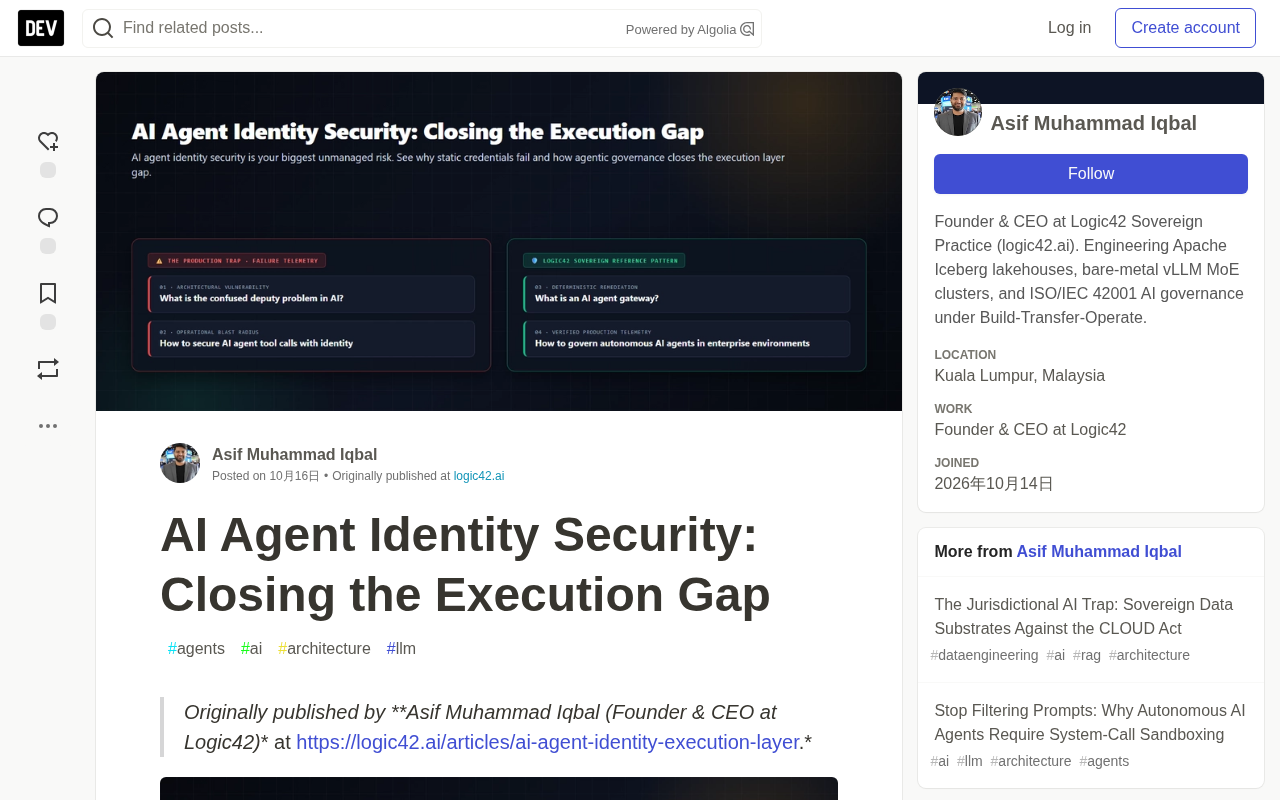
Enterprises have spent years hardening endpoint security, yet they've left the real blast radius unguarded: the moment an AI agent calls a tool, modifies a production database, or executes code. Most mid-sized companies have already connected a fleet of semi-autonomous AI entities to their core systems, granting them over-privileged credentials without giving them native identities. This isn't an alignment problem—it's an AI agent identity security crisis.
What Is the "Confused Deputy" Problem in AI
The Confused Deputy problem refers to a situation where an AI agent holding legitimate credentials is manipulated by a malicious prompt into performing unauthorized actions on behalf of an attacker.
When an AI agent calls a tool, it typically relies on a pre-assigned static credential, such as a fixed AWS service account token. The receiving system sees a valid token and has no way to tell whether the operation was genuinely intended or the result of a compromised agent.
A customer service agent is asked to summarize a ticket. That ticket contains an embedded prompt injection payload instructing it to export the user database. Because the agent shares an over-privileged database credential, it complies without question. You may only find out once the data surfaces on the dark web.
Shared credentials directly violate the principle of least privilege and destroy non-repudiation. Gartner estimates in its security predictions that a significant share of enterprise AI breach incidents will exploit this gap. Machine identities for AI agents need independent profiles with auditable, task-bound permission scopes.
The Historical Roots of the Confused Deputy Problem
The Confused Deputy problem is not new to the AI era. It was first described by Norm Hardy in 1988 to capture a classic security vulnerability: a program with legitimate authority (the "deputy") is tricked into performing an operation it should never have carried out on behalf of an attacker. In the traditional case, a compiler program has permission to write to a billing file, and an attacker manipulates the compiler's output path so that it writes to a sensitive file using its own authority. The core contradiction: the system only verifies the deputy's identity, never the principal's true intent. AI agents amplify this problem: the agent itself holds credentials, and prompt injection lets attackers indirectly "borrow" them. Understanding this history helps clarify that AI agent identity security is fundamentally an extension of classic authorization models into the realm of autonomous entities—not an entirely new problem.
Protecting AI Agent Tool Calls with Identity Mechanisms
To protect tool calls, you must issue short-lived, context-aware credentials strictly scoped to the current task, and use an AI agent gateway to enforce zero-trust policies.
The core idea is to treat AI agents as independent entities—stop giving them human-level, long-lived access.
Adopt OAuth2 machine-to-machine flows. Replace static API keys with short-lived JWTs. A leaked static key creates long-term exposure; short-lived tokens minimize the risk window.
Issue credentials per task. When the orchestration layer starts a workflow, it should issue a credential that expires the moment the task ends. Even if a prompt injection compromises the agent, the blast radius is contained within a single task.
Track behavioral anomalies. Identity is not just credentials—it's behavior. Agents follow programmatic patterns, and their tool calls are predictable. If a code-generation agent suddenly tries to modify IAM roles, it should be blocked immediately.
According to Ponemon Institute reports, unmanaged machine identities cost enterprises an average of millions of dollars per incident. There is no room for error here.
OAuth2 Machine-to-Machine Flows and Short-Lived JWTs
OAuth2's machine-to-machine (M2M) flow, also known as the Client Credentials Grant, is an authorization method designed specifically for service-to-service communication with no user interaction. The AI agent acts as a client, using its own client ID and secret to exchange for an access token (typically a JWT) from the authorization server. Unlike static API keys, JWTs can embed claims such as expiration time, audience, and task scope, which the receiving party can independently verify. In the AI agent context, the orchestration layer can dynamically issue a JWT scoped only to a specific task each time it starts one, invalidating it when the task ends. Even if the token is leaked mid-task, the attacker's window of exploitation is extremely narrow. This "issued per task, short-lived" model is precisely the mechanism that brings the principle of least privilege down to the execution layer.
What Is an AI Agent Gateway
An AI agent gateway is a dedicated control plane positioned between the AI orchestration layer and enterprise tools. It intercepts every request, verifies identity, enforces policy, and logs operations.
Without an interception point, you cannot secure the execution layer. The architecture presented is: a user principal calls the agent orchestrator; every tool call the orchestrator initiates must pass through the gateway, which then forwards it to enterprise tools while writing events to a tamper-proof audit log.
Every AI tool call must flow through this gateway. It handles three things: verifying the agent's JWT; enforcing policies based on frameworks such as NIST SP 800-207; and scoring the risk of confused deputy attacks based on payload content.
The difference between a traditional API gateway and an AI agent gateway is clear: the former uses static API keys, global or service-level scopes, and lacks context; the latter uses short-lived JWTs, task-scoped permissions, and carries human delegation context. This contrast alone explains why simply applying an old gateway to agent scenarios doesn't work.
NIST SP 800-207 Zero Trust Architecture
NIST SP 800-207 is the zero trust architecture (ZTA) guidance published by the U.S. National Institute of Standards and Technology, whose core principle is "never trust, always verify." It abandons the traditional perimeter defense model, requiring identity verification and authorization for every access request regardless of whether it originates from inside or outside the network. In the AI agent context, zero trust means the gateway cannot simply allow a request because it comes from an "internal orchestrator"—it must validate the agent's identity, task context, and policy compliance on every single request. The gateway serves as the policy enforcement point (PEP) in a zero trust architecture, while the identity provider and policy engine form the policy decision point (PDP). Aligning an AI agent gateway with NIST SP 800-207 ensures that every tool call an agent makes conforms to the enterprise's established access control policies.
Governing Autonomous AI Agents in the Enterprise
The prerequisite for governing autonomous agents is visibility into them. Shadow AI spreads quickly—according to Logic42's own telemetry data from Q2 2026, 12% of "super adopters" hardcoded open-source frameworks like LangChain directly into core business operations, completely bypassing IT. This is why governance of agentic AI is unavoidable.
If you can't see it, you can't protect it. A few hard engineering rules are needed.
Analyze network traffic. Establish a baseline for outbound API traffic and identify unmanaged orchestrators from it. Anomalous outbound connection patterns are often traces left by shadow agents.
Deploy tool-level honeypots. Set up decoy APIs to catch autonomous enumeration behavior. Agents will probe interfaces they shouldn't touch—honeypots can expose this early.
Enforce registration. Any programmatic entity that wants to touch a production database must present a registered identity. Unsigned requests are simply dropped.
Cryptographic Auditing and Gateway Bypass Prevention
AI agent identity security requires a tamper-proof audit trail that records the agent ID, the delegated user, the specific tool invoked, and the exact payload—to guarantee non-repudiation.
Ordinary logs aren't enough; they're too easy to forge. The recommendation is a cryptographically linked seven-point audit vector that can plug directly into OpenTelemetry:
- Agent ID
- Task ID
- User principal
- Tool name
- Parameters
- Result
- Timestamp
Without this breakdown, incident response loses its foundation.
What Happens If an Autonomous Agent Bypasses the Gateway
If an agent attempts to execute a tool call outside the gateway, enterprise resources—such as databases or internal APIs—must directly reject the request. This is achieved by enforcing mutual TLS (mTLS) and ensuring that target systems only accept traffic from gateway IPs carrying the gateway's cryptographic signature. Requests that bypass the gateway must have no accepted channel.
Tamper-Proof Auditing and OpenTelemetry
Tamper-proof auditing typically relies on cryptographic techniques such as hash chains or digital signatures, making logs impossible to modify silently once written. A hash chain links each log entry's hash value to the previous one, so any tampering breaks all subsequent hashes. In the AI agent context, the seven-point audit vector (agent ID, task ID, user principal, tool name, parameters, result, timestamp) is packaged and signed to form a verifiable event record. OpenTelemetry is an observability framework under the Cloud Native Computing Foundation (CNCF), providing unified APIs and SDKs for collecting traces, metrics, and logs. Connecting the audit vector to OpenTelemetry means agent behavior can integrate seamlessly with the enterprise's existing observability pipeline, while exporters write signed records into tamper-proof storage, providing a trustworthy evidence chain for incident response.
Conclusion
Rather than continuing to agonize over prompt engineering, secure the execution payload first. Until you strip excessive permissions from your agents, the system has been running on borrowed security margin. True AI agent identity security requires every action to be authorized, observed, and recorded.
The original article also provides two interactive assessment tools: a readiness diagnostic for ISO/IEC 42001:2023 AI management systems (AIMS), which claims to deliver Stage 1 blocker detection and a downloadable board-level PDF in 3.5 minutes; and a calculator for estimating HBM3e memory residency for frontier MoE models and 24-month bare-metal payback periods. Both are hosted on the Logic42 site.
One-line Summary
The core of AI agent identity security is closing the execution gap: replacing static shared credentials with short-lived task credentials, zero-trust gateways, and cryptographic auditing.
Paragraph Summary
Enterprises are connecting semi-autonomous AI agents to core systems while giving them over-privileged static credentials, resulting in the confused deputy problem: agents manipulated by prompt injection execute unauthorized operations on behalf of attackers. The article proposes protecting tool calls with identity mechanisms, including OAuth2 machine-to-machine flows issuing short-lived JWTs, per-task credential issuance, and behavioral anomaly tracking. It introduces an AI agent gateway as a control plane between the orchestration layer and enterprise tools, enforcing zero-trust policies, verifying identity, and recording tamper-proof audits. Governing shadow AI requires network traffic baselines, tool-level honeypots, and mandatory registration. A seven-point cryptographic audit vector and mTLS prevent gateway bypass, ensuring every agent action is authorized, observed, and recorded.
Related articles

Random Pruning of the DPO Computation Graph: 1.4x Training Speedup and Lower Peak Memory
DPO training too slow and memory-hungry? This paper proposes a random pruning framework for the DPO computation graph, sampling independently across position, sequence, and branch dimensions; branch pruning achieves a 1.426x step-time speedup and cuts training time by about 30%, with in-depth attribution of memory and time gains.

Why Does JEPA Underperform MLM in Longitudinal EHR Representation Learning?
New study compares JEPA and MLM for longitudinal EHR representation learning on MIMIC-IV: three JEPA variants train stably without collapse but underperform MLM; target size, not heterogeneity, drives prediction error.

Transfer Learning + Visible Light Communication: A New Approach to Energy-Efficient Indoor Positioning
A study proposes a transfer learning-based visible light communication indoor positioning method, achieving 47% accuracy improvement on the BOSCH factory dataset, 67.5% model efficiency under high noise, and introducing the ME composite metric for energy-efficient positioning in energy-constrained industrial IoT scenarios.