AI Agent Learning Path for Beginners: From Theory to Real-World Practice

A structured three-module roadmap for learning AI Agent development from theory to real-world deployment.
This article breaks down a comprehensive AI Agent learning path into three modules: Fundamentals (BDI theory, AutoGen), Advanced (Perception/Planning/Execution components, private deployment), and Hands-On Practice (DeepSeek + RAG knowledge base projects). It provides beginners with a clear, systematic route from core concepts to production-ready agent systems.
Why You Need a Systematic AI Agent Learning Path
As large language models continue to advance, AI Agents have become one of the most closely watched technical directions today. The technical essence of AI Agents traces back to the classic AI concept of the "Perception-Reasoning-Action Loop" — a concept rooted in the BDI (Belief-Desire-Intention) architecture that emerged from classical AI and robotics research in the 1980s.
The BDI architecture evolved from philosopher Michael Bratman's theory of intentional action and was formalized as a computable AI system design paradigm by Anand Rao and Michael Georgeff in the 1980s: Belief represents the agent's cognitive model of the world's current state; Desire represents the set of goals the agent wishes to achieve; and Intention represents the specific action plan the agent has committed to executing at any given moment. This three-part structure profoundly influenced autonomous agent design for decades to come. In modern LLM-based agents, the System Prompt initializes the Belief state, the user's task input corresponds to Desire, and the Chain-of-Thought reasoning dynamically generated during inference is precisely how Intention manifests and gets revised at each decision step.
In the era of large language models, the LLM serves as the "reasoning core," receiving environmental state through a System Prompt. The Function Calling mechanism enables it to write code, query databases, and call APIs to take "actions." Short-term conversational context and long-term vector memory together form the "perception layer." The fundamental difference from traditional software's "input-process-output" paradigm is that an Agent possesses multi-turn autonomous decision-making capability — it can loop repeatedly until a goal is achieved. With an LLM as its "brain," interacting with the external world via Tool Use/Function Calling, and using a memory module to maintain contextual coherence, the LLM is upgraded from "answering questions" to "autonomously completing objectives." Yet for beginners, most available tutorials share a common problem: they are fragmented and lack structure.
One Bilibili content creator mentioned that, in preparing a comprehensive Agent course, he spent an entire month watching every kind of Agent tutorial on the platform — from viral videos with millions of views to obscure ones with only dozens — and concluded that most content is "not systematic enough and not complete enough," making it hard for beginners to both understand the underlying principles and get sufficient hands-on practice.

This is the real pain point in AI Agent education today: the conceptual barrier is low (everyone can say the word "agent"), but the engineering barrier is high. Actually building a functional Agent system requires connecting theory, technical components, toolchains, and deployment — all at once.
Breaking Down the Three Modules of AI Agent Learning
According to this course's overall structure, the complete AI Agent learning path is divided into three modules: Fundamentals, Advanced, and Hands-On Practice — a breakdown that serves as a solid reference for beginners.

Fundamentals: Understanding What an AI Agent Actually Is
The core goal of the fundamentals module is to answer the question "what is it?" It covers the following topics:
- Core Agent Theory: Understanding the essence of an intelligent agent — an AI system capable of autonomously perceiving its environment, making decisions, and executing actions — rather than just a chatbot.
- AutoGen Multi-Agent Development: AutoGen is a multi-agent conversational framework open-sourced by Microsoft Research in October 2023. Its core design philosophy is to decompose complex tasks into a "dialogue flow" among multiple specialized agents. Unlike LangChain's chain-based invocation, AutoGen introduces the
ConversableAgentabstraction, where each agent can be an LLM instance, a human proxy, or a tool executor. This unified abstraction philosophy allows heterogeneous agents to collaborate without extra adaptation layers. A "planner agent" decomposes the task, a "executor agent" carries it out, and a "reviewer agent" validates the result — the "plan-execute-verify" loop is naturally achieved through pure message passing, with no need to explicitly define a DAG (Directed Acyclic Graph) workflow, greatly reducing the complexity of building multi-agent systems. Notably, AutoGen 0.4, released in late 2024, introduced an asynchronous messaging mechanism based on the Actor model — where each agent runs concurrently as an independent Actor, communicating via message queues — resolving the synchronous blocking performance bottlenecks of earlier versions and marking a significant transition from research tool to production-grade framework. - Multi-Agent Collaboration Logic: How multiple agents divide labor, communicate, and cooperate to complete complex tasks — a key trend in current agent engineering.
- Industry Scenarios and Career Directions: Helping learners build a clear understanding of industry trends and career paths right from the start.
The value of this stage lies in establishing the right mental model. Many beginners equate agents with "ChatGPT with a wrapper," but true agents emphasize autonomy and tool-calling capability.
Advanced: Mastering the Three Core Components
The advanced module dives into the technical depth of "how to do it," focusing on the three core components of an intelligent agent:
- Perception: How an agent acquires and understands input, including processing multi-modal inputs such as text, images, and structured data.
- Planning: How an agent decomposes complex goals into executable subtasks — this is the key factor determining an agent's level of intelligence. Among common planning strategies, ReAct (Reasoning + Acting), proposed by Google DeepMind in 2022, alternates between generating "Thought" and "Action" steps, prompting the model to output its reasoning process before each tool call, significantly reducing hallucination rates. The deeper logic here is forcing the model to "think before acting," making intermediate reasoning chains observable and debuggable — a crucial foundation for agent interpretability. Tree of Thoughts (ToT), jointly proposed by Princeton and Google in 2023, extends the single reasoning chain into a tree-structured search, allowing the model to evaluate and backtrack across multiple reasoning paths — analogous to "comparing multiple approaches on a scratch pad" — especially suited for mathematical reasoning and strategic planning tasks requiring systematic exploration. Newer planning paradigms such as Plan-and-Execute (separating high-level planning from execution details to reduce context window consumption) and Self-Refine (allowing the model to critically reflect on its own output and iteratively improve without additional supervision signals) have been integrated into mainstream frameworks, together forming the modern agent planning technology stack.
- Execution: How an agent calls tools, APIs, or external systems to actually complete tasks — Function Calling is the standard interface currently supported by mainstream LLMs for tool invocation.
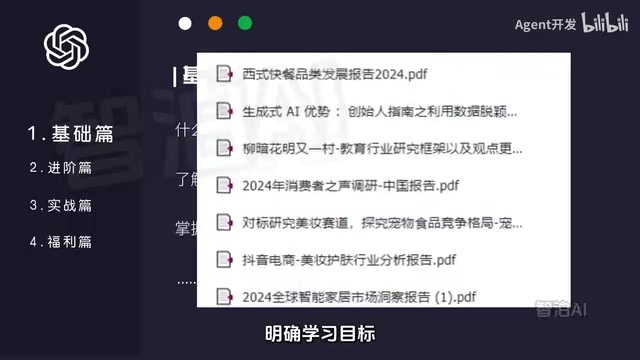
The advanced module also covers agent decision-making application scenarios, tool calling, model fine-tuning, and private deployment solutions. Private deployment is especially critical, driven by three factors: data compliance (regulated data in finance and healthcare cannot be uploaded to third-party servers), cost control (API fees in high-frequency scenarios can far exceed local inference costs), and customization needs. On the technical implementation side, Ollama provides a command-line tool for pulling and running mainstream open-source models like Llama, Mistral, and Qwen with a single command. For enterprise-level high-concurrency scenarios, vLLM leverages its PagedAttention technology (inspired by OS virtual memory management's paging concept, dynamically allocating KV Cache on demand rather than pre-allocating contiguous blocks, fundamentally resolving GPU memory fragmentation) to boost inference throughput by 10–24x over traditional implementations. Quantization techniques (such as 4-bit quantization in GGUF format, which compresses model weights from FP16 precision to 4-bit integer representations, reducing memory footprint by approximately 75% within acceptable accuracy loss) allow 70B parameter models to run on consumer-grade GPUs (such as a single RTX 4090), further lowering the hardware barrier. The maturity of these three types of tools has collectively driven the adoption of private agent deployment solutions and is a necessary step in moving agents from demo to production.
Hands-On Practice: From Project Deployment to Monetization
If the first two modules address cognitive and technical questions, the hands-on practice module focuses on "can it actually be built?" The course covers several project cases closely tied to real business scenarios:
- Digital Human Project: A comprehensive application combining voice, appearance, and conversational capabilities.
- E-commerce Intelligent Customer Service: A typical real-world deployment of AI Agents in a vertical commercial scenario.
- Medical Health Records Assistant: A domain-specific intelligent agent integrated with a professional knowledge base.
- DeepSeek + Agent + Personal Knowledge Base: Building an intelligent agent system with a private knowledge base using a domestic large language model.
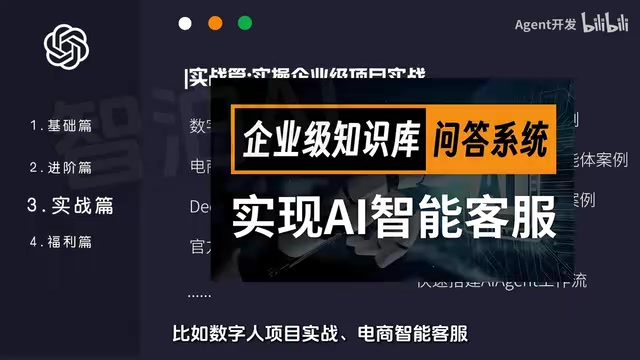
The last case — "Building an Agent + Personal Knowledge Base with DeepSeek" — has strong practical relevance. DeepSeek is a domestic large language model developed by DeepSeek (深度求索). Its R1 series matches GPT-4o in reasoning capability, but API call costs are approximately 1/10 to 1/30 of the latter, with full weights open-sourced and support for local deployment — making it one of the most mainstream base model options in China's Agent ecosystem. DeepSeek-R1 is also notable for its innovative training approach: it uses rule-reward-based reinforcement learning (the GRPO algorithm) rather than RLHF dependent on human annotation, allowing the model to spontaneously develop "long chain-of-thought" reasoning capabilities — particularly advantageous for agent tasks requiring multi-step planning.
Combined with RAG (Retrieval-Augmented Generation) technology to build a personal knowledge base, this has become one of the most mainstream agent deployment solutions for individual developers and small-to-medium businesses. RAG was first formally proposed by Meta AI in 2020. Its workflow consists of three key stages: the Indexing stage splits documents into semantic text chunks and converts them into high-dimensional semantic vectors via an Embedding model (such as OpenAI's text-embedding-3 or the open-source BGE series), storing them in a vector database (such as Chroma, Milvus, or Pinecone); the Retrieval stage uses approximate nearest neighbor (ANN) search algorithms (such as HNSW — a hierarchical navigable small world graph-based index structure that completes similarity searches across millions of vectors in millisecond-level latency) to quickly recall the Top-K most relevant chunks; the Generation stage feeds the retrieved context chunks along with the original question into an LLM to generate the final answer. Compared to directly fine-tuning a model, RAG can inject private or up-to-date knowledge without retraining, at extremely low cost. Advanced RAG variants such as HyDE (Hypothetical Document Embeddings — having the LLM first generate a "hypothetical answer" and then using its vector for retrieval, solving the semantic space misalignment between questions and answers), RAG-Fusion (multi-query fusion re-ranking, improving recall by generating multiple query variants and merging results), and GraphRAG (structured retrieval based on knowledge graphs, open-sourced by Microsoft, capable of capturing inter-document entity relationships and excelling at globally-scoped questions requiring cross-document reasoning) are upgrading RAG from simple semantic search to a deep-reasoning knowledge Q&A system — a core technical pillar for deploying agents in knowledge-intensive scenarios.
Practical Tips for Beginners Learning AI Agent Development
Drawing from this course's design philosophy, here are a few general recommendations for beginners:
First, theory and hands-on practice must go hand in hand. Simply watching videos without building anything makes it very hard to truly master agent development. The course author specifically emphasizes "practical cases combining knowledge and hands-on work" precisely because agent development is fundamentally an engineering discipline.
Second, start with a framework to lower the entry barrier. Whether it's AutoGen or another agent framework (such as LangGraph or CrewAI), running a complete workflow with mature tools is more efficient than diving into low-level principles from the start. Mature frameworks have already encapsulated complex logic for tool calling, memory management, and multi-agent communication, allowing beginners to see working results much faster. It's worth noting that different frameworks suit different scenarios: LangGraph excels at fine-grained workflow control in a state-machine style, CrewAI specializes in role-playing-style agent collaboration, and AutoGen stands out in conversation-driven multi-agent negotiation scenarios. Choose your focus based on the type of project you're targeting.
Third, learn with a goal in mind — focus on employment and monetization directions. The course introduces industry scenarios and job analysis from the very beginning, signaling that learners should be application-oriented rather than aimlessly accumulating knowledge points.
Conclusion
The three-stage path — from theory to components to hands-on projects — represents a relatively mature approach to organizing AI Agent educational content. For learners who want to get started with intelligent agent development, this "full-stack" knowledge structure can effectively reduce the time wasted going down wrong paths.
Of course, any tutorial is only a starting point. Agent technology is still evolving rapidly — from single agents to multi-agent collaboration, from prompt engineering to autonomous planning, from cloud APIs to local private deployment — the technical frontier is redefined every few months. Real capability growth still requires continuous refinement through actual projects.
Key Takeaways
Related articles

The Truth Behind Codex 'Build a Website in 5 Minutes': AI Isn't Creating Sites—It's Helping You Copy Them
Exposing the truth behind viral Codex 5-minute website videos: creators aren't building original sites with AI—they're copying shared prompts or scraping others' work. Learn AI coding tools' real limits.

Getting Started with AI Agent Development: A Complete Guide from Concept to Practice
A comprehensive guide to AI Agent architecture and development, covering automated marketing, intelligent customer service, and investment analysis scenarios with single and multi-agent collaboration.

The Truth Behind Codex 'Build a Website in 5 Minutes': AI Isn't Creating Sites — It's Helping You Copy Them
Exposing the truth behind viral Codex 5-minute website videos: creators aren't building original sites with AI — they're copying shared prompts or scraping others' work.