AI Agent Learning Roadmap: A Four-Week Plan from Zero to Enterprise-Grade Intelligent Agents

A four-week roadmap from Agent theory to enterprise-grade hands-on projects, timed to catch the AI talent wave.
Using Beijing's new intelligent agent AI policy as a starting point, this article argues that Agent engineering is becoming a core industry demand. Based on a 748-episode Bilibili course, it outlines a four-week learning path: Week 1 covers LLM, planning, memory, and tool components; Week 2 dives into ReAct and CoT paradigms; Week 3 tackles multi-agent collaboration, Prompt tuning, and Token economics; Week 4 solidifies everything through real projects. With China's AI talent gap projected at 5 million by 2030, the article concludes the entry window remains wide open.
The winds of AI policy are quietly shifting. A new intelligent agent AI policy rolled out in Beijing contains just 10 provisions — yet it sketches a remarkably clear picture of where China's AI industry is headed over the next few years. Agentic AI, orchestration layer engineering, Token economics, OPC AI companies — terms that once appeared only in academic papers are now showing up in government documents. Wherever policy points, resources and talent demand will follow. People who know how to build Agents may well be among the most sought-after professionals in the next three to five years.
This article is based on a 748-episode beginner-to-advanced AI Agent tutorial on Bilibili. It distills a clear learning path — from zero background to being capable of handling enterprise-level intelligent agent projects — to help you avoid a lot of unnecessary detours.
Policy Signals and the Talent Gap
The business world tends to react fastest to policy signals. According to observations from the tutorial author's team, there has been a noticeable increase in Agent platform job postings recently, with visible salary growth. This reflects the industry's concentrated demand for Agent engineering skills.

CCTV has previously reported multiple times that China's AI talent gap is projected to reach 5 million by 2030. This figure means Agent-related skills will remain in short supply for quite some time. For individuals, the window to break into this space is still wide open.
It's worth noting that while the opportunity is clear, many people struggle with knowing where to start. The author candidly admits being in the same position six months ago, spending four hard months just to get a clear picture. The learning path below is distilled directly from that experience of trial and error.

Week 1: Master the Core Theory of Agents
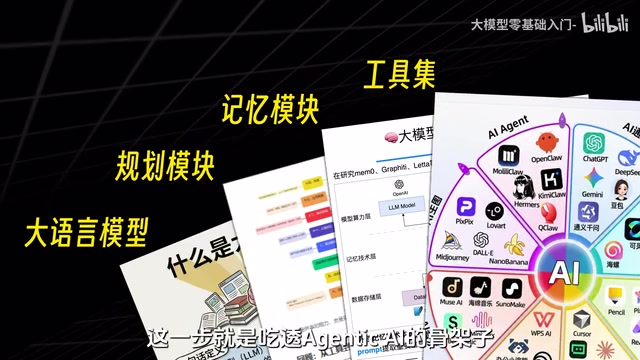
At the beginner stage, the priority isn't rushing to write code — it's understanding the overall architecture of Agents first. An intelligent agent is typically made up of several core components: a large language model (LLM) acting as the brain, a planning module for task decomposition, a memory module for storing context, and a set of tools (Tools) for interacting with the external world.
Getting a clear picture of how these components relate to each other is essentially understanding the "skeleton" of Agent AI. This step may seem foundational, but it determines whether you'll truly understand how Agents operate later on. Many beginners skip the theory and jump straight into frameworks, only to find themselves unable to debug problems — which ends up being far less efficient.
Week 2: Master Working Principles and Classic Paradigms
Week 2 focuses on how Agents work and solutions to common challenges. The key topics here are classic Agent paradigms like ReAct and Chain-of-Thought (CoT).
The ReAct (Reasoning + Acting) paradigm has the model alternate between reasoning and acting, while CoT enhances a model's ability to solve complex problems through chain-of-thought. Understanding these paradigms is fundamentally about understanding "how to get a model to solve problems in an organized way" — which matters far more than simply writing code, and is also the underlying logic of what's called "orchestration layer engineering."
Only by mastering the methodology of problem decomposition and reasoning can you design sensible Agent workflows when facing real business scenarios, rather than being led around by frameworks and APIs.
The ReAct paradigm was proposed by a Google Research team in 2022. Its core idea is to interweave a language model's "Reasoning" with
Related articles

JobRunner MCP Server: AI Agents Can Now Fix Failed Java Jobs
JobRunner launches an open-source MCP server enabling AI agents to view cluster status, diagnose failures, and recover Java jobs—incident response from any cloud coding environment or existing agent.

MLAI Digital Launches 9 Security Agents: MCP Server Safeguards the Full Lifecycle of Agentic AI
MLAI Digital launches Security MCP Server with nine built-in specialized security agents covering vulnerability discovery, attack simulation, prompt injection detection, API and infrastructure assessment, and accelerated remediation—embedding security validation across the full Agentic AI lifecycle from development to production.

Running Isaac Lab on H100 GPUs: Exploring Better Approaches
Exploring optimization methods for running Isaac Lab on NVIDIA H100 GPUs, including MIG configuration, mixed precision, TensorRT acceleration, and community experience to improve robotics simulation and reinforcement learning efficiency.