AI Agent Learning Roadmap: From Fundamentals to Real-World Practice

A three-module AI Agent course that takes learners from core principles to real-world project development.
This article introduces a structured AI Agent development course designed to solve the fragmentation problem plaguing most existing tutorials. The course is divided into three modules — Fundamentals (Agent principles, prompt engineering, workflows), Advanced (RAG, multi-agent collaboration, tool calling, and mainstream frameworks), and Hands-On Practice (real projects including a knowledge base assistant, customer service agent, and office automation tool) — supported by a full set of learning resources to close the learning loop. The key takeaway: learn by building, stay project-driven, and be skeptical of overnight-expert claims.
Why Do So Many Learners Quit AI Agent Development Halfway?
AI Agents are among the hottest directions in applied AI today, yet relatively few learners ever reach the point of building one independently. Before creating a structured course, one Bilibili creator spent a month surveying a wide range of Agent tutorials — from viral videos with hundreds of thousands of views to niche content with only a few hundred — and arrived at a common conclusion: most courses are fragmented and lack a coherent system. After finishing them, learners still can't complete a standalone agent project.
This observation cuts to the core pain point of learning Agent development. The Agent tech stack spans large model invocation, prompt engineering, retrieval augmentation, tool calling, multi-agent collaboration, and more. A gap in any single layer can prevent a project from ever working end-to-end. The real problem with fragmented learning isn't a shortage of knowledge points — it's the absence of a path that connects those points into a complete development capability.
Three Modules That Build a Complete Knowledge System
This course breaks Agent learning into three modules: Fundamentals, Advanced, and Hands-On Practice. The layered structure itself is a systematic answer to the question of how to learn.
Fundamentals: Building the Theoretical and Engineering Foundation
The Fundamentals module focuses on Agent principles, prompt engineering, and workflow design. The goal at this stage is to get up to speed quickly — understanding how an agent perceives, makes decisions, and executes actions. For beginners, prompt engineering is often the most underestimated component. It's far more than crafting a well-worded sentence; it's the key factor that defines an agent's behavioral boundaries and output quality. Workflow design teaches learners how to organize individual model calls into a controlled, multi-step task chain.

Prompt engineering refers to the practice of deliberately designing the instructions passed to a large model in order to guide it toward the desired output. In an Agent context, a prompt must do more than describe a task — it needs to define the agent's role, behavioral constraints, output format, and the conditions that trigger tool calls. Common prompt techniques include Chain-of-Thought (guiding the model to reason step by step), Few-shot examples (providing reference patterns), and structured output constraints (ensuring results can be parsed programmatically). A poorly designed system prompt is often the root cause of unstable agent behavior or poor output quality, which is why this step receives far more attention in engineering practice than most casual users expect.
Advanced: Core Capabilities and Mainstream Frameworks
The Advanced module carries higher technical value, covering RAG knowledge bases, Agent architecture, multi-agent collaboration, and tool calling — all applied through hands-on development with mainstream frameworks. RAG (Retrieval-Augmented Generation) is the key technology for giving agents access to proprietary knowledge, while multi-agent collaboration represents the cutting edge of current engineering practice. Mastering these capabilities is what it truly means to cross the threshold from "using AI" to "building AI."
RAG works by first retrieving relevant document chunks from an external knowledge base when a question is posed to a large model, then feeding those chunks together with the question into the model. This grounds the model's response in real-time, private, or specialized knowledge rather than relying solely on what it learned during training. The approach effectively addresses the hallucination problem and knowledge cutoff limitations of large models, and serves as core infrastructure for enterprise-grade Agent deployments. Building a RAG system typically involves document chunking, vector embedding, vector database storage, and similarity retrieval — steps that present a real engineering learning curve for beginners.
Multi-agent collaboration refers to decomposing complex tasks and distributing them across multiple agents with different roles or capabilities, with a coordinator aggregating the results. Popular frameworks such as AutoGen, CrewAI, and LangGraph all provide multi-agent orchestration capabilities. This architecture can significantly improve the quality of complex task completion, but it also introduces new engineering challenges around inter-agent communication, state synchronization, and error propagation.
Hands-On Practice: Turning Knowledge into Project Experience
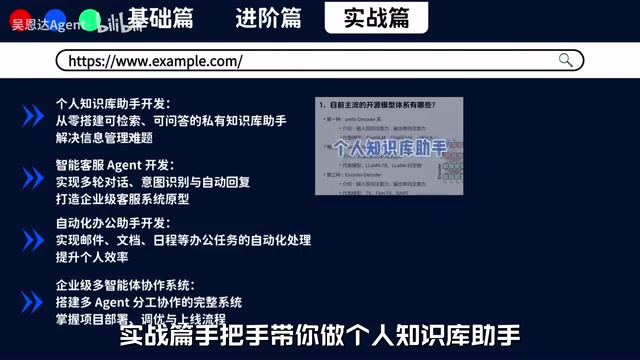
The Hands-On Practice module is where the entire course lands. It walks learners step by step through real projects including a personal knowledge base assistant, an intelligent customer service agent, and an office automation assistant. These projects cover the most mainstream Agent deployment scenarios — knowledge management, customer service, and office automation — making them highly transferable to real-world work.
Learning by Doing: The Value of Supplementary Resources
To lower the barrier for beginners, the creator has compiled a full set of supplementary materials including a learning roadmap, prompt templates, deployment tools, lecture notes, and hands-on project notes. This kind of "learn and practice simultaneously" resource pack is especially valuable for self-directed learners, because Agent development is a practice-driven skill — watching videos without getting your hands dirty rarely translates into real capability.
From a course design perspective, these supplementary resources close the learning loop: the roadmap provides direction, templates reduce the difficulty of getting started, and deployment tools bridge the gap between writing code and actually running it.

Advice for Learners
The greatest value of a structured course like this is that it offers a well-mapped path, helping learners avoid the detours of fragmented study. That said, it's worth approaching claims like "go from zero to expert in seven days" with healthy skepticism. Agent development is an engineering skill that requires continuous, accumulated practice. Real growth comes from repeatedly building and debugging projects — not from passively consuming course hours.
For readers who want to learn AI Agent development systematically, the modular framework of this course offers a solid reference: start by solidifying your understanding of core principles and prompt engineering, then tackle advanced capabilities like RAG and multi-agent systems, and finally validate what you've learned through complete end-to-end projects. Regardless of which course you choose, "learn by doing, driven by projects" remains the most effective approach to mastering agent development.
Related articles

Anthropic IPO Explained: Fuel for the AI Boom or the Spark for a Bubble?
Anthropic files for an IPO under ticker ANT. Breaking down the prospectus: 80% of revenue from usage-based pricing, $72B of an $80.7B net loss being non-cash charges, 900% net revenue retention, and how past IPOs like SpaceX performed on day one and over three years — answering the AI bubble question.

Will AI Kill the Research Paper? Mathematicians Offer a New Answer
Mathematicians on the Lex Fridman podcast discuss whether AI will kill research papers—from journal review pressure to Lean formal verification, GitHub open source fatigue to Mathlib's crowdsourcing model, exploring the evolution of academic contributions and the future of mathematical knowledge verification.

Enterprise LLM Development: From RAG to Multi-Agent in Practice
A course breakdown of enterprise LLM application development: from prompt engineering and RAG to multi-agent engineering practice and FDE project delivery, helping developers understand why Agent technology is a key focus for enterprise deployment and learn systematically to avoid detours.