AI Agent Learning Roadmap: How Beginners Can Get Up to Speed Without Wasting Time

A three-step, output-first learning roadmap to help beginners break into AI Agent development without wasting time.
Adapted from a Bilibili creator's methodology, this article argues that beginners should learn AI Agents with employment and output as their north star — cutting scope ruthlessly rather than chasing every new term. It introduces the formula Agent = LLM + Memory + Tools, then lays out three steps: filter all topics into must-learn/good-to-know/skip; drive learning through one real project; and choose the fastest path to shipping results. The full roadmap is: Python speed run → LLM fundamentals → RAG → Agent → real-world project integration.
AI Agent development has been on fire lately — from large language models and RAG to LangChain and multi-agent collaboration, new concepts keep emerging at a dizzying pace. For beginners trying to break in, the biggest challenge usually isn't difficulty — it's not knowing what to learn and what to skip. This article is adapted from a Bilibili creator's methodology for learning Agent development. The core idea: instead of chasing every new buzzword, plan a clear learning path around your actual goals.
Build the Right Mindset Before Diving into Agents
When faced with a flood of constantly updated technical terms, the most common mistake is letting the jargon intimidate you — falling into the trap of "learn one thing, another pops up." The creator offers a vivid analogy: learning to build Agents is like learning to drive. New car models come out every year, but what you need to master is driving, not how to manufacture an engine.
In other words, as an application developer, you don't need to start from low-level math proofs and algorithm derivations. What you need is to learn how to call and combine existing capabilities to solve real problems. Technology changes every day, but the underlying logic of application development stays stable — and that's the foundation of this entire learning roadmap.
The creator breaks learners into three types: those who watch videos for entertainment; those who want to study fundamentals, derive formulas, and do algorithm research; and the largest group — people who want to use Agents to find jobs, build projects, or take on freelance work, but don't know where to start. This methodology is primarily aimed at the third group: pragmatic learners driven by employment and output.
One Core Formula: Agent = LLM + Memory + Tools
To understand what an Agent actually is, remember this simplified formula: Agent = LLM + Memory + Tools.
Sticking with the driving analogy: the LLM is the engine, memory is the fuel tank, and tools are the components that actually make the car move and do work. What truly determines whether an Agent can complete a task is usually its tool-calling capability.

Based on this formula, everything you need to learn falls into two main categories:
- Model knowledge: prompt engineering, API calls, RAG (Retrieval-Augmented Generation)
- Engineering skills: LangChain framework, tool calling
As for the underlying principles — knowing the general idea is enough. You don't need to get lost in mathematical derivations. This deliberate trade-off is the key to dramatically compressing your total learning load.
RAG (Retrieval-Augmented Generation) is one of the core implementations of the "memory" module in Agent systems. A large model's knowledge is frozen at its training cutoff — it can't access your company's internal documents or real-time information. RAG works by splitting external documents into small chunks, vectorizing them, and storing them in a database. When a user asks a question, the system first retrieves the most relevant chunks from the database, then injects those chunks into the prompt for the model to generate an answer. This allows the model to "reference" private knowledge it was never trained on. Understanding the basic RAG pipeline — document chunking → vectorization → retrieval → generation — is a prerequisite for building enterprise knowledge base Agent projects, and it's the most technically intensive piece of the "must-learn" portion of this roadmap.
LangChain is one of the most popular Agent development frameworks available today. It provides standard interfaces for chaining together LLMs, memory, tools, and RAG pipelines, so developers don't have to build every integration from scratch. Think of it as a "building block" toolkit: model calls, document loaders, vector retrieval, tool calls — all come as ready-made modules you can compose as needed to run a complete Agent pipeline. For application developers, getting comfortable with LangChain's chained calls and AgentExecutor logic is an important shortcut to shipping real projects quickly.
Three-Step Approach: From Knowledge Map to Real Projects
The full learning roadmap can be broken into three steps, each focused on doing less and focusing more.
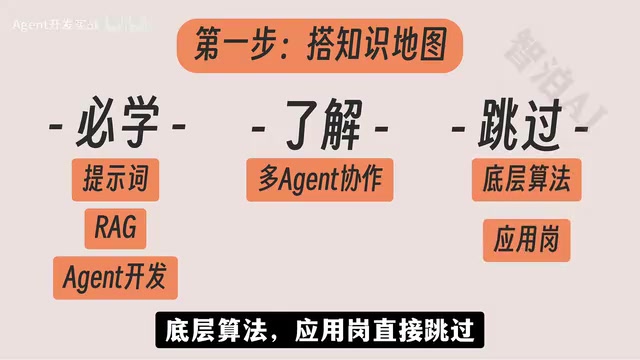
Step 1: Build a Knowledge Map — Classify and Filter
Divide all learning topics into three buckets — must-learn, good-to-know, and skip:
- Must-learn: prompt engineering, RAG, Agent development
- Good-to-know: multi-agent collaboration (rarely used in production)
- Skip entirely: low-level algorithms, underlying theoretical derivations
This single filtering pass alone cuts your learning load in half. For beginners, being willing to skip things is more important than trying to learn everything.
Step 2: Project-Driven Learning — Connect the Dots
Use one real project to tie all the concepts together. For example, if you're building an enterprise knowledge base, go deep on the RAG pipeline: document chunking, retrieval, and recall. Running through the full workflow around a single project is far more effective than studying ten isolated topics in a vacuum. A project naturally forces you to fill in the skills you actually need — rather than passively accumulating buzzwords.
Project-driven learning is highly efficient because it transforms passive input into active debugging. When you're working on a real-world scenario like an enterprise knowledge base, you'll naturally run into concrete problems — failed document parsing, low retrieval recall rates, context length overflow — and the knowledge you gain from solving those problems sticks far better than taking notes from a lecture. When choosing a project, prioritize "closed-loop" ones with clear inputs, processing steps, and visible outputs — for example: upload a PDF → a Q&A bot returns answers with cited sources. These projects work well as portfolio pieces, and they naturally weave together RAG, tool calling, and prompt engineering along the way, preventing concepts from floating in isolation.
Step 3: Calculate ROI — Choose the Right Path
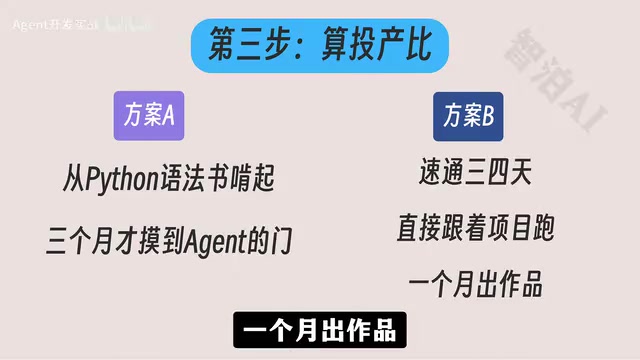
Finally, do the math on your learning return on investment. The creator compares two scenarios:
- Option A: Start from Python syntax basics — three months before you even touch Agent development
- Option B: Speed through the basics in three to four days, jump straight into a project, ship something in a month
The conclusion is straightforward: opportunity windows don't wait. Option B is the more practical choice. For people whose goal is employment and freelance work, shipping visible output as quickly as possible is more valuable than chasing a perfectly complete knowledge system.
The Full Roadmap and Three Self-Check Questions
Putting all three steps together, the complete learning path looks like this:
Python speed run → LLM fundamentals → RAG → Agent development → Real-world project integration
The goal of this roadmap isn't to cover every cutting-edge concept — it's to find the shortest path to actually shipping something.
More importantly, this gives you a decision framework for evaluating any new concept. Whenever something new goes viral, ask yourself three questions:
- Will I actually use this in my target project?
- Will learning it produce something visible and tangible?
- Is the ROI — time invested vs. return — actually worth it?
Think through these three questions, and you'll know whether to invest time in learning something new. Technology evolves every day, but as long as you plan around your goals, you won't be led around by the nose by an endless stream of buzzwords.
Final Thoughts
The greatest value of this methodology isn't that it prescribes a specific framework tutorial — it's that it offers an "outcome-first" learning mindset. For the vast majority of people who want to use AI Agents to find jobs or build projects, choosing the right direction and being willing to make trade-offs will do more for your learning efficiency than grinding through everything.
One important caveat: this approach is oriented toward employment, and intentionally de-emphasizes foundational theory. If your goal is algorithmic research or a deep understanding of model mechanics, you'll need a different, more systematic learning path — the "skip the fundamentals" strategy here doesn't apply to you.
Related articles

From Enterprise Practice to a Reusable Template: Lessons from Building an AI Agent
A developer shares an open-source AI Agent template built from an enterprise project, covering natural language data Q&A, analysis, auto-generated PPTs, and email distribution.

Nintendo's Open-World Design Evolution: Breaking Down Fire Emblem Fortune's Weave
Nintendo brings the open-world design philosophy of Breath of the Wild to Fire Emblem with the massive Switch 2 title Fortune's Weave. Here's what it means.
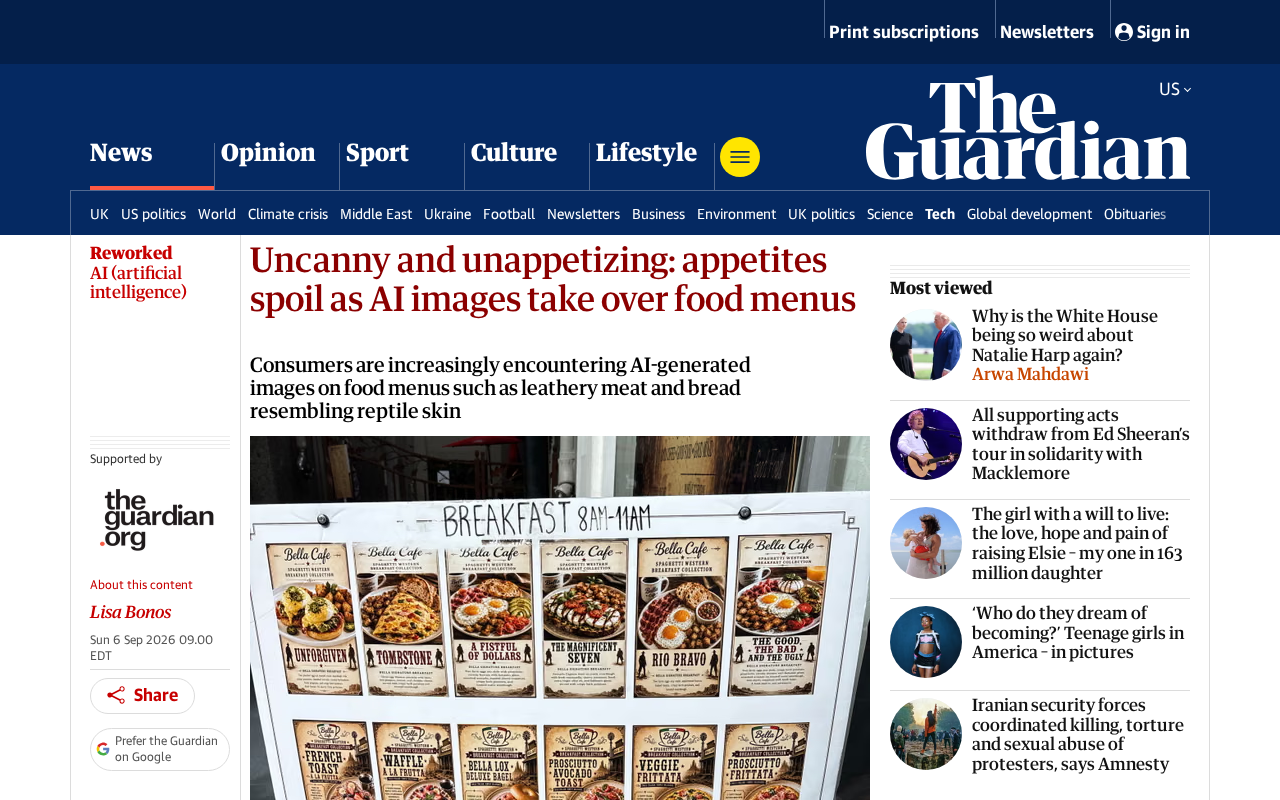
AI-Generated Food Photos Are Ruining Menus: How the Uncanny Valley Kills Appetite
AI-generated food images are flooding restaurant menus and delivery apps, but uncanny details kill appetite instead of sparking it. Here's why the uncanny valley effect hurts brands.