AI Agent Memory Design in Practice: A 4.5-Hour Workshop Breaks Down the Persistent Memory Challenge

The core of Agent memory isn't storing chat logs—it's strategically retaining, retrieving, consolidating, and forgetting.
This article introduces a 4.5-hour online workshop led by Oracle's Nacho Martínez Rincón on designing and implementing persistent memory for Agents built on frameworks like LangChain and LangGraph. It points out that the real challenge of Agent memory is the scarcity of the context window: more memory means easier overload, while less memory means worse cross-session continuity. The workshop covers cross-session persistence, memory extraction and retrieval, memory consolidation and forgetting, and context window load management, with hands-on practice based on Python and the Oracle Agent Memory Package and no prior Oracle experience required. Participants receive code, notebooks, and recordings. The article concludes by emphasizing that making "forgetting" a formal topic reflects how Agent memory engineering is shifting from "store as much as possible" to "manage selectively."
Why Agent Memory Is More Than Just Storing Chat Logs
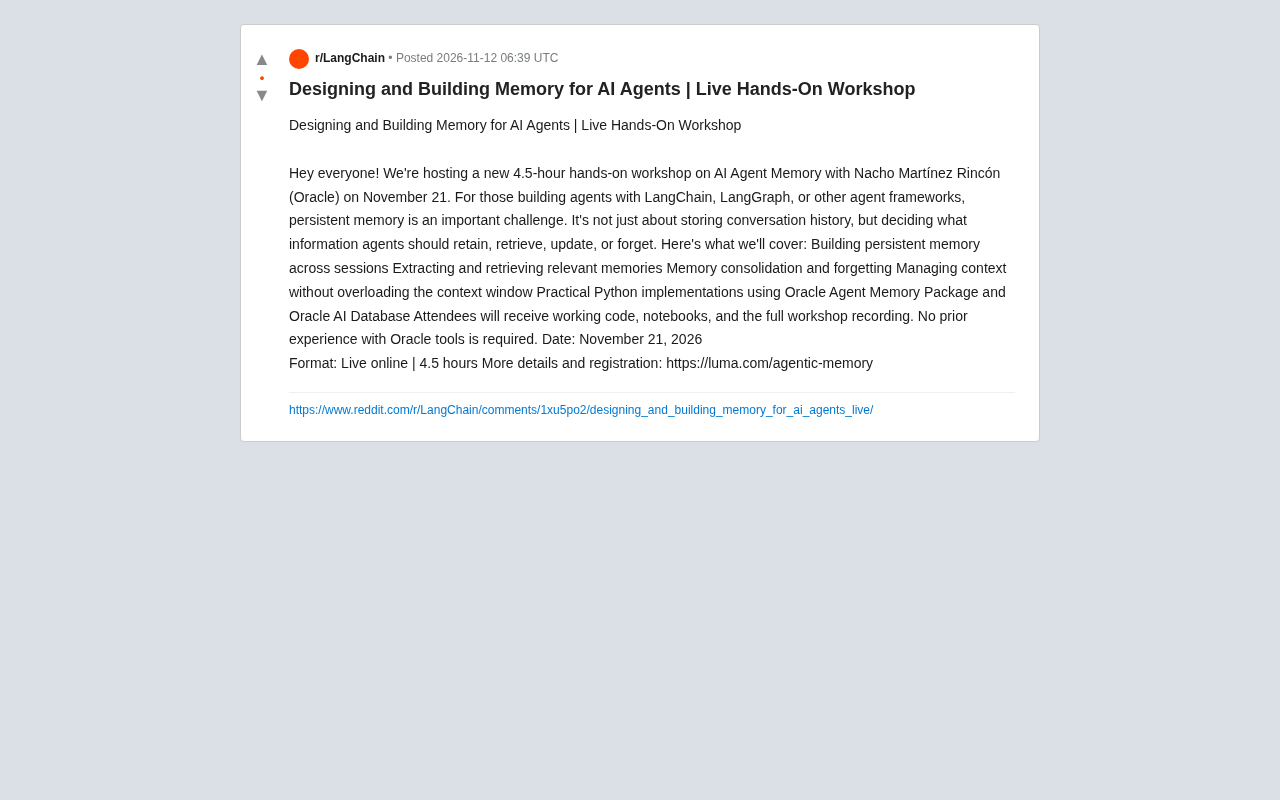
When adding memory to an Agent, many people's first instinct is to stuff the conversation history into a vector database. But according to a hands-on workshop announced on Reddit, the real challenge lies in judgment: which information should be retained, which should be retrieved, which should be updated, and which should be forgotten. This 4.5-hour online workshop, led by Oracle's Nacho Martínez Rincón, focuses precisely on persistent memory for Agents built on frameworks like LangChain and LangGraph.
The essence of this problem is the scarcity of the context window. Every round of Agent inference must carry memory—the more memory, the more easily the context gets overloaded; the less memory, the worse the continuity across sessions. The workshop lists "managing memory without overloading the context window" as a standalone topic, which shows that simply expanding the context is not the solution.
Context window refers to the upper limit on the number of tokens a large language model can process in a single inference, including the system prompt, conversation history, retrieved memories, and the current user input. The context windows of mainstream models have expanded from the early 4K and 8K to 128K and even 1M tokens today, but a larger window does not equal a solved memory problem: on one hand, filling it with irrelevant content dilutes the model's attention to key information (the "lost in the middle" phenomenon); on the other hand, a longer context means higher inference cost and latency. Therefore, the design goal of an Agent memory system is to place only the information most relevant to the current task within a limited context budget, rather than cramming in all history. This is also why retrieval, consolidation, and forgetting strategies for memory are just as important as storage itself.
The Five Memory Stages Covered by the Workshop
According to the outline published by the organizers, the content covers the complete chain from storage to forgetting:
Building Cross-Session Persistent Memory
Keeping an Agent's state across two sessions is the first layer of persistent memory. The engineering problems involved include storage selection, read/write timing, and data model design. The workshop will include Python hands-on practice using the Oracle Agent Memory Package and Oracle AI Database, and it explicitly states that no prior experience with Oracle tools is required.
Memory Extraction and Retrieval
Stored memory does not equal usable memory. How to extract fragments relevant to the current task from a large amount of history is the core of the retrieval layer. This stage directly determines the quality of the Agent's answers—if retrieval is off, no amount of subsequent reasoning power will help.
Memory Consolidation and Forgetting
This is the stage most tutorials tend to skip. Memory consolidation refers to summarizing scattered information into higher-level knowledge, while forgetting means strategically discarding low-value content. Together they control the rate at which the memory store expands and also affect retrieval accuracy.
Memory consolidation borrows a concept from cognitive science; in the Agent context, it refers to summarizing multiple scattered, repetitive, or low-level experiences into a more refined higher-level representation. For example, consolidating "the user mentioned liking science fiction on Monday" and "the user mentioned having read The Three-Body Problem on Wednesday" into "the user prefers science fiction literature." Common implementations include periodic summarization, entity/fact extraction written into a structured memory store, and similarity-based clustering and merging. Consolidation can significantly reduce the number of memory entries and improve the signal-to-noise ratio of retrieval, but it also carries the risk of information loss—over-compression may discard details useful for specific tasks, so a trade-off between compression rate and fidelity is needed.
Memory forgetting is typically implemented in engineering through several mechanisms: time-decay-based weighting (the older the memory, the lower its retrieval priority), access-frequency-based eviction (similar to an LRU cache strategy), importance-score-based pruning (the model or rules determine whether a memory still has value), and explicit expiration and deletion strategies (such as clearing temporary task context after a task is completed). The opposite of forgetting is unbounded growth of the memory store, which leads to slower retrieval, more noise, and higher storage costs. Compared with the default "append-only" mode of vector databases, introducing a forgetting strategy means the memory system needs to maintain metadata (timestamps, access counts, importance labels), which also imposes additional requirements on data model design.
Context Window Load Management
Even with a well-designed memory store, the amount stuffed into the context still needs to be controlled. The workshop lists this as a separate item, implying that a common failure mode in practice is: the memory system is built, but every call floods in excessive content, diluting the model's attention.
Hands-On Path and Target Audience
The workshop is centered on Python code, and participants will receive runnable code, notebooks, and a complete recording. This delivery format is fairly friendly to self-learners—a 4.5-hour live stream is hard to follow in full, but the recording and code allow for later reproduction.
In terms of the tech stack, the content is aimed at developers already using LangChain, LangGraph, or other Agent frameworks. For those who have never touched an Agent framework at all, the memory layer is an advanced topic, and the prerequisite knowledge gap may be significant. The organizers specifically note "no Oracle experience required," indicating that the database portion will start from the basics and will not assume the audience is familiar with the Oracle ecosystem.
LangGraph is a framework introduced by the LangChain team for building stateful, multi-step Agent applications. Its core abstraction is the "graph": nodes represent processing steps (such as calling a model or executing a tool), edges define control flow, and the built-in checkpointer mechanism can persist the graph's execution state to external storage, thereby supporting cross-session recovery and long-term memory. This is directly related to the persistent memory discussed in this article—the checkpointer is responsible for saving the Agent's runtime state (including message history), while the memory layer builds on this to decide what is worth keeping long-term and how to retrieve and update it. Understanding this layering helps distinguish two different levels of engineering problems: "state persistence" and "semantic memory management."
A Signal Worth Noting
Making "forgetting" a formal topic rather than an afterthought reflects that Agent memory engineering is shifting from "store as much as possible" to "manage selectively." The practice of endlessly piling up conversation history is barely workable in short-session scenarios, but once an Agent needs to run long-term, the write, update, and eviction strategies for memory become key variables in system stability. This workshop places consolidation and forgetting alongside persistence and retrieval, which can be seen as a microcosm of this shift in understanding.
For developers building Agents, rather than finding yet another vector database, what's more worth thinking through first is: when should your Agent forget what?
Event information: November 21, online live stream, 4.5 hours long. For registration details, see luma.com/agentic-memory.
Related articles

Prompt Engineering for Beginners: From Writing Prompts to Engineering Thinking
Starting from the essence and four functions of prompts, this article systematically explains the six-step process, four success criteria, learning value, and practical limitations of prompt engineering to help you build a complete understanding.

Anthropic Launches Nasdaq IPO: AI Giant's Listing and Risk Disclosures
Anthropic officially launches its Nasdaq IPO under ticker ANT, with market valuation expected to potentially exceed SpaceX's record. The prospectus devotes nearly 100 pages to AI risks, while first-half revenue grew over 14x but net losses widened sharply, reigniting the AI bubble debate.

Rust cURL Clone Uses 4,832 unsafe Blocks—Is the Memory Safety Myth Broken?
A Rust cURL clone uses 4,832 unsafe keywords, challenging Rust's memory safety narrative. We analyze what unsafe really means, compare Fil-C, and examine rewrite motives.