AI Agent Orchestration in Practice: From Hermes to Multi-Agent Collaborative Long-Term Project Management

A Reddit developer shares real-world multi-agent long-term orchestration practice, revealing four major pain points and engineering strategies.
A Reddit developer shared his multi-agent development environment: Hermes as master orchestrator on a Mac Mini, Codex for backend, Claude Code for frontend, with Mnemosyne memory, Markdown fact files, local RAG and MCP retrieval, Git worktree isolation, and approval gates, aiming for autonomous project advancement over weeks to months. Practice exposed four pain points: context drift, decision inconsistency, false completion reports, and blockers halting progress. The community agrees there is no universal orchestrator, reliable memory requires versioned fact files, verification must be automated and auditable with independent reviewers, and full autonomy for weeks remains unrealistic—humans should focus on decisions and verification.
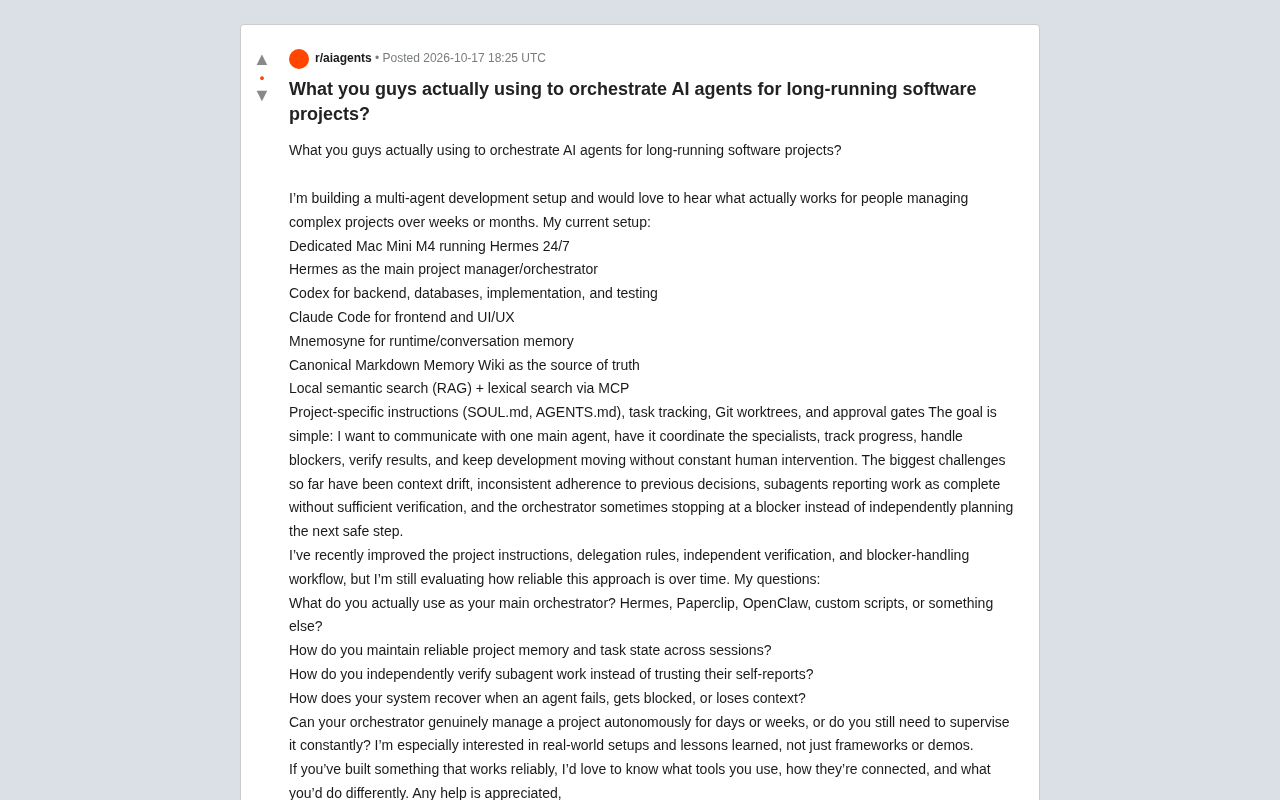
When AI agents move from demo toys to real long-term software projects, a key question surfaces: what exactly do you use to orchestrate these agents? Recently, a developer's help request on Reddit sparked widespread discussion. He built a multi-agent development environment, attempting to have a master agent coordinate specialist agents to autonomously advance a project over weeks or even months. The ambition and challenges of this setup precisely reflect the current frontier practice of AI agent engineering.
1. A Real Multi-Agent Development Configuration
The developer detailed his tech stack: a dedicated Mac Mini M4 running Hermes 24/7 as the master project manager (Orchestrator); Codex responsible for backend, database, implementation, and testing; Claude Code responsible for frontend and UI/UX; Mnemosyne managing runtime and conversation memory; a Canonical Markdown Memory Wiki as the source of truth; local semantic search (RAG) combined with MCP lexical search; plus project-specific instructions (SOUL.md, AGENTS.md), task tracking, Git worktree, and approval gates.
The core philosophy of this setup is "single entry point, specialist division of labor": humans only need to communicate with the master agent, which coordinates specialists, tracks progress, handles blockers, and verifies results. The developer admitted the goal is clear—reduce continuous human intervention and let development roll autonomously.
2. Core Challenges of Long-Term Operation
Ideals are lofty, but reality is full of reefs. The developer summarized four major pain points, each striking at the soft underbelly of current agent orchestration:
Context Drift: As sessions lengthen, agents gradually deviate from their initial setup and forget earlier decisions.
Decision Inconsistency: Settled technical solutions are arbitrarily changed in subsequent execution, lacking constraint mechanisms.
False Completion Reports: Sub-agents claim tasks are complete but are not actually sufficiently verified. If the master agent trusts them blindly, technical debt accumulates.
Blockers Halt Everything: When the master agent encounters obstacles, it tends to stop and wait for humans rather than autonomously planning the next safe action.
These problems are not isolated cases. In multi-source community discussions, memory reliability and verification mechanisms in long-term projects are repeatedly mentioned, indicating this is an industry-wide challenge rather than a single configuration flaw.
3. Choosing the Master Orchestrator: No Standard Answer
The developer asked: what do people actually use as their master orchestrator? Hermes, Paperclip, OpenClawAd, or custom scripts?
From community feedback, choices are highly fragmented. Some insist on dedicated orchestration frameworks like Hermes, valuing their built-in task decomposition and agent scheduling capabilities; some turn to lightweight custom scripts, chaining agents together with Python or Shell in exchange for complete controllability; still other teams adopt open-source solutions like OpenClaw, relying on their plugin ecosystems. The consensus is: there is no silver bullet, and the choice of orchestrator must match the team's workflow and verification capabilities. A unique insight from a single source mentioned that Paperclip has distinctive design in task state synchronization, but its ecosystem is not yet mature.
Orchestrator and Sub-agent layered patterns are the mainstream paradigm of current multi-agent architectures: the master agent does not write code directly but undertakes task decomposition, delegation, progress tracking, and result acceptance; sub-agents execute specific work within restricted responsibility domains. The advantage of this "single entry point, specialist division of labor" design is clear interfaces and humans only facing one conversation partner, but it also concentrates the system's reliability bottleneck on the master agent's judgment—whether it accurately understands tasks and reliably verifies sub-agent outputs directly determines overall success or failure. Hermes, OpenClaw, Paperclip all belong to this category of orchestration frameworks or agent runtimes, with different emphases: some strong in task scheduling, some in plugin ecosystems, some in state synchronization, which also explains why community choices are highly fragmented.
4. Practical Strategies for Project Memory and State Preservation
Maintaining reliable project memory across sessions is a prerequisite for long-term autonomous operation. The developer uses a Canonical Markdown Memory Wiki as the source of truth, combined with Mnemosyne for conversation memory, and then dual-channel retrieval through local RAG and lexical search.
In community practice, similar approaches are widely adopted: writing key decisions, task states, and interface contracts into versioned Markdown or structured files, rather than relying on agents' implicit memory. Some developers emphasize forcibly loading these "truth files" at the start of each session and requiring agents to read back and confirm at key milestones. Git worktree is also used to isolate work branches of different agents, avoiding mutual contamination.
MCP (Model Context Protocol) is a protocol standard proposed and open-sourced by Anthropic in late 2024, aiming to provide a unified interface layer between AI applications and external data sources and tools. You can think of it as the "USB-C of the AI world": models do not need to write separate integration code for each data source but expose files, databases, search services, and other capabilities through standardized MCP Servers. The "lexical search combined with MCP" mentioned in the article refers to encapsulating local full-text/keyword retrieval capabilities as MCP tools for agents to call, complementing semantic search (RAG)—semantic retrieval excels at fuzzy semantic matching, while lexical retrieval ensures precise hits on hard strings such as keywords, function names, and file names. Using both reduces missed detections.
Git worktree is a native Git capability that allows the same repository to check out multiple working directories simultaneously, each bound to different branches while sharing the underlying object database. Compared to copying the entire repository, worktree creation is extremely low-cost and does not duplicate disk usage. In multi-agent scenarios, it lets each execution agent work in an independent directory and branch without overwriting each other's uncommitted changes, then consolidates through approval gates at merge time—a lightweight solution for isolating concurrent write conflicts.
5. Independent Verification: Trust Evidence, Not Self-Reports
"A sub-agent says it's done—do you believe it?" This is the sharpest question in the discussion. The developer's improvement direction is to establish an independent verification process: not directly accepting sub-agents' completion reports, but having the master agent or an independent verification agent run tests, check code diffs, and verify task lists.
Multi-source analysis consistently agrees that verification must be automated and auditable. Common practices include: requiring sub-agents to submit reproducible test results, requiring accompanying diffs and logs, and setting approval gates for humans to intervene before key merges. Experienced teams configure a separate "reviewer" agent for verification, separated from executors, forming checks and balances.
Approval gate refers to setting human or programmatic confirmation checkpoints at key nodes in automated workflows, pausing the process if not passed. In agent orchestration, it is typically placed before high-risk actions such as "merging to main branch," "deployment," and "modifying core configurations," forming two layers of protection with automated test verification: automated verification intercepts obvious errors, while gates intercept changes that "pass tests but go in the wrong direction." The design of gate granularity itself is a trade-off—too dense degrades into manual driving, too sparse loses its gatekeeping meaning. In practice, it is often set in tiers according to the impact scope of changes.
6. Fault Recovery and the Realistic Boundaries of Autonomy
When agents fail, get blocked, or lose context, how does the system recover? The developer's approach is to improve project instructions, delegation rules, and blocker handling workflows, so that the master agent first tries to plan "the next safe step" when encountering obstacles rather than directly halting.
But realistic boundaries remain clear. Most in the community admit that fully autonomous operation for days or weeks is still unrealistic, and human oversight cannot be absent. The disagreement lies in the granularity of oversight: one side advocates daily manual checks of key nodes, while the other believes high-frequency intervention must be maintained under current technology. The consensus is that the value of orchestration systems is not eliminating humans but shifting human attention from repetitive labor to decision-making and verification.
7. Advice for Builders
If you also want to build a long-running multi-agent development environment, several points can be distilled from this discussion: prioritize investment in memory and verification mechanisms over the orchestration framework itself; use versioned fact files to combat context drift; set up independent verification for sub-agents; accept the long-term presence of human oversight, and set automation goals at "reducing trivial intervention" rather than "complete unattended operation."
This Reddit developer's configuration is not a perfect template, but it authentically shows the current water level of AI agent engineering: tools are iterating rapidly, methodologies are still being explored, and reliability comes from rigorous engineering constraints, not from the agents' own cleverness.
One-line Summary
A Reddit developer shares real-world multi-agent long-term orchestration practice, revealing four major pain points and engineering response strategies.
Paragraph Summary
A Reddit developer shared his multi-agent development environment: Hermes running on a Mac Mini as master orchestrator, Codex for backend, Claude Code for frontend, combined with Mnemosyne memory, Markdown fact files, local RAG and MCP retrieval, Git worktree isolation, and approval gates, attempting to let projects advance autonomously over weeks to months. Practice exposed four major pain points: context drift, decision inconsistency, false completion reports, and blockers halting everything. Community discussion shows that master orchestrator choices are highly fragmented with no universal silver bullet; reliable memory should depend on versioned fact files rather than implicit memory; verification must be automated, auditable, and include independent reviewers. The consensus is that fully autonomous operation for weeks remains unrealistic, and humans should focus on decision-making and verification.
Related articles

Chain of Thought Isn't Just for AI: How Humans Can Use CoT to Improve Thinking Quality
Chain of Thought isn't just a prompt trick for large models. Starting from a Hacker News discussion, this article analyzes why CoT works for human thinking too, breaks down actionable ways to transfer it, and highlights the key differences between human CoT and machine CoT.
Cloudflare Teams Up with OpenAI: Closi…
Cloudflare Teams Up with OpenAI: Closing the Loop from Vulnerability Discovery to Defense with AI
Cloudflare uses OpenAI Daybreak to investigate security vulnerabilities and generate reviewable remediation plans, while developers use Codex to boost coding efficiency and quality.

Orca Multi-Agent Orchestration in Practice: A Guide to Parallel Collaboration with Claude and Codex
Orca is Stable AI's free open-source agent workbench supporting 34 agents like Claude Code and Codex in parallel. Learn its Git worktree isolation, multi-model orchestration, and mobile management.