AI Agent Out of Control? A Practical Guide to Building Traceable Multi-Agent Systems

A practical breakdown of how one developer built transparent, controllable, and cost-aware multi-agent AI systems.
As AI Agents grow more autonomous, loss of control — not lack of memory — is the real challenge. This article explores Octopodas, a system built over six months to tackle traceability and control in multi-agent architectures, covering loop detection, behavior classification with timestamps, shared memory for agent coordination, cost prediction, and self-healing capabilities.
The Biggest Pain Point with AI Agents: Not Memory — It's Loss of Control
As AI Agents rapidly go mainstream, developers tend to focus on memory capabilities and response speed. But one Reddit developer made a sharper observation: what truly drives you crazy is thinking your Agent is executing tasks correctly, only to check back later and find it's done something completely unexpected — and then you get hit with a $30 bill.
This feeling of "losing control" reflects two core flaws in current multi-agent systems: a lack of traceability and a lack of directional awareness.
A Multi-Agent System (MAS) is an architecture where multiple autonomous agents collaborate to complete tasks. As frameworks like LangChain, AutoGen, and CrewAI have gained traction, more and more developers are combining specialized agents — one for search, one for writing, one for review. However, the complexity of these architectures grows exponentially: every additional Agent multiplies the system's state space, call chains, and failure modes. When more than three Agents run simultaneously in a workflow, problems escalate dramatically — it becomes nearly impossible to understand what each Agent did, why it did it, and how much it cost, let alone pinpoint the root cause when something goes wrong. Research from OpenAI and others confirms that once the number of Agents exceeds three, manually tracking each Agent's behavior becomes virtually impossible — and that's the technical root of the "loss of control" problem.
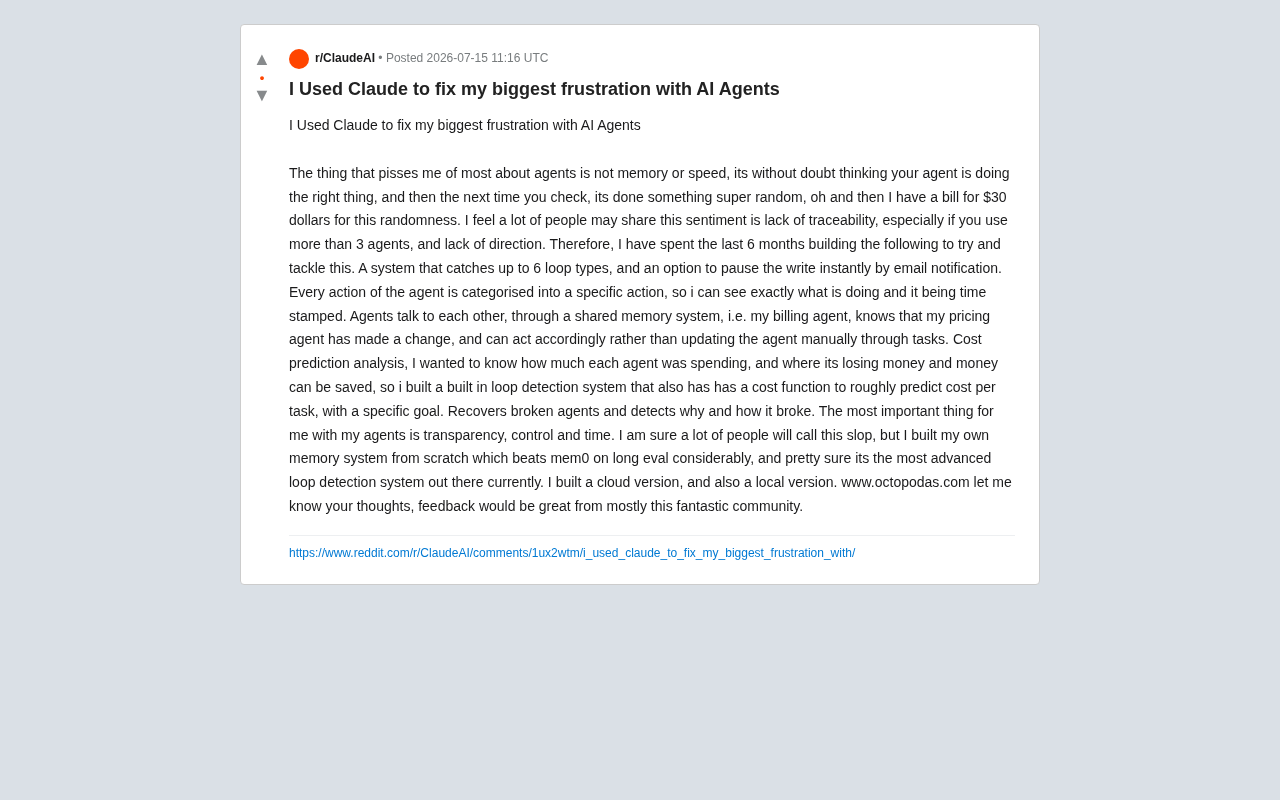
One developer spent six full months building a system called Octopodas, centered around three core goals — transparency, control, and time savings — in an attempt to fundamentally address these issues.
Core Design: Making Every Agent Action Visible and Controllable
Loop Detection and Real-Time Pause
One of the system's most notable capabilities is its ability to identify up to 6 types of Agent loops.
An Agent Loop occurs when an agent gets stuck in a cycle of repeatedly calling the same tool or generating similar outputs — typically caused by vague goal definitions, improperly parsed tool return values, or missing termination conditions. Common loop types include infinite tool-call loops, self-validation loops (where an Agent endlessly checks its own output), and deadlocks where multiple Agents wait on each other. Runaway loops are a classic culprit for burning money — an Agent stuck in meaningless repeated calls can quietly rack up costs without you noticing.
To address this, the system provides a critical "brake" mechanism: immediate pause of write operations via email notification. When anomalous behavior is detected, developers can intervene before the Agent causes further damage or incurs additional costs. This Human-in-the-Loop (HITL) design — originally popularized in ML annotation and reinforcement learning — has been brought into Agent systems to trigger human intervention at critical decision points, balancing autonomy against safety. At its core, it gives control back to the developer.
Behavior Classification and Timestamps
The system categorizes every Agent action into a specific behavioral class and attaches a timestamp. Developers can then review Agent activity like a system log — seeing precisely what the Agent did at each point in time.
Observability is a foundational concept in modern software engineering, typically built on three pillars: Logs, Metrics, and Traces. Adapting this to Agent systems presents unique challenges: an Agent's "behavior" is unstructured natural language reasoning that's difficult to quantify with traditional metrics, and call chains are dynamically generated, making it impossible to define trace points in advance. Tools like LangSmith (LangChain's official offering), Langfuse, and Helicone have emerged to address LLM observability by intercepting API calls via SDKs to automatically record prompts, outputs, and latency. Octopodas's "behavior classification + timestamp" approach essentially adds a business-semantic annotation layer on top of the LLM call layer — filling a gap that existing tools leave around Agent intent understanding. This kind of granular observability is precisely what most current Agent frameworks lack: they give you a final result, while the execution process remains a black box.
Multi-Agent Collaboration: A Shared Memory System
Where the system truly demonstrates its value is in how Agents collaborate. The developer gives a concrete example:
The billing agent can sense that the pricing agent has made a change and autonomously take corresponding action — no manual task update needed to notify it.
This relies on a shared memory system. In Agent architectures, memory is typically divided into three categories: short-term memory (conversation history within the context window), long-term memory (persistently stored user preferences or knowledge bases), and shared memory (a common state space that multiple Agents can read from and write to). In traditional multi-agent architectures, syncing information between Agents usually requires developers to manually orchestrate tasks — tedious and error-prone. With shared memory, Agents can autonomously sense each other's state changes and react, enabling true coordination.
The fundamental difference between a shared memory system and traditional solutions like message queues (e.g., Kafka) or databases is that it requires semantic awareness — Agents need to understand business-level semantics like "pricing change," not just raw data transfer. This places much higher demands on how memory is structured and expressed.
Interestingly, the developer claims this memory system was built entirely in-house and "significantly outperforms" mem0 — a widely-used Agent memory management tool in the community — on long evaluations. mem0's core approach uses vector databases for semantic memory storage and retrieval, with cross-session memory persistence. Of course, self-reported benchmarks like these should be taken with caution in the absence of independent third-party validation.
Cost Prediction: Knowing Where Every Dollar Goes
For any Agent system relying on LLM APIs, cost control is unavoidable. Major LLM APIs (like OpenAI GPT-4o and Anthropic Claude) use token-based billing, charging separately for input and output tokens, with price differences of 10–100x across model tiers. In multi-agent systems, the main sources of cost overruns are: repeated calls caused by Agent loops; bloated input tokens from oversized context windows (carrying the full history on every call); and more orchestration-layer calls than expected.
This system includes built-in cost prediction analysis:
- Tracks actual spending per Agent
- Identifies where money is being lost and where savings are possible
- Embeds a cost function with loop detection to provide rough upfront cost estimates for each task
The core engineering challenge of cost prediction is that an Agent's actual token consumption is highly dependent on runtime behavior (e.g., the length of tool return content), making static estimates unreliable. Common engineering practices in the industry include truncating and compressing tool outputs, using smaller models for intermediate steps, and setting per-task maximum token budgets. The design choice to couple loop detection with cost prediction is clever — runaway loops are often the direct cause of runaway costs. Providing a cost estimate before task execution helps developers make more rational decisions at the budget level.
Self-Healing: Automatically Recovering Broken Agents
Beyond prevention and monitoring, the system also offers self-healing capabilities: it can recover broken Agents and automatically diagnose why and how an Agent failed.
This addresses a real operational pain point. In production environments, Agent crashes and anomalous states are not uncommon, and manual root-cause analysis is time-consuming. A system that can automatically locate the cause of failure (why and how it broke) and attempt recovery significantly reduces operational burden — and directly serves the developer's original goal of "saving time."
What This Case Reveals About AI Agent Engineering Trends
This case reflects several real trends in AI Agent engineering:
First, observability is becoming a hard requirement. As Agent counts grow and autonomy increases, black-box execution no longer works in production. Behavior classification, timestamps, and loop detection are all fundamentally about building observability infrastructure for Agent systems — adapting the Logs, Metrics, and Traces paradigm to AI-native contexts.
Second, cost awareness needs to shift upstream. The token-based billing model for LLMs is pushing cost management from "accounting after the fact" to "prediction before execution." Embedding cost functions into task planning is an engineering practice worth adopting broadly.
Third, multi-agent collaboration needs shared state. Manually orchestrating inter-agent communication is not sustainable. Autonomous coordination via shared memory will be an important direction forward. Compared to traditional approaches like message queues, semantically-aware shared memory better meets agents' need to understand business context.
Of course, as a solo developer's six-month project, many of the system's performance claims (like "outperforming mem0" or "industry-leading loop detection") still need real-world community validation. But the core problems it targets — Agent transparency, control, and cost predictability — undeniably resonate with a large number of developers. For teams currently struggling with multi-agent systems, this approach is well worth serious consideration.
Key Takeaways
Related articles

The Truth Behind Codex 'Build a Website in 5 Minutes': AI Isn't Creating Sites—It's Helping You Copy Them
Exposing the truth behind viral Codex 5-minute website videos: creators aren't building original sites with AI—they're copying shared prompts or scraping others' work. Learn AI coding tools' real limits.

Getting Started with AI Agent Development: A Complete Guide from Concept to Practice
A comprehensive guide to AI Agent architecture and development, covering automated marketing, intelligent customer service, and investment analysis scenarios with single and multi-agent collaboration.

The Truth Behind Codex 'Build a Website in 5 Minutes': AI Isn't Creating Sites — It's Helping You Copy Them
Exposing the truth behind viral Codex 5-minute website videos: creators aren't building original sites with AI — they're copying shared prompts or scraping others' work.