AI Agent Performance Optimization in Practice: Three Key Upgrades That Dramatically Improved Output Quality

Three key upgrades—trust, approval gates, and parallel sub-agents—dramatically boost AI Agent output quality.
This article presents a multiplicative model for AI Agent performance based on workload, trust, and automation. It details three critical upgrades: eliminating silent failures through introspection instructions and code-based execution, implementing approval gates at financial decision points to enable true autonomous operation, and deploying parallel sub-agents with physical tool isolation for speed and security. Practical tips on Token cost management and skill auditing round out the guide.
Redefining the Value Standard for Agents
Many people fall into a trap when optimizing AI Agents: they keep stacking skills, expanding tool libraries, and increasing memory capacity, only to find that their Agent runs slower and becomes harder to trust. There's a widely overlooked underlying logic behind this.
An Agent's actual output is determined by three variables: workload (how many tasks the Agent completes), trust (how much you believe in its output), and degree of automation (how much work requires no human intervention). The key insight is that these three variables don't simply add up — they multiply. Any weak link drags down overall performance.
This multiplicative model essentially borrows from series system thinking in systems reliability engineering. In a series system, overall reliability equals the product of each component's reliability — if any single component drops to zero, the entire output becomes zero. This stands in stark contrast to the additive thinking common in traditional KPI assessments: under an additive model, weakness in one dimension can be compensated by strengths in others; under a multiplicative model, the weakest link has veto power. This also explains why many organizations invest heavily in expanding their Agent's tool library and task scope, only to find that actual delivered value declines — because the trust multiplier remains stuck at a low level.
Relentlessly increasing workload while trust stagnates doesn't give you a capable assistant — it gives you more work to manually review. This "trust line" is the core metric for measuring an Agent's true value. Only work above the trust line can truly be removed from your plate.
Upgrade One: Eliminating Silent Failures
Why Silent Failures Are the Greatest Threat
The most dangerous thing an Agent can do isn't making mistakes — it's claiming it finished when it actually did nothing. Take an email reply workflow as an example: the Agent reports having sent nine replies, when in reality not a single one went out, with no error messages whatsoever. This "silent failure" is the core pain point of agent systems: they sometimes cannot distinguish between "something was done" and "claiming something was done."
Silent Failure is a classic problem in software engineering, but it takes on a unique character in the LLM Agent context. Traditional software silent failures typically stem from missing exception handling or swallowed errors; LLM Agent silent failures stem from a fundamental characteristic of language models — they are essentially probabilistic text generators that cannot truly distinguish between "describing an action" and "executing an action." When an Agent's API call fails without receiving an explicit error return, it may continue generating "task completed" text based on the task description in its context, because that's the most semantically reasonable next sentence. This is fundamentally different from human "self-deception" — the model isn't deliberately hiding anything; it simply lacks the ability to independently perceive real-world state.
The root cause is that without constraints, Agents evaluate themselves based on intent — since they executed the steps, they consider the task successful.
Four Specific Countermeasures
Inner Check (Introspection Instructions): Add mandatory self-verification statements at the end of each skill. For example: "Before telling me you're done, open the result you generated and check it against the requirements; if you can't open it, that means you didn't finish — report what you actually found rather than what you expected." This single line of instruction switches the Agent's evaluation standard from "execution intent" to "actual deliverable."
Introspection instructions are essentially a meta-cognitive prompting technique, an extension of Chain-of-Thought in Prompt Engineering. The core principle is using instructions to force the model to add a verification step before outputting conclusions, shifting the evaluation anchor from "process completed" to "result verifiable." This is analogous to the assertion mechanism in software testing — rather than checking whether code executed, you check whether the post-execution state matches expectations. In practice, the effectiveness of such instructions is highly dependent on the specificity of wording: a vague "please confirm completion" is nearly useless, while a concrete operational instruction like "open the generated file and read the first three lines" can truly trigger verification behavior.
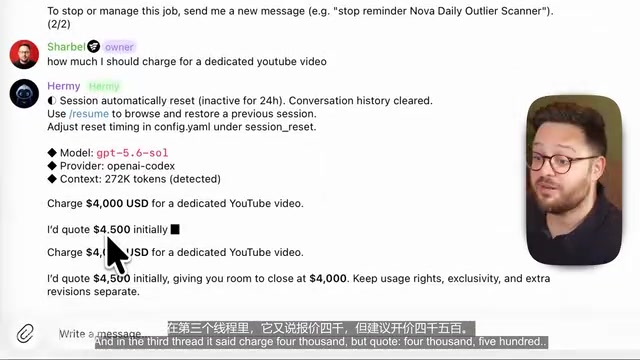
Replace Instructions with Code for Numerical Tasks: When the same pricing question was asked across three independent conversation threads, the Agent gave three completely different answers — $4,000, $6,000, and $4,500 — improvising each time. For any deterministic task involving numbers, write it into a script rather than relying on prompts. This simultaneously delivers lower Token consumption and higher output stability.
Getting three different answers to the same question across three threads exposes the fundamental limitation of large language models on deterministic computation tasks. LLM reasoning is based on autoregressive generation from Token probability distributions, with each generation influenced by temperature parameters, sampling strategies, and subtle context differences. Even with temperature set to 0, different conversation histories and system prompts can cause slight shifts in attention weights, producing different numerical outputs. This is why the industry broadly recommends delegating numerical computation, data queries, and other deterministic tasks to traditional code execution, while limiting the LLM's role to natural language understanding, intent recognition, and text generation — areas where it excels. This "LLM decides, code executes" division of labor is known as a "hybrid architecture."
Precondition Checks: Verify all dependencies before skill execution — Is the inbox connection working? Does the pricing file exist and is it the current month's version? If any condition isn't met, the Agent stops immediately and reports honestly, rather than forging ahead with guesswork.
Execution Hooks: Run custom code at task completion nodes with strict success conditions: if a task finishes without any verifiable output, it doesn't count as successful. This mechanism is the foundation that makes the next two upgrades possible.
Upgrade Two: Approval Gates — The True Foundation of Autonomous Operation
A Counterintuitive Insight
Most people view approval gates as obstacles — they slow the Agent down, and people plan to "add them later once they trust it more." This logic is completely backwards.
Without gates, the Agent can do anything, so you have to watch its every move — that's not autonomous operation, that's just creating a "speed bump" for yourself. With gates, you can truly let go of everything within the safety boundary and get on with your life. Approval gates aren't a limitation on autonomy — they're a prerequisite for it.
This perspective aligns with the "Principle of Least Privilege" in information security and the "Safety Interlock" concept in industrial automation. In nuclear power plant control systems, it's precisely because multiple layers of safety interlocks exist that operators dare to let reactors run automatically most of the time. Without these mechanisms, any automation would require continuous human monitoring, actually reducing efficiency. Psychologically, this also involves the "paradox of control" — the prerequisite for humans to hand over control to automated systems is their certainty that they can reclaim control at critical moments. The very existence of approval gates serves as a psychological safety net, transforming the operator's mindset from "I must watch every step" to "I only need to intervene at key checkpoints."
How to Draw the Red Line
Using an email reply Agent as an example, the red line is drawn at money and commitments: the Agent can answer questions, schedule calls, send information, and request details, but the moment pricing, quotes, date commitments, or deliverables are involved, it pauses immediately and waits for human decision-making.

The practical effect of this boundary: roughly seven out of eight messages are processed fully automatically, with only one in eight requiring human intervention. Combined with scheduled daily tasks (auto-run at 9 AM every day) and Telegram push notifications — push to somewhere you'll actually check, or the task isn't truly complete — the entire workflow achieves genuinely unattended operation.
Another overlooked capability is the undo function: automatically saving snapshots before modifying files, with the ability to roll back at any time. Few people enable this mechanism, but it's the key to making high-risk operations safe — just as emergency exits give people the confidence to enter buildings.
Upgrade Three: Sub-Agent Parallel Processing for Speed
The Efficiency Bottleneck of Serial Execution
Before introducing sub-agents, the email workflow was a classic serial structure: read inbox → search sender info → check history → draft reply, one step after another, painfully inefficient.
The solution is to distribute tasks to multiple sub-agents for parallel execution. Here's a critical detail: sub-agents only have access to the tools assigned to them. The email classification sub-agent can only read and classify the inbox — it has no tools for sending emails, writing files, or any consumptive operations. It's not that rules forbid it — the tools simply don't exist.
This is the essential difference between "rule-based isolation" and "physical isolation": rules are just words in a document that the model may or may not follow; physical isolation means removing the tools entirely, with no possibility of circumvention. Speed and security improve simultaneously.
This distinction maps to the fundamental difference between "Access Control Lists" (ACL) and "network segmentation" as security paradigms in information security. ACL is policy-based soft control — the system knows the rules but may be bypassed due to misconfiguration or vulnerabilities; network segmentation is architecture-based hard control — the attack surface is eliminated at the physical level. In the LLM Agent context, this distinction is particularly important because large language models face "Prompt Injection" risks: malicious inputs or complex contexts can cause models to ignore rule constraints in system prompts. But if a tool simply doesn't exist in the Agent's available tool list, even if the model is "persuaded" to perform an operation, it cannot find the corresponding API endpoint to execute it — achieving true zero-trust security.
The Hidden Cost of Token Consumption Cannot Be Ignored
There's another widely overlooked issue: every enabled skill — its name and description — is fully loaded into the context with every message, every sub-agent call, and every scheduled task trigger, continuously consuming Tokens. Even idle skills are quietly generating costs.
Understanding this hidden cost requires knowledge of the Context Window mechanism in the Transformer architecture. Each time an Agent processes a message, system prompts, skill descriptions, conversation history, and user input are concatenated into a complete Token sequence fed to the model. Skill descriptions typically exist as JSON Schema formats for Function Calling, with each skill potentially consuming 200-500 Tokens. If 20 skills are enabled, skill descriptions alone could consume 4,000-10,000 Tokens — these Tokens are billed with every API call and crowd out context space that could otherwise be used for actual task reasoning. More importantly, too many tool descriptions also cause "tool selection confusion": the model needs to choose among more options, increasing the probability of selecting the wrong tool. This is a triple negative effect simultaneously impacting cost, speed, and accuracy.
I recommend running regular "skill audits": list all enabled skills, count the total Tokens they consume before even a single character of input, and identify skills that haven't been used in the past 30 days. These zombie skills are silently burning through your budget.

Practical recommendation: keep only 6 essential daily-use skills, disable everything else, and re-enable on demand when needed.
Four Hard-Won Lessons
Here are the major mistakes made in practice, worth learning from:
- Don't add a skill just because it "looks cool." Every enabled skill is an ongoing cost. The skills you remove often outnumber those you keep, and every time you streamline, the Agent gets better.
- Don't let an Agent execute financial operations without a review mechanism. Financial decisions require final human confirmation — this red line should never be surrendered to automation.
- Don't trust success reports that can't demonstrate deliverables. If an Agent claims to have completed a task but can't produce verifiable results, treat it as a failure, not a default success.
- Strictly follow the upgrade sequence: First establish trust mechanisms, then add approval gates, and only then expand parallel capabilities. Blindly speeding up a fundamentally untrustworthy Agent only creates more messes, faster.
Conclusion: True Automation Is Predictability
The Agent that generates real business value every week now runs fewer skills than it did six months ago. What actually changed is this: its behavior became predictable — it proactively reports when something goes wrong, automatically pauses at critical checkpoints, and requires zero manual triggering throughout.
The essence of performance improvement isn't smarter models or fancier tools — it's building a solid trust system until you can finally use its output directly in production without watching over its shoulder.
Related articles

GPT-6 Astra Voice Mode Hands-On: A Voice-Driven Personal Automation Operating System
In-depth analysis of GPT-6 Astra voice mode demo, showing how voice commands complete video-to-article conversion, landing page building, calendar management, and more. Codex-powered multi-threaded collaboration is redefining AI automation workflows.

A Complete Guide to AI OCR for Large PDF Documents with 1000+ Pages
How to handle OCR for 1000+ page scanned PDFs using AI: covers Gemini batch calls, Tesseract, PaddleOCR, and cloud OCR services with accuracy, cost, and speed comparisons.

DeepSeek Harness Open Source Explosion: Deep Dive into Plugin Hot-Swapping Architecture
DeepSeek Harness open-source coding framework hits 150K GitHub stars with "everything is a plugin" architecture rivaling Claude Code. Deep dive into dynamic hot-swapping, trace tracking, and critical security gaps.