GPT-6 Astra Voice Mode Hands-On: A Voice-Driven Personal Automation Operating System
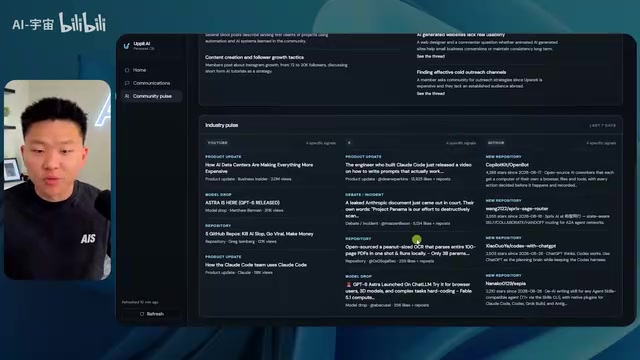
GPT-6 Astra voice mode enables system-level automation through voice alone, powered by Codex execution.
A hands-on demo shows GPT-6 Astra's voice mode completing complex workflows—video conversion, landing page creation, calendar management—without writing code. Powered by Codex with multi-threaded coordination and deep tool integration (Slack, ClickUp, Fireflies), it demonstrates a shift from single-point tasks to system-level AI collaboration, though real-world stability needs further validation.
When Voice Becomes the Gateway to Productivity
In a hands-on demonstration on Bilibili, an AI automation creator showcased his complete workflow collaboration with GPT-6 Astra's voice mode. The entire demo revolved around one core question: Can you build and operate an entire personal operating system using voice alone?
The answer appears to be yes. Throughout the demonstration, the creator didn't write a single line of code or manually operate complex interfaces. Instead, through conversations with Astra, he completed a series of real business tasks including converting videos to published articles, building course landing pages, calendar management, and meeting board integration. This wasn't simple voice assistant interaction—it was an automation experiment approaching "digital twin" level capability.
What this attempt touches on is the concept of a "Personal OS" (Personal Operating System), a topic long discussed in the productivity tools community. Its intellectual lineage traces back to Notion's "Second Brain" philosophy and Tiago Forte's systematized Personal Knowledge Management (PKM) methodology in Building a Second Brain. The core pain point of traditional PKM tool chains lies in data silos between tools leading to extremely high context-switching costs—users must manually transfer information between Notion, calendars, email, and project management tools. The emergence of AI orchestration layers like Astra attempts to fundamentally eliminate this friction by having AI handle cross-tool information routing and state synchronization through a unified natural language interface.
You might not have noticed, but the entire process can be completed on a computer or seamlessly taken over on a phone—the creator repeatedly emphasized the smoothness of cross-device synchronization, meaning this automation capability is truly "available anytime, anywhere."
The Technical Core of Astra Voice Mode: Codex-Driven Multi-Threaded Collaboration
Voice Is Just the Interaction Layer, Codex Is the Execution Engine
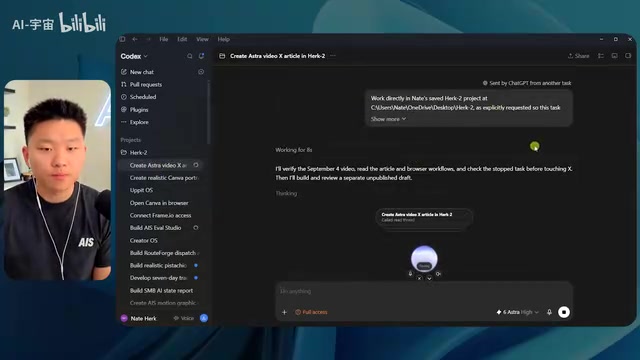
A key technical detail in the demonstration: Astra's voice mode backend calls Codex. When you issue voice commands, the system is actually orchestrating an AI operating system, executing browser operations, and running multiple task threads.
Codex is OpenAI's AI model series specifically designed for code understanding and generation. Its core capability lies in converting natural language instructions into executable program logic. Early versions of Codex powered GitHub Copilot's underlying engine. As versions evolved, its capabilities expanded from simple code completion to multi-step task planning and autonomous execution. In Astra's architecture, Codex serves as the "execution layer"—after voice input undergoes semantic parsing, Codex breaks down intent into specific operation sequences: calling browser APIs, triggering third-party service webhooks, managing file systems, etc. This three-layer "voice → intent → execution" architecture is the mainstream paradigm for current AI automation systems, where the voice layer lowers interaction barriers, the intent layer handles semantic understanding, and the execution layer produces actual side effects.
The creator demonstrated a typical scenario: he had Astra convert "yesterday's YouTube video" into an X (Twitter) article and publish it. Behind this single voice command, the system automatically completed the following actions:
- Downloaded the original video and transcribed its content
- Reorganized it into article format for the X platform
- Extracted 11 screenshots from the video
- Analyzed each image's content and inserted them into the correct positions in the article
- Automatically cropped non-fullscreen screenshots and matched the 5:2 cover ratio
- Automatically blurred API keys and personal email addresses that appeared in the frames
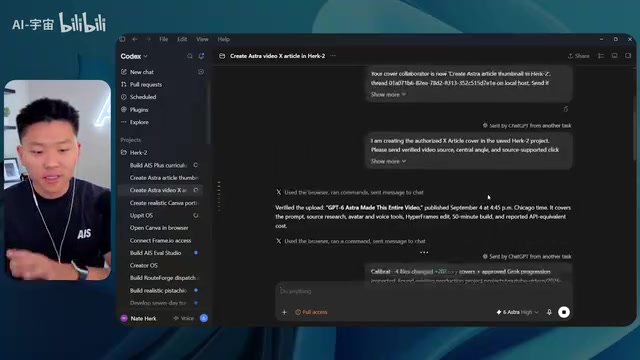
What's more noteworthy is the multi-threaded coordination capability. Codex's multi-threaded coordination means it can simultaneously maintain the context state of multiple tasks, similar to an operating system's process scheduling mechanism. The creator simultaneously initiated article tasks, cover tasks, and landing page development tasks. Astra could identify conversations from these different contexts and ensure they all ran within the designated "Herc 2 project" to access the correct skill sets and contextual information.
Context Understanding Is the True Prerequisite for Useful AI Automation
The creator repeatedly emphasized one point: Beyond capability, you need the right context and connections to truly be effective. When he communicated with Astra via voice, the system "seemed to genuinely understand me and my business."
This was particularly evident in the details: when he requested an X article cover without specifying a particular image, Astra autonomously searched YouTube for that photo of "feet up on desk, editing video with OpenAI logo" and proactively adjusted it to X's aspect ratio. The system needed to extract information from multiple data sources and understand the creator's "entire brain"—this cross-source context integration capability is the most fundamental difference between AI orchestration layers and traditional single-point tools.
From Single-Point Tools to a Voice-Driven Personal Operating System
Deep Integration with Real Business Systems
What makes this demonstration most convincing is that it connects to real production environments, not demo sandboxes. The creator showed deep integration with the following tools:
- Real calendar: After voice-adding events, they immediately appear in his actual calendar
- Slack, ClickUp, email: Can directly reply to team communications and start new discussions in a unified interface
- Fireflies meeting transcripts: The newly added meeting board can capture meeting dates, one-line summaries, and to-do tasks
- School community: Reads course structure and automatically generates branded landing pages
Fireflies is a representative product in the Meeting Intelligence track, which focuses on converting unstructured meeting audio into structured actionable information. Its technology stack typically includes three layers: Automatic Speech Recognition (ASR), Speaker Diarization (identifying "who said what when"), and summary and action item extraction based on large language models. The integration between Fireflies and Astra reflects an emerging architectural pattern: vertical domain AI tools expose structured data through standardized APIs, while "orchestration layer" AIs like Astra handle cross-tool data aggregation and task routing. Each tool can evolve independently, with the orchestration layer only maintaining interface protocols.
This system, called "Upnote OS" (phonetic transcription, possibly UpNode OS), essentially converges the creator's scattered workflows into a voice-controllable hub. From a technical architecture perspective, such systems face three core challenges: permission management (how to securely proxy user access to multiple OAuth-authorized services), effective management of context windows (how to isolate yet share context across different tasks), and error recovery (how to gracefully degrade rather than crash the entire chain when a subtask fails).
Significant Leap in Browser Operation Capabilities
The creator called GPT-6 Astra's browser capabilities "the strongest I've seen." One example: he gave the system two images and had Astra complete the design in Canva. Although it took some time, considering the complexity of rendering and browser operations, the results were impressive.
Another more impactful case came from the AIS Live event: the creator sent Codex links to over 150GB of video footage and requested a 60-second promotional video for the event, which was completed in just two requests. It's worth noting that current multimodal large models don't directly "read" all raw bytes of video—150GB of raw footage first goes through a video understanding pipeline: keyframe extraction (typically 1-3 frames per second), scene segmentation, and audio transcription, ultimately converting into multimodal token sequences the model can process. What truly tests the model's capability is: identifying segments that fit the narrative logic from massive footage, understanding the emotional weight of different scenes, and generating executable editing instructions. If completing the task in two requests is accurate, it indicates the model has strong one-shot task planning capabilities, but may also reflect the degree to which the task was pre-structured—precisely what independent verification struggles to assess.
Quality of Generated Output: Not Just Functional, But Stylistically Designed
When Astra completed the course landing page, the creator opened it in full screen—the page featured dynamic layered design using Scrollcraft, with mountains in the background moving at different speeds, creating a parallax scrolling effect.
Parallax Scrolling is a visual technique originating from game development: different layers of elements on a page move at different rates, with foreground moving fast and background slow, creating a three-dimensional depth perception. In modern web implementations, this is typically achieved through CSS transform properties or JavaScript's Intersection Observer API controlling displacement ratios of each layer, with tools like Scrollcraft encapsulating this effect into low-code components. What's noteworthy isn't just the visual effect itself, but that the AI system can extract brand visual specifications (color tones, fonts, composition style) from workspace scans and automatically map them to Scrollcraft's template parameters—this demonstrates multimodal understanding capability: the system simultaneously processed visual information from screenshots, design tokens in CSS style files, and image assets in the brand asset library.
More critically, style consistency: the new page automatically retained the AI Automation Society website's signature visual language, including blue color tones, mountain backgrounds, and even maintained unified design on authentication pages. The system could do this because it "scanned the workspace and found everything needed."
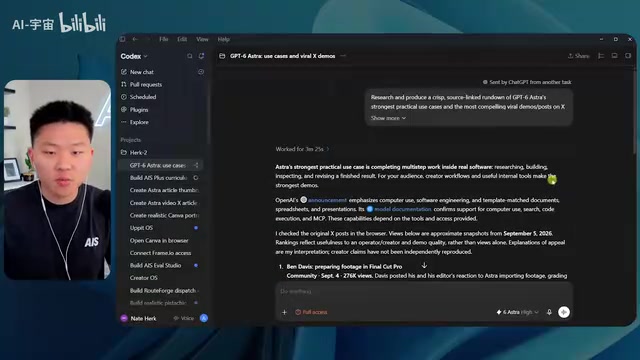
After verification, the creator confirmed these were indeed real course content offered in the community, not placeholders—Astra reviewed actual course data and rebuilt the complete course system.
A Rational Perspective: The Gap Between Demo Effects and Daily Use
While this demonstration is undoubtedly exciting, we need to maintain calm judgment. First, this article is based on a single-source Bilibili video demonstration lacking independent third-party verification. The actual stability and success rate of some capabilities (such as "generating a promotional video in just two requests") are difficult to assess.
Second, the creator himself is a content creator and course seller in the AI automation field, and the demonstration has obvious product promotion attributes—the video ending directly guides viewers to his courses to learn "how to use Astra and Scrollcraft." This means what's shown is the effect under ideal conditions; failure cases and debugging costs in daily use are not presented.
There's also a risk dimension worth noting that's often overlooked: when AI systems deeply integrate user personal data (calendars, emails, meeting transcripts, course data), platform continuity itself becomes a risk variable. The March 2025 case of genetic testing company 23andMe filing for Chapter 11 bankruptcy protection serves as a warning—Chapter 11 allows companies to continue operating under court supervision while reorganizing debt, with the core controversy being the legal status of millions of users' sensitive data in bankruptcy assets. For "personal operating systems" built on a single AI platform, this issue equally applies: when service providers face business crises, where will users' carefully constructed automation workflows go?
Additionally, the official nature of the "GPT-6 Astra" naming warrants attention and should be verified against OpenAI's formal release information.
Conclusion: AI Automation Is Moving from Single-Point Tasks to System-Level Collaboration
Setting aside promotional elements, this demonstration does point toward a valuable direction: AI automation is moving from "single-point tasks" to "system-level collaboration." Voice as the interaction gateway, Codex as the execution engine, multi-threaded parallel processing, and deep business system integration—these four elements combined sketch out an entirely new working paradigm.
The creator quoted a thought-provoking statement: "It's not cost that justifies price, but price that justifies cost." When AI can complete so much complex collaboration for you, what's truly scarce may no longer be execution capability, but the judgment and context-building ability to know "what to have it do."
Key Takeaways
- GPT-6 Astra's voice mode demonstrates system-level AI automation capabilities, completing complex workflows including video-to-article conversion, landing page creation, and calendar management through voice commands alone
- The technical foundation relies on Codex as the execution engine, supporting multi-threaded task coordination and deep integration with real business systems (calendars, Slack, ClickUp, Fireflies, etc.)
- Generated outputs show not only functional completeness but also brand style consistency, automatically extracting and applying visual design specifications
- Browser operation capabilities show significant advancement, handling complex tasks like Canva design and processing over 150GB of video footage
- Despite impressive demonstrations, gaps remain between ideal showcase conditions and daily use stability, requiring cautious evaluation of practical applicability and platform dependency risks
Related articles
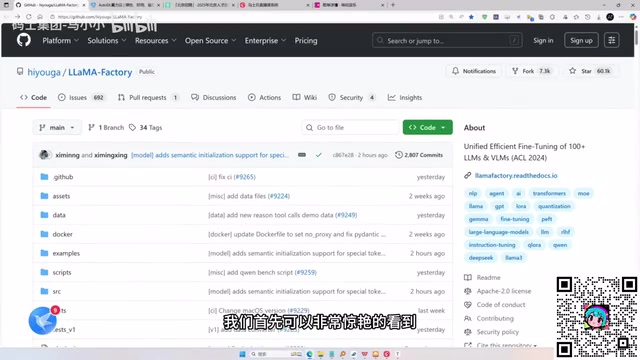
LLaMA-Factory in Practice: A Complete No-Code Guide to Fine-Tuning Large Models
An introduction to LLaMA-Factory, the open-source fine-tuning tool: its 60.1K-star background, supported models and algorithms, local vs. cloud deployment, and CUDA setup steps.

Zeng Ming's Deep Retrospective: Why OpenAI May Not Be the Ultimate Winner — and Why the Corporate System Will Disappear
Zeng Ming's deep retrospective on the AI endgame: model companies are just infrastructure, OpenAI and Anthropic won't be the final winners; the next battle is the Agent entry point standard; the corporate system will disappear as AI restructures collaboration, and only mission-driven companies can survive the cycle.
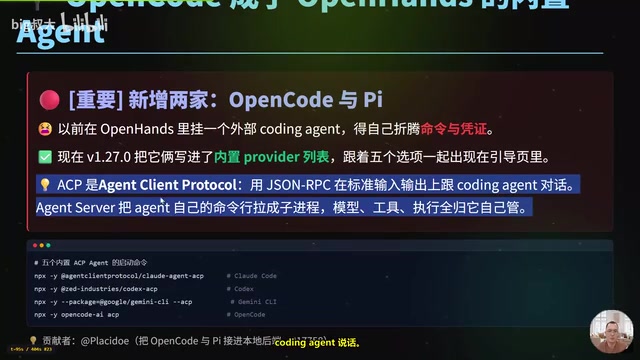
OpenHands v1.28.0: OpenCode and PI Added as Built-in Agents, API Keys Requestable In-Conversation
OpenHands ships 5 releases in 21 days: v1.27.0 adds OpenCode and PI as built-in agents, v1.28.0 enables in-chat key requests. ACP integration, credential reuse, model list changes, and upgrade advice.