AI Agent Performs Mouse Brain Surgery: Is the Era of Autonomous Operation Arriving?
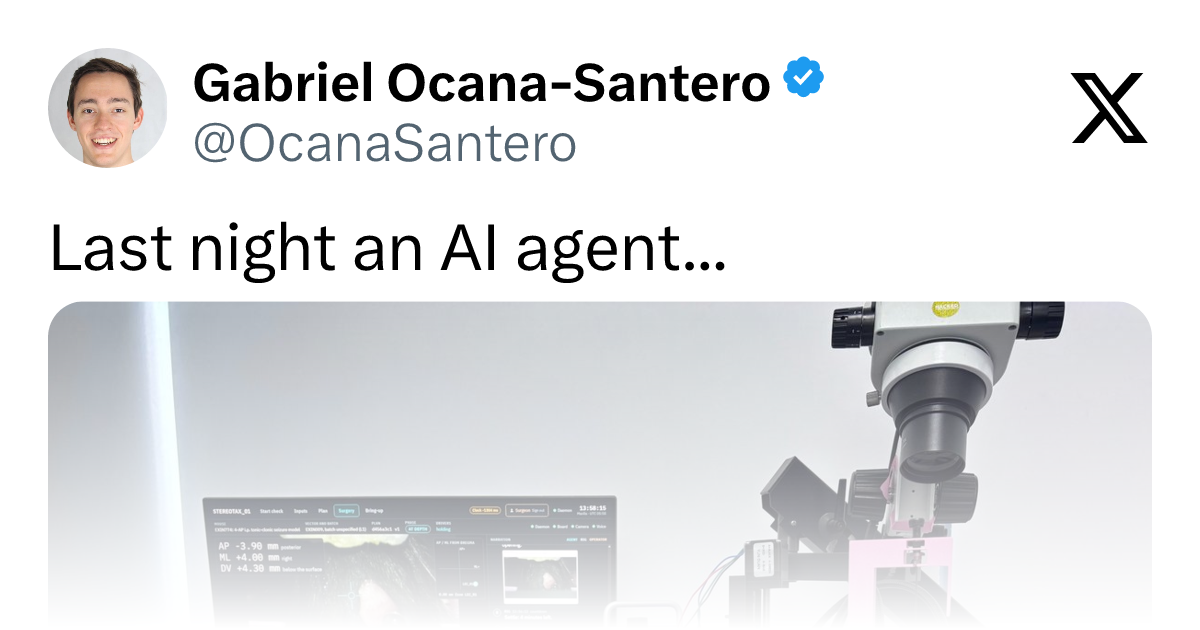
A Hacker News post claims an AI agent independently performed mouse brain surgery, sparking cautious discussion on autonomous AI in healthcare.
The article analyzes a Hacker News post claiming an AI agent independently performed mouse brain surgery. Since the original post lacks papers, videos, and official verification, the author frames the discussion as exploring technological trends rather than endorsing facts. The article notes that this event points to AI's capability leap from surgical assistance tool to autonomous executor, with its technical foundation in mature multimodal perception and long-horizon task planning, though anomaly handling remains a core difficulty. Community discussion centers on three concerns: safety validation, liability attribution, and reproducibility. The author believes AI healthcare implementation requires simultaneous advancement in simulation validation, human-machine authorization boundary design, and new regulatory frameworks, and that calm public scrutiny is a necessary condition for technological maturity.
Event Recap: AI Agent Independently Performs Brain Surgery
Recently, a post titled "Last night an AI agent performed brain surgery on a mouse" sparked discussion in the Hacker News community. The poster claimed that an AI agent completed brain surgery on a mouse without human intervention. The post received 27 upvotes and 24 comments. Although it didn't gain much traction, the discussion was quite focused: what does it really mean when an AI agent steps from the virtual world into the operating room?
It's important to note that this news currently exists only as a community post, without accompanying papers, videos, or official press releases. The discussion on Hacker News also leans cautious, with many commenters asking about experimental details, the type of surgery, and animal welfare review. Therefore, this article is more of an analysis of the technological trend this event points to, rather than an endorsement of the specific experiment.
From Assisting Tool to Autonomous Execution: The Agent's Capability Leap
Over the past few years, AI's role in healthcare has mainly focused on image recognition, pathology analysis, and surgical assistance positioning. Although the da Vinci surgical robot is called a "robot," every movement is still controlled by the surgeon. What "AI agent performs surgery" implies is a further merging of the decision-making and execution chains—the agent not only identifies targets but also plans paths, controls instruments, and completes operations.
The technical foundation for this leap comes from two aspects. First, the improved ability of multimodal models to understand visual and spatial information enables the agent to perceive tissue states in real time; second, the maturation of agent frameworks in long-horizon task planning allows them to continuously adjust strategies in scenarios like surgery that are highly time-sequenced and feedback-intensive. Some in the Hacker News comments pointed out that the real difficulty lies not in single-step operations but in anomaly handling—whether sudden situations like bleeding or tissue adhesion can be promptly identified and the operation halted.
AI Agent refers to an AI system capable of perceiving the environment, autonomously planning, and executing multi-step tasks to achieve goals. Unlike models that simply output predictions, it has a closed-loop capability of "perception—decision—action." In surgical scenarios, this means the agent needs to integrate visual input, spatial reasoning, and instrument control, and continuously revise strategies based on feedback as the task progresses. Current mainstream agent frameworks typically have large models responsible for high-level planning and specialized modules for low-level control, working together to complete long-horizon tasks. Understanding this architecture helps grasp the essential difference between "autonomous surgery execution" and "surgical robot assistance": in the latter, decision-making authority always remains with the surgeon, while in the former, part of that authority is transferred to the system itself.
Da Vinci Surgical Robot is currently the most clinically mature robot-assisted surgical system, where doctors operate robotic arms from a console to perform minimally invasive surgery. Its core value lies in filtering hand tremors, providing magnified 3D vision, and enhancing instrument flexibility, but all movement commands come from the surgeon, and the system itself makes no autonomous decisions. Therefore, the da Vinci robot is often seen as a "teleoperation tool" rather than an "autonomous agent." Distinguishing between the two is crucial for discussing regulation and liability in AI surgery—existing medical device approval systems are mostly designed for passive or semi-active devices, and there is no mature framework covering autonomous decision-making systems.
Three Core Concerns in Community Discussion
Among the limited 24 comments, the discussion focused on three directions.
Safety validation. Some commenters argued that there is a huge biological and engineering gap between mouse experiments and human surgery, from anesthesia management to tissue scale, and they cannot be directly compared. Extrapolating animal experiment results to clinical practice requires extremely rigorous step-by-step validation.
Liability attribution. When operations are performed autonomously by an agent, how should responsibility be divided when complications occur? Is it the model developer, the device manufacturer, or the supervising clinical team? Existing medical regulatory frameworks are hardly prepared for this.
Reproducibility. Since the original post lacked technical details, multiple commenters called for disclosure of experimental protocols and failure cases. This is particularly critical in AI medical research—a system that only showcases successful cases cannot prove its reliability.
Reproducibility is a fundamental requirement of scientific research, referring to the degree to which independent researchers can replicate original experimental results under the same conditions. In AI medical research, reproducibility faces additional challenges: model weights, training data, random seeds, and hardware environments all affect results. Reporting only successful cases without disclosing failure cases and experimental protocols makes it impossible for external researchers to judge the system's true reliability. For high-risk applications like autonomous surgery, lack of reproducibility means the system's behavior in edge cases cannot be evaluated, and thus cannot provide a basis for regulatory approval. This is also the deeper reason why Hacker News commenters demanded disclosure of experimental details.
Implications for AI Healthcare Implementation
Setting aside the completeness of information in this post itself, the trend it reflects is worth attention. AI agents are shifting from "advisors" to "executors," and healthcare is one of the implementation scenarios with the lowest tolerance for error. This means the industry needs to advance simultaneously on three levels: closed-loop validation between simulation and real environments, design of authorization boundaries for human-machine collaboration, and new regulatory frameworks for autonomous operations.
For developers and researchers, the value of experiments like mouse brain surgery may not lie in demonstrating what AI "can do," but in exposing where it still needs human fallback. The calm and even slightly skeptical atmosphere of discussion on Hacker News is precisely the public scrutiny necessary for such technology to mature.
Note: The original material for this article is solely a community post, lacking experimental details and third-party verification. Relevant conclusions should be viewed as exploration of trends rather than factual confirmation.
Related articles

Qwen 3.8 Beats Opus at Coding—But Can Your Mac Run It?
Open-source Qwen 3.8 beats Opus 4.6 at coding at just 18GB, but how much Mac memory do you need? 24GB crashes; 32GB is the sweet spot. Full config guide inside.

Claude Code + Agent: Building a Fully Automated AI Testing Loop
Bilibili course breakdown: how test developers can use Claude Code terminal-based Agents to build a fully automated AI testing loop. Compares permission boundaries of terminal vs. device Agents, explains why enterprise projects choose Claude Code over Open Claude-type tools, and outlines the Node.js environment setup and DeepSeek model integration path.

Working with AI Agents Requires Nerves of Steel
The more autonomous AI agents become, the heavier the user's psychological burden. Drawing from a Hacker News discussion, this article analyzes black-box anxiety, behavior drift, and monitoring fatigue in agent collaboration, and offers practical approaches like sandbox isolation, permission control, and task granularity management to reduce cognitive load.