AI Agent Permission Control in Practice: How to Set Boundaries for Agents That Can Take Action

As AI Agents move to production, permission control becomes the hardest challenge — and no standard playbook exists yet.
As AI Agents move from demos to production systems capable of real operations, managing permissions becomes far more complex than traditional user or service account management. A Reddit discussion surfaced six core challenges: whether permissions should be dedicated to Agents, how to block actions that are technically possible but business-inappropriate, where policies should be enforced, when to require human approval, and how to prevent privilege escalation across multi-Agent delegation chains. While principles like least-privilege identities, externalized policy enforcement, context-aware rules, and progressive permission narrowing are widely recognized, combining them into a coherent system for unpredictable Agents remains an unsolved problem.
When AI Agents stop merely answering questions and start actually executing operations within systems — creating customer records, issuing refunds, sending emails, calling internal APIs, transferring funds, and modifying cloud infrastructure — permission control shifts from a secondary concern to the number-one challenge in production environments. A recent technical discussion on Reddit hit this pain point squarely: faced with agents that can "act," how should teams actually design their authorization layers?
The Core Problem: Agents Are Not Ordinary Users
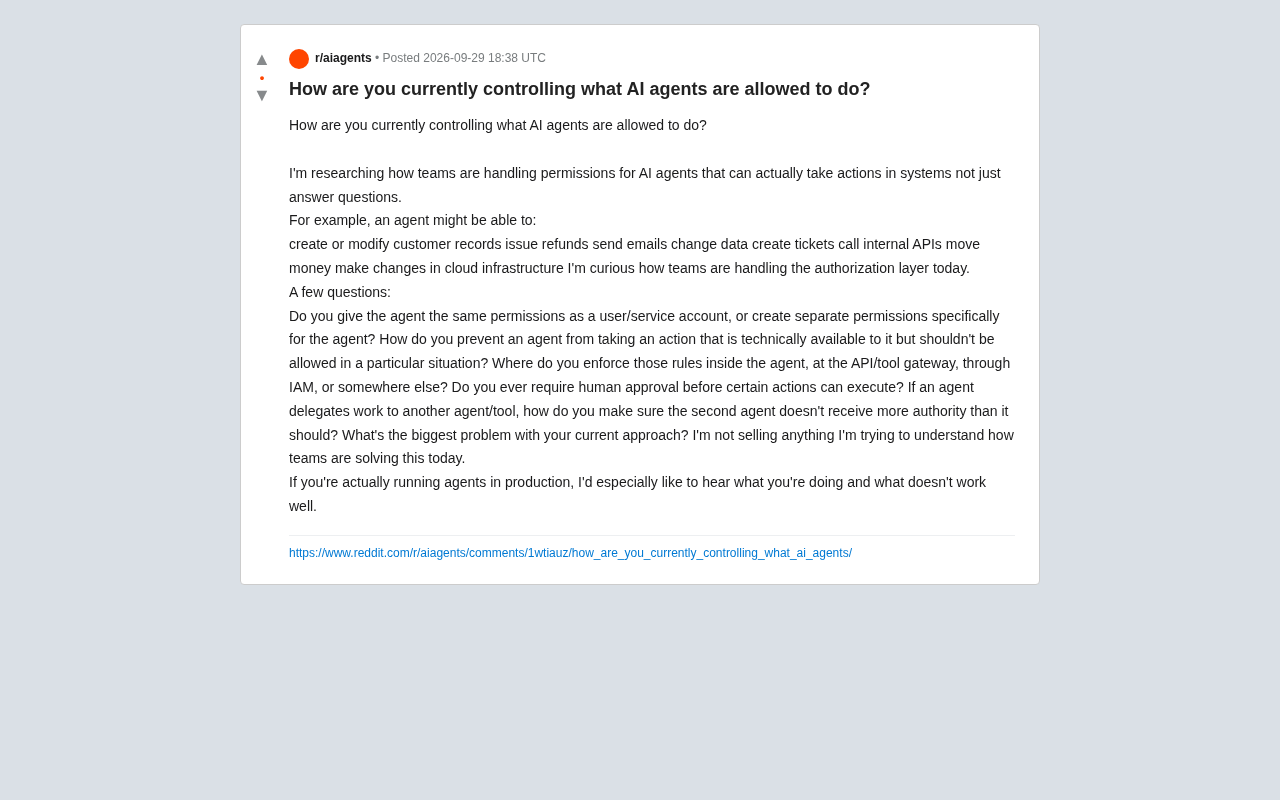
The person who started the discussion made it clear they weren't pitching a product — they wanted to understand how teams are actually solving this problem today. The scenarios they listed are representative: an Agent might be authorized to create or modify customer records, issue refunds, send emails, change data, create tickets, call internal APIs, move funds, or make changes to cloud infrastructure.
What these operations share is that they all carry irreversible or high-impact side effects. A read-only Q&A bot that makes a mistake, at worst gives a wrong answer. An Agent with write access that makes a mistake can directly cause financial loss or data corruption. This is the fundamental reason Agent authorization is thornier than traditional permission management: Agents are neither equivalent to human users nor to service accounts with fixed behavior. They are autonomous decision-makers whose execution paths cannot be fully predicted.
Six Key Authorization Design Questions
The questions raised in the discussion cover nearly every dimension an Agent authorization system needs to address. Each is worth unpacking.
Reuse Existing Permissions or Create Dedicated Ones?
The first question: do you give Agents the same permissions as users or service accounts, or do you create dedicated permissions specifically for Agents? Reusing existing accounts might seem convenient, but the risk is that the Agent's behavioral boundaries get defined by a human user's full permission set — and humans typically hold far more access than any single task requires. The safer approach is to establish a least-privilege identity specifically for the Agent, granting permissions at the granularity of individual tasks.
Technically Possible ≠ Business-Appropriate
The second question is more subtle: how do you prevent an Agent from executing an action that is "technically possible but shouldn't be done in this specific context"? For example, an Agent may have refund permissions, but shouldn't automatically issue a refund when an order is under dispute. These kinds of constraints typically can't be expressed through static IAM policies, because they depend on context and business rules — dynamic judgment must be introduced into the decision chain.
This type of context-sensitive dynamic constraint is difficult to express in traditional access control models. Classic RBAC (Role-Based Access Control) can only describe "role X can perform action Y" — it cannot express "only allow this when condition Z is true." A better fit for Agent scenarios is ABAC (Attribute-Based Access Control), which allows policies to reference requester attributes, resource attributes, and environmental context simultaneously. Going further, some teams have begun exploring OPA's Rego language or AWS Cedar for writing such contextual rules — for example, "when a refund exceeds $500 and the order is in dispute, human approval must be triggered." Rules like these can be adjusted dynamically without modifying Agent code, and represent a critical technical path for decoupling business compliance requirements from the AI execution layer.
Where Do the Rules Actually Get Enforced?
The third question points to the architectural layer: where are these rules actually enforced — embedded inside the Agent, placed at an API/tool gateway, or handled through IAM? Putting rules inside the Agent is the most flexible but least trustworthy approach, since the Agent itself is the unpredictable executor. Placing them in a tool gateway or an independent policy enforcement point creates an externalized hard constraint that the Agent cannot bypass. This is a classic principle of security design: don't let the controlled party control itself.
In engineering practice, externalized policy enforcement is typically implemented using policy engines like OPA (Open Policy Agent) or Cedar. These tools allow teams to write authorization rules in a declarative language, completely decoupled from business code. Before the Agent makes any tool call, it must first query the policy engine for an allow decision — the policy engine itself is an immutable external black box from the Agent's perspective. A similar architectural pattern is the Policy Enforcement Point (PEP) in API gateways, where all requests are filtered before reaching backend services. The core value of this design: even if an Agent is hijacked by a Prompt Injection attack, the attacker can only manipulate the Agent to send requests — they cannot bypass the hard interception at the gateway layer.
The Hard Problems: Human Approval and Permission Delegation
The discussion also touched on two advanced questions that represent the toughest challenges in current practice.
Should High-Risk Operations Require Human Sign-Off?
Should human approval be required before certain operations execute? For high-impact actions like fund transfers or deleting production data, introducing a "human-in-the-loop" approval step is close to industry consensus. But the hard part is balance — too many approvals destroy the automation value of Agents, while too few leave risk exposure. Precisely defining which actions require human intervention is itself a design art.
The Cascading Amplification Risk in Permission Delegation
The final question is especially dangerous in multi-Agent collaboration scenarios: when one Agent delegates work to another Agent or tool, how do you ensure the second Agent doesn't gain permissions beyond what it should have? If permissions get amplified through the delegation chain, an attacker only needs to compromise the weakest link in the chain to potentially leverage the entire system's elevated privileges. This requires the authorization system to support "progressive narrowing" of permissions rather than default inheritance — every delegation should result in a subset of permissions, never a superset.
This problem corresponds to a specific security concept: Privilege Escalation. In multi-Agent architectures, its variant is known as the "confused deputy" problem — a middle-layer Agent uses its own higher-level permissions to execute operations on behalf of a caller, inadvertently completing actions the caller was never authorized to perform. Anthropic, in its Model Specification and related security documentation, classifies these scenarios under the threat model of Prompt Injection and Indirect Injection Attacks: attackers can plant malicious instructions by contaminating external content the Agent reads (such as web pages, emails, or documents), inducing the Agent to delegate high-privilege operations downstream. Defenses include progressively narrowing permissions at each layer, cryptographically signing and verifying the call source at every Agent layer, and passing non-forgeable "caller permission tokens" through the delegation chain.
Why This Topic Has Become Urgent Now
This discussion gained traction because it precisely captures the critical gap that emerges as AI Agents transition from "demo toys" to "production systems." In the past, the focus was on whether Agents could complete tasks correctly. Now, teams actually running Agents in production are realizing: doing it correctly is just the baseline — doing it "safely, controllably, and auditably" is the real threshold.
The original poster specifically emphasized wanting to hear from people "actually running Agents in production" about what approaches haven't worked — this pursuit of failure experience is itself a signal that the field lacks mature best practices, and most teams are still feeling their way forward. From least-privilege design and externalized policy enforcement to context-aware dynamic authorization, human approval checkpoints, and progressive permission narrowing in delegation chains — none of these principles are individually new. But how to combine them into a complete system that accommodates the inherent unpredictability of Agents remains an open question.
For teams deploying AI Agents, rather than waiting for a ready-made solution, the better path is to treat the authorization layer as a first-class citizen from day one — because once an Agent can truly "touch money, touch data, and touch infrastructure," permission gaps are no longer bugs. They're incidents.
Related articles

Gaussian Process Bandit Optimization: Exploration Strategies and Inference Regret Guarantees
Cumulative regret guarantees in Bayesian optimization fail to reflect final recommendation quality. This article examines a new study that provides inference regret guarantees for Gaussian process bandit optimization through exploration query strategies and fill distance analysis, validated on hyperparameter optimization and control tasks.

The Most Detailed Codex Guide on Bilibili: From Installation to Real-World Practice
The most detailed Codex guide on Bilibili: from app store installation to daily work mode configuration, with a real coffee shop project demonstrating file organization, data extraction, dashboard creation, and other practical tasks. Learn to use Plan Mode and desktop pets to leverage Codex efficiently.

Appearance Compensation in Volume Rendering: Why RGB Accuracy Cannot Guarantee Density Correctness
Volume rendering research reveals that volumetric data perfectly reproducing external RGB views may still contain density errors: appearance compensation can double central density and keep external rays unchanged even when L2 error exceeds 14.52%. Density recovery depends on appearance capacity, spatial resolution, and measurement design.