AI Agent Rolled Back After One Week: How Chain Degradation Can Destroy Automation

AI Agent rolled back in a week: chain degradation drops 10-step success rate from 95% to just 59%.
This post-mortem examines a real incident where a customer service AI Agent was taken offline in under a week. The root cause: "chain degradation" — even at 95% per-step success, a 10-step workflow yields only ~59% end-to-end success, which is unacceptable in production. Testing missed this because it only validated atomic capabilities, not their combined behavior. The author proposes two fixes: converge deterministic logic into code to reduce the number of model-driven steps, and add human checkpoints at high-risk nodes to prevent error amplification. The takeaway: an Agent's value is automation, not full autonomy — and it's worth applying whenever its error rate beats a human's.
A Real Production Incident: Agent Taken Offline in Under a Week
A developer shared on Bilibili a recent failure from their team: they had deployed an AI Agent designed for customer service and business operations, with the goal of replacing large volumes of manual work and automating business workflows. The Agent was rolled back and taken offline in under a week.
This wasn't a problem with model capability, nor was it the wrong product direction. It was a trap that's highly representative of real-world Agent deployments — chain degradation in business success rates. For any team considering pushing an Agent to production, this post-mortem is more valuable than any demo.
Chain Degradation: 95% to the Power of Ten Leaves Only 59%
The core issue lies in the Agent's probabilistic execution nature. A complete business workflow is typically composed of multiple critical steps chained together, and each step carries some probability of failure.
The author presents a clear mathematical model: suppose a workflow contains 10 key steps, each with an impressive success rate of 95%. That sounds quite reliable. But when these steps are chained in series, the overall success rate becomes 0.95 to the 10th power — roughly 59%.
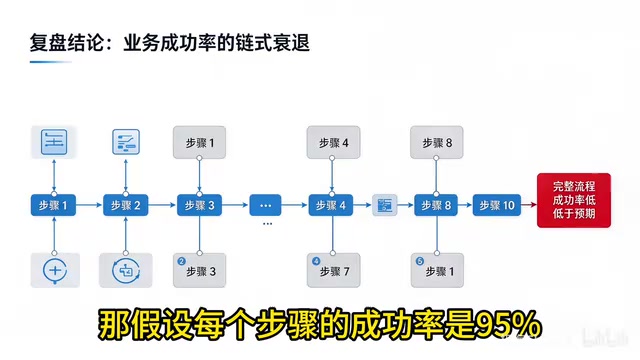
In other words, the end-to-end success rate of a complete business workflow can fall below 60%. For any serious production system, that number is unacceptable. The Agent was meant to save labor costs, but instead required constant human monitoring and intervention — ultimately adding to operational overhead rather than reducing it.
This simple multiplication reveals a truth many people overlook: high per-step success rates get diluted rapidly across long chains. The more steps, the worse the degradation.
This phenomenon is known in reliability engineering as the Series System Reliability problem. In traditional software, a deterministic function either succeeds or fails, and you can typically handle failures with exception handling and retry logic. But in LLM-driven Agents, a "failure" doesn't always throw an exception — the more dangerous case is when the model produces an output that looks reasonable but is actually wrong, and that silent error propagates into the next step. These "soft failures" trigger no alerts, yet quietly accumulate drift throughout the pipeline. A 95% per-step success rate in an Agent system therefore encompasses two fundamentally different risks: detectable hard failures, and hard-to-spot semantic drift — and the latter is usually the true root cause of production incidents.
Why Testing Didn't Catch the Problem
A natural question: why wasn't the full workflow tested before launch?
The author acknowledges the obvious reason — the number of possible workflow combinations in the business orchestration layer was simply too large.
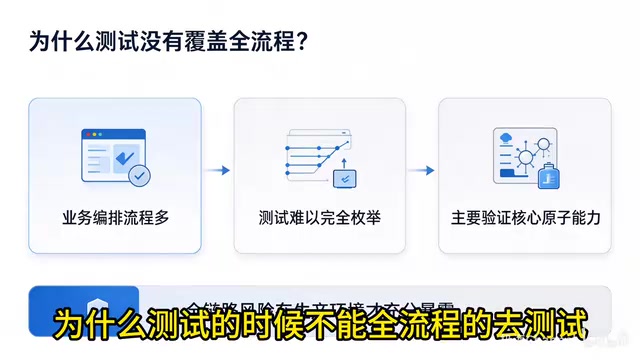
When an Agent can dynamically orchestrate different execution paths based on user input, the number of possible workflow combinations grows nearly exponentially. Testing cannot realistically enumerate every branch. So pre-launch testing typically only validates core atomic capabilities — ensuring individual tool calls and individual decision nodes work correctly — but fails to cover their combined end-to-end behavior.
This is precisely what makes chain degradation so insidious: every atomic capability passes its tests, creating an illusion that everything is fine. But when these are strung together in a real production environment, the accumulated error finally surfaces.
Optimization 1: Reduce Steps and Converge Deterministic Logic Into Code
The author is clear that switching to a stronger model is not the cure — it only alleviates symptoms without addressing the root cause. Real improvement requires rethinking the Agent's design philosophy.
The first optimization is reducing the number of steps in the workflow. Based on the per-step probability model, fewer steps means higher overall success rates.
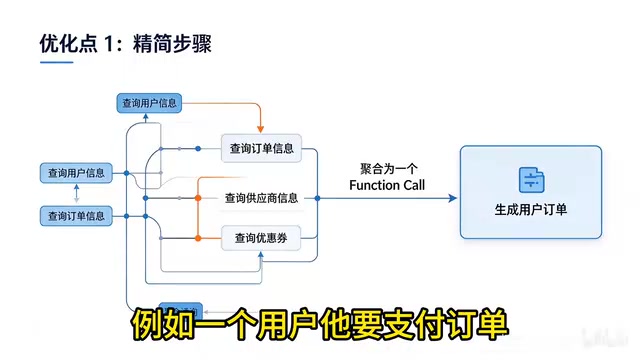
The author uses a payment order example. The old design decomposed function calls very granularly: after receiving user input, the model would separately query user information, order information, supplier information, and coupon data — each step delegated to the model for a probabilistic decision.
But in practice, many of these intermediate steps are deterministic and don't require the model to make probabilistic judgments at all. A better approach is to aggregate them into a single function call — for example, directly "generate user order" — and hard-code the previously scattered query logic at the code level.
The underlying design philosophy is worth keeping in mind: pull probabilistic decision-making back into code wherever possible. If something can be solved deterministically, don't hand it to a probabilistic model. The model should only handle the steps that genuinely require its judgment.
Optimization 2: Add Human Checkpoints to Interrupt Error Amplification
The second optimization is inserting human confirmation at critical nodes.
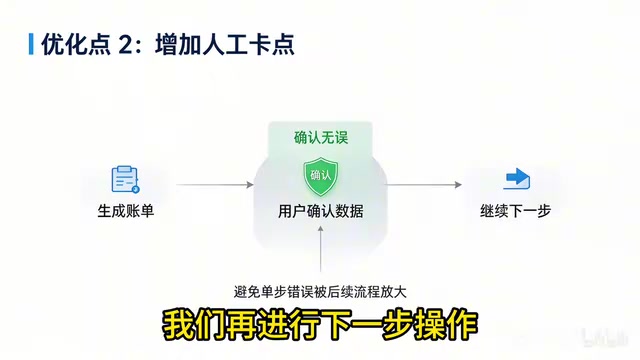
For instance, after generating an invoice, have the user confirm the data is correct before proceeding — rather than letting the Agent push through the entire flow uninterrupted.
The purpose is to break the chain amplification of errors. In a fully automated pipeline, a small mistake at an early step gets inherited and amplified by each subsequent step, ultimately causing the entire business outcome to drift. Human checkpoints act as "circuit breakers" in the pipeline, intercepting and correcting errors before they propagate.
This is essentially a pragmatic human-in-the-loop design — not pursuing 100% automation, but preserving human judgment at the highest-risk nodes.
Human-in-the-loop (HITL) is a well-established design pattern in AI systems engineering. It refers to retaining mechanisms for human intervention at specific nodes in an automated workflow. It doesn't mean the system is "not smart enough" — it's an industry-validated risk management strategy. In autonomous driving, L2/L3 driver assistance is a classic example of HITL design: the system handles the bulk of routine decisions while humans take over at critical moments. Applying this thinking to Agent engineering comes down to identifying high-impact, low-confidence nodes — steps where mistakes have serious consequences and the model's confidence is relatively low. Adding confirmation steps at these nodes preserves the efficiency gains of the Agent while keeping uncontrollable risks within a range that humans can intervene in time.
Conclusion: The Core Value of Agents Is Automation, Not Full Autonomy
The author's conclusion is measured and clear-eyed: don't expect an Agent to completely execute every part of your business workflow.
In his view, the core value of an Agent can be distilled into one word — automation — meaning replacing work that was previously done manually at scale. The benchmark is straightforward: as long as the Agent's error rate is lower than a human's, it has practical value. Humans make mistakes too; the question is who makes fewer, at lower cost.
It's worth emphasizing that the author isn't opposed to Agents as a technical direction — he's calling for teams to rationally assess their own business context: Is this workflow suitable for an Agent? Which steps are deterministic and can be handled in code? Which steps must retain a human checkpoint?
For all teams pushing Agent deployments to production, this "rolled back in a week" post-mortem offers three directly applicable lessons: use a mathematical model to assess end-to-end success rates, converge deterministic logic into code, and add human checkpoints at high-risk nodes. The gap between a working demo and a production-ready system is filled with exactly these engineering details.
Related articles

Chain of Thought Isn't Just for AI: How Humans Can Use CoT to Improve Thinking Quality
Chain of Thought isn't just a prompt trick for large models. Starting from a Hacker News discussion, this article analyzes why CoT works for human thinking too, breaks down actionable ways to transfer it, and highlights the key differences between human CoT and machine CoT.
Cloudflare Teams Up with OpenAI: Closi…
Cloudflare Teams Up with OpenAI: Closing the Loop from Vulnerability Discovery to Defense with AI
Cloudflare uses OpenAI Daybreak to investigate security vulnerabilities and generate reviewable remediation plans, while developers use Codex to boost coding efficiency and quality.

Orca Multi-Agent Orchestration in Practice: A Guide to Parallel Collaboration with Claude and Codex
Orca is Stable AI's free open-source agent workbench supporting 34 agents like Claude Code and Codex in parallel. Learn its Git worktree isolation, multi-model orchestration, and mobile management.