AI Agent Runs Go Wrong — Is the Trace Really Enough?

A trace records the agent's internal perspective; when errors stem from external state inconsistency, the trace alone is insufficient and can even mislead.
This article discusses whether a trace is sufficient to diagnose a multi-step AI agent that completes execution without errors but produces wrong results, concluding that it depends on the failure type. A trace records the agent's model calls, tool calls, parameters, and return values — essentially a "black box" of the agent's internal perspective. It can prove what the agent did, but cannot independently prove what the external world became as a result. When errors stem from logic decision errors or parameter passing errors, the trace is usually sufficient; but when facing external state inconsistency, async operations, and eventual consistency scenarios, every step in the trace shows normal yet masks a false premise — at which point you need database state, API dashboards, file systems, downstream logs, and other information beyond the trace. The article offers practical recommendations such as incorporating external state snapshots into run records, doing end-to-end verification of write operations, and keeping a reproducible healthy run for comparison.
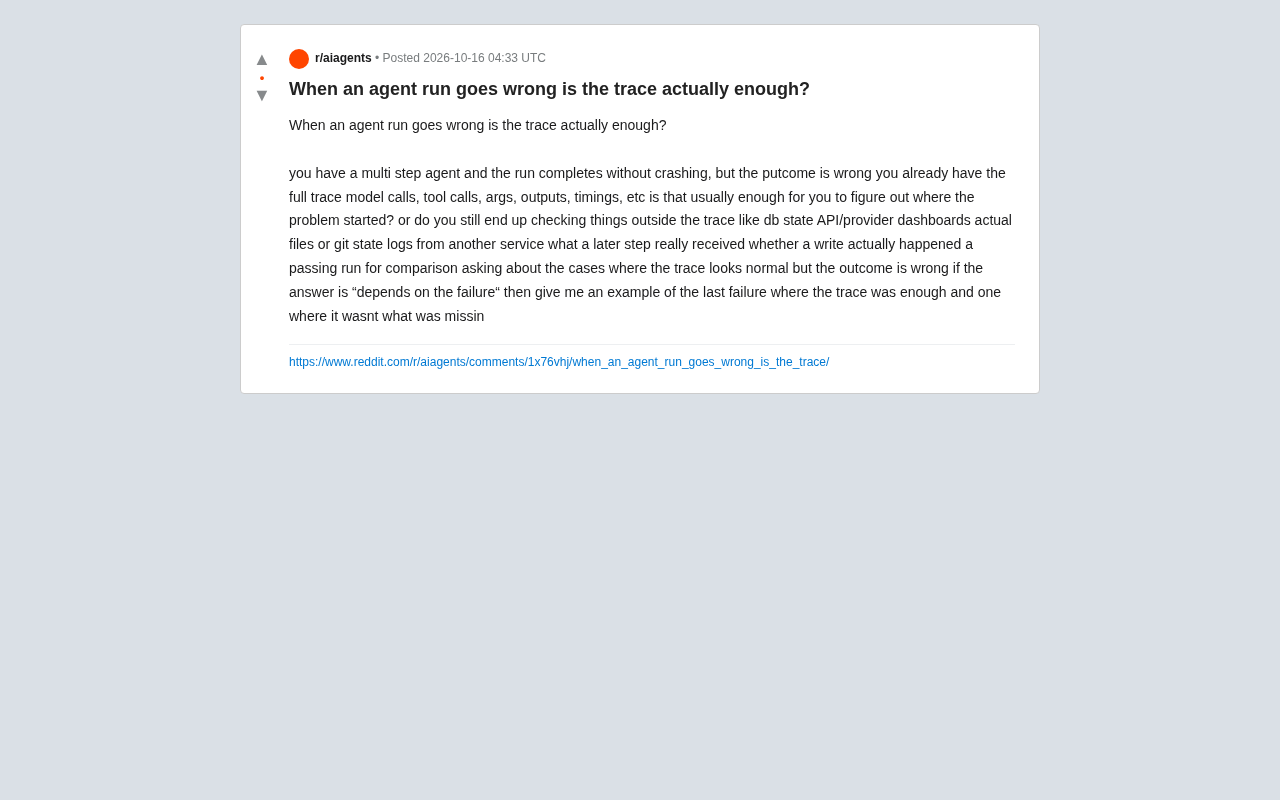
A multi-step AI agent finishes execution, no errors thrown, but the result is just wrong. At this point you have a complete trace in hand — model calls, tool calls, parameters, outputs, timings, all of it. The question is: is this information usually enough to pinpoint the problem? Or do you still have to step outside the trace to dig through database state, API dashboards, actual files, Git history, logs, or even compare against a healthy run?
A recent Reddit discussion posed the precise version of this question: only considering those cases where "the trace looks perfectly fine, but the final result is wrong." If the answer is "it depends on the failure type," then give an example where the trace is sufficient, and an example where it isn't.
What a Trace Can and Cannot Answer
A trace is essentially a "black box" record of agent behavior. It tells you what the agent thinks happened: which model was called, what prompt was fed in, which tool was selected, what parameters were passed, what return values came back, and how much time each step took.
But a trace has a fundamental limitation — it records the agent's internal perspective. It does not record state changes in the outside world. A write operation shows "success, returned 200" in the trace, but that row in the database may never have been committed due to a transaction rollback. A file read returns correct content in the trace, but that could be a cache, not the real file state.
In other words, a trace can prove "what the agent did," but cannot independently prove "what the world became as a result."
When the Trace Is Enough
One scenario repeatedly mentioned in the discussion is: logic decision errors.
When an agent picks the wrong branch in multi-step reasoning — say, interpreting "user wants a refund" as "user wants an exchange," or choosing the wrong order of calls between two APIs — this type of error can be fully diagnosed within the trace. You can see the prompt, the model's reasoning output, why it chose that tool — the problem point is right there.
Another scenario where the trace is sufficient is parameter passing errors. The agent extracts a field from step 2's output in step 3, but the extraction logic is wrong, causing the parameter passed to step 4 to be incorrect. The trace fully records each step's input and output, so this kind of chain break can be closed-loop diagnosed within the trace.
Simply put: if the root cause of the error lies entirely within the agent's decision space, the trace is enough.
When the Trace Is Not Enough
The failure case with the most resonance in the discussion is external state inconsistency.
A typical example: the agent calls a write API, the trace shows the call succeeded and returned a confirmation, but the subsequent read step gets stale data. Every step in the trace is "normal," yet the actual result is wrong.
In this case, the information you need beyond the trace includes:
- Actual database state: Was the write truly committed, or was it rolled back?
- API/provider dashboard: Did the call actually reach the server, or was it rate-limited/degraded?
- Actual file system: Is the agent reading a real file or a cache?
- Logs from another service: What did the downstream service actually do after receiving the request?
- Git state: Does the code version match what the agent ran with?
- A healthy run for comparison: The differences between a normal run and an abnormal run with the same input
The common thread among these is: they all lie outside the agent's "perception boundary." A trace cannot see what it was never notified about.
Eventual Consistency is a consistency model in distributed systems where, at any given moment, different nodes may hold different replicas of data, but the system guarantees that after some time all replicas will converge to the same state. When an agent calls a write API and immediately reads the same data, it's easy to hit this window — the write has "succeeded" (the server accepted the request), but the data is not yet visible on the read path. In this case, the agent's subsequent reasoning is based on stale data, yet the trace shows all calls returning normally, because from the API contract's perspective there genuinely was no error. To diagnose this type of problem, you need to align the trace timestamps with the timestamps of external systems (database, message queue, cache layer) to determine whether the read operation occurred before the write operation actually took effect. Relying solely on the call chain order in the trace, you cannot detect this kind of "within-the-time-window" ordering mismatch.
Trace Blind Spots: Async, Caching, and Eventual Consistency
The deeper issue is that modern agent systems rely heavily on asynchronous operations and eventual consistency.
The agent calls a write API, the API returns 202 Accepted — this shows as "success" in the trace. But the actual write may not complete for several seconds, or may never complete at all due to a backlog in the downstream queue. The agent then goes to read, gets the old value, and continues making decisions based on it. The entire trace is logically self-consistent, but every piece of reasoning is built on a false premise.
Diagnosing this type of failure requires timeline alignment: putting the trace timestamps and external system timestamps side by side to discover that the "read" happened before the "write" actually took effect. Looking at the trace alone, you'd think the agent was making consistent decisions in a consistent world.
202 Accepted is an HTTP status code meaning "the request has been accepted for processing, but processing is not yet complete," typically used in asynchronous API scenarios. Unlike 200 OK, 202 does not guarantee the operation has taken effect — it only indicates that the server received the request and scheduled subsequent processing. In agent traces, 202 and 200 are often uniformly labeled as "success," which masks a critical difference: 200 usually means the operation is complete, while 202 means the operation may still be in a queue, may execute seconds later, or may never execute due to downstream failure. When an agent treats 202 as "already written" and continues, it may read stale data in subsequent steps. To troubleshoot this type of problem, you need to distinguish "submission success" from "execution success" in the trace, and confirm the actual execution status in the external system.
Practical Recommendations: What Else You Need Beyond the Trace
Several actionable directions emerged from the discussion:
Incorporate external state snapshots into the run record. Don't just record what the agent called — also record key external system states before and after critical steps. This is essentially adding a layer of "world state" anchors to the trace.
Do end-to-end verification of write operations. Don't rely solely on the API's success response — explicitly verify in subsequent steps whether the write actually took effect. If verification fails, there should be a clear "verification failed" record in the trace, rather than a silent false premise.
Keep a reproducible healthy run. When an abnormal run's trace looks normal, diffing against a healthy run is the fastest diagnostic method. The prerequisite is that you have reproducible inputs and environment snapshots.
Distinguish between agent-internal errors and external system errors. Clearly annotate in the trace whether each step is an "agent decision" or an "external call," and attach verifiable actual state after external calls. This way, at minimum, you can distinguish in the trace between "the agent thought wrong" and "the world didn't respond the way the agent thought it would."
Conclusion
Back to the original question: is the trace enough?
The answer is indeed "it depends on the failure type." When the root cause lies in the agent's decision logic or parameter passing, the trace is usually sufficient. When the root cause lies in external state changes that the agent cannot perceive, the trace is not only insufficient — it can actively mislead you, because it looks too normal.
One summary from the Reddit discussion nails it: a trace can tell you what the agent experienced, but it cannot tell you what happened to the world. For any agent that interacts with external systems, the gap between these two is where bugs hide.
One-line Summary
A trace records the agent's internal perspective; when errors stem from external state inconsistency, the trace alone is insufficient and can even mislead.
Paragraph Summary
This article discusses whether a trace is sufficient to diagnose a multi-step AI agent that completes execution without errors but produces wrong results, concluding that it depends on the failure type. A trace records the agent's model calls, tool calls, parameters, and return values — essentially a "black box" of the agent's internal perspective. It can prove what the agent did, but cannot independently prove what the external world became as a result. When errors stem from logic decision errors or parameter passing errors, the trace is usually sufficient; but when facing external state inconsistency (e.g., writes not committed, cache returning stale values), asynchronous operations, and eventual consistency scenarios, every step in the trace shows normal yet masks a false premise — at which point you need database state, API dashboards, file systems, downstream logs, and other information beyond the trace. The article offers practical recommendations such as incorporating external state snapshots into run records, doing end-to-end verification of write operations, and keeping a reproducible healthy run for comparison.
Related articles

Random Pruning of the DPO Computation Graph: 1.4x Training Speedup and Lower Peak Memory
DPO training too slow and memory-hungry? This paper proposes a random pruning framework for the DPO computation graph, sampling independently across position, sequence, and branch dimensions; branch pruning achieves a 1.426x step-time speedup and cuts training time by about 30%, with in-depth attribution of memory and time gains.

Why Does JEPA Underperform MLM in Longitudinal EHR Representation Learning?
New study compares JEPA and MLM for longitudinal EHR representation learning on MIMIC-IV: three JEPA variants train stably without collapse but underperform MLM; target size, not heterogeneity, drives prediction error.

Transfer Learning + Visible Light Communication: A New Approach to Energy-Efficient Indoor Positioning
A study proposes a transfer learning-based visible light communication indoor positioning method, achieving 47% accuracy improvement on the BOSCH factory dataset, 67.5% model efficiency under high noise, and introducing the ME composite metric for energy-efficient positioning in energy-constrained industrial IoT scenarios.