AI Agent Security Regression Testing: Automatically Blocking Behavioral Degradation Like CI Failures

Treat AI Agent security regressions as CI failures by freezing prompts, configs, schemas, and traces for reproducible detection.
Traditional answer quality metrics can mask dangerous changes in AI Agent tool-calling paths. This article introduces an engineering approach to integrate Agent security regression testing into CI/CD pipelines. By freezing four key elements — Prompt, model config, tool schema, and execution trace — teams can achieve reproducible automated security detection, shifting from metrics-driven debates to trace-driven evidence when identifying behavioral degradation.
A Neglected Agent Risk: Security Regression
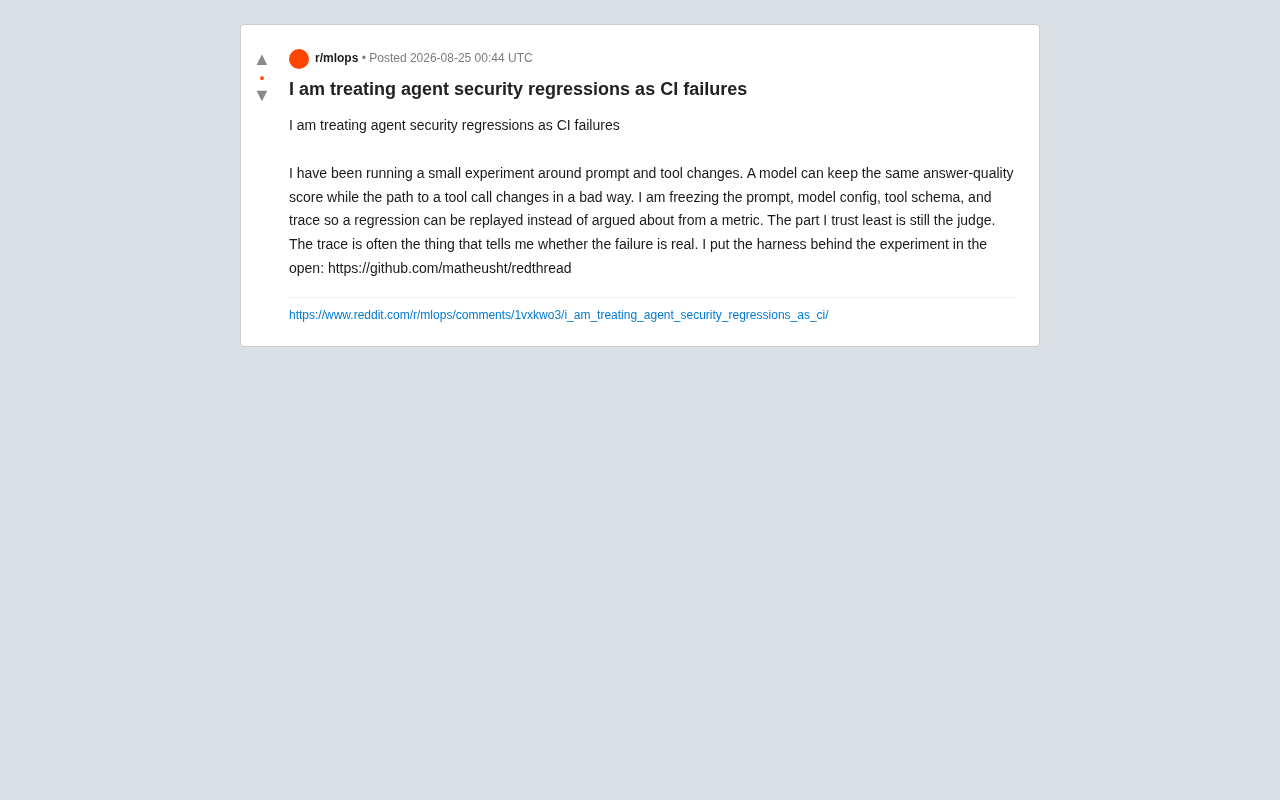
When building AI Agents, most teams focus on "answer quality" — whether the model provides correct, useful responses. However, a developer recently shared an experiment on Reddit that reveals a more insidious problem: a model can maintain the same answer quality scores while its tool-calling paths silently deteriorate in harmful ways.
In other words, your evaluation metrics might look perfectly fine, but the way your Agent executes tool calls behind the scenes has already developed security vulnerabilities. Without dedicated monitoring mechanisms, this kind of "silent degradation" is easily masked by traditional quality scoring systems.
The developer proposed a solution with strong engineering sensibility: treat Agent security regressions as CI (Continuous Integration) failures. Continuous Integration is a cornerstone practice in modern software engineering — after every code change submission, the system automatically runs a preset test suite, and any test failure blocks the code merge. This mechanism ensures the codebase's quality baseline doesn't gradually erode through frequent changes. Applying the same concept to AI Agents means every change in Agent behavior must pass security behavior tests. Just as a unit test failure after a code commit blocks the merge, Agent behavioral degradation should also be automatically caught and blocked.
Why Answer Quality Scores Can't Detect Path Problems
Metrics Mask Tool-Calling Path Degradation
Traditional Agent evaluation typically focuses on the correctness of final outputs. But the "process" by which an Agent completes a task is equally important — perhaps even more so. This involves a core AI Agent capability: Tool Calling. Since OpenAI introduced Function Calling in 2023, Agents completing complex tasks by invoking external APIs, database queries, file operations, and other tools has become the dominant paradigm. However, tool calling introduces security dimensions that don't exist in traditional text generation: call ordering, permission verification, data access scope, and other procedural factors directly relate to system security, yet are often invisible in the final output.
Consider this scenario: An Agent is asked to query user data. In the first implementation, it verifies permissions before calling the database. After a Prompt tweak or model upgrade, it skips permission verification and accesses the data directly.
From the final answer's perspective, both versions might return correct data with identical quality scores. But the latter clearly has a severe security flaw — it violates the "principle of least privilege" and "defense in depth" strategies in information security. In traditional application security, such privilege escalation vulnerabilities (like Broken Access Control in the OWASP Top 10) are among the most common security threats. This is a textbook case of "answer quality unchanged, tool-calling path degraded."
Multiple Factors That Trigger Agent Behavioral Degradation
Many factors can trigger this type of degradation:
- Prompt adjustments: Even subtle wording changes can alter the model's understanding of tool usage order. LLMs are far more sensitive to prompts than intuition suggests — research shows that even changes in punctuation, instruction ordering, or synonym substitution can cause significantly different decisions in tool selection and call sequencing.
- Model configuration changes: Temperature parameters and model version upgrades can both affect decision paths. Model version upgrades in particular (e.g., from GPT-4-0613 to GPT-4-turbo), while typically performing better on general benchmarks, may exhibit different behavioral patterns in specific tool-calling scenarios.
- Tool Schema modifications: Changes to tool definitions directly impact calling logic. Tool Schemas (typically defined in JSON Schema format) describe a tool's name, parameters, return values, and other information. Any field additions, deletions, or description text modifications can change the model's understanding of when and how to use that tool.
These variables interweave to give Agent behavior considerable uncertainty. Without systematic regression detection, it's difficult to pinpoint where problems originate.
Core Method: Freezing Key Elements for Reproducible Regression Detection
The most valuable engineering insight from this experiment is: make regressions "replayable" rather than relying on metrics to "argue about."
The specific approach freezes four key elements:
- Prompt: Ensures input instruction consistency
- Model config: Locks the model version and parameters
- Tool schema: Fixes the tool interface specification
- Trace: Records the complete call chain
Once these four elements are frozen, any regression can be precisely reproduced. This means when a team debates "whether this actually counts as a real degradation," instead of arguing over abstract numbers, they can directly pull up the complete execution trace for comparison.
This shift from "metrics-driven" to "trace-driven" essentially brings mature reproducibility principles from software engineering into AI Agent quality assurance. In traditional software debugging, "the hardest bug to fix is one you can't reproduce" is a universally acknowledged rule of thumb. By freezing all variable factors and preserving complete execution traces, developers transform the Agent's non-deterministic behavior into deterministic regression test cases, dramatically reducing the difficulty of troubleshooting and fixing issues.
Limitations of Automated Judgment: Why Execution Traces Are the Ground Truth
The author candidly points out the part of the entire experiment he "trusts least" — the judge.
In automated evaluation, another model or rule system is typically used to determine whether an Agent's behavior is compliant. This is the currently popular LLM-as-a-Judge paradigm — using a powerful LLM (like GPT-4) to judge another model's output quality or behavioral compliance. This method was systematically proposed in 2023 by researchers from UC Berkeley and others (e.g., the MT-Bench paper) and quickly became an industry standard. However, the judge itself can also err, have biases, or misjudge edge cases. Research has revealed multiple systematic biases in LLM judges: position bias (tendency to favor answers appearing in specific positions), verbosity bias (preference for longer responses), and inconsistency when judging fine-grained behaviors involving security and permission control. This is a common pain point in the current LLM-as-a-Judge paradigm.
Traces Are the Key Evidence for Judging Failures
Precisely because judges are unreliable, the author emphasizes: execution traces are often the key to determining whether a failure truly exists.
When an automated judge signals "failure," humans can trace back the complete trace to see exactly how the Agent arrived at its error state step by step. Traces provide irrefutable factual evidence, while scores are merely one potentially flawed interpretation of those facts. This is similar to the "log auditing" philosophy in traditional software operations — when an alerting system reports an anomaly, engineers need to trace back to raw logs to confirm whether the problem truly exists and identify the root cause. In the AI Agent context, execution traces are the Agent behavior's "logs," faithfully recording every step's input, reasoning process, tool selection, parameter passing, and return results.
This insight is instructive for all teams building Agent evaluation systems: don't blindly trust automated judgment conclusions — preserve sufficient raw traces for retrospective verification.
Open-Source Tool redthread: Integrating Security Testing into CI/CD Pipelines
The author open-sourced the testing framework behind this experiment under the name redthread, hosted on GitHub (github.com/matheusht/redthread).
The value of such tools lies in transforming Agent security testing from one-off manual checks into automated steps that can be integrated into CI/CD pipelines. CI/CD (Continuous Integration/Continuous Deployment) pipelines are the standard infrastructure for modern software delivery, automating the entire process from code commit to production deployment. Embedding Agent security testing into this pipeline means security verification becomes an unskippable "Quality Gate" in the delivery process. After each Prompt or tool change submission, the system automatically replays frozen test scenarios, and once abnormal degradation in tool-calling paths is detected, it triggers an alert just like a unit test failure.
This also reflects the industry trend of "Shift Left Security." Shift Left Security is a core principle of the DevSecOps movement, advocating moving security testing from the end of the development lifecycle to the earliest possible stage. The traditional approach discovers problems through penetration testing or security audits after a product goes live, while Shift Left advocates automatically executing security verification with every code (or in this context, Prompt/configuration) change. Tech giants like Netflix and Google have widely adopted this practice in traditional software development, and now this philosophy is extending into AI Agent development.
Practical Implications for AI Agent Development Teams
Though small in scale, this experiment reflects several important trends in Agent engineering:
First, security needs to "shift left" into the development process. Rather than remediation after production incidents, intercept behavioral degradation at the CI stage. This aligns perfectly with the software engineering principle that "the earlier a bug is found, the lower the cost to fix" — IBM research shows that defects found in production cost 100x more to fix than those caught during the design phase.
Second, reproducibility is the foundation of quality assurance. Freezing Prompts, configurations, Schemas, and Traces to enable precise problem reproduction is a prerequisite for rational discussion.
Third, don't over-rely on single scoring metrics. Answer quality scores are just one of many dimensions — "process metrics" like tool-calling paths and permission usage patterns also need monitoring. This represents an evaluation philosophy shift from "outcome-oriented" to "dual process + outcome orientation."
Fourth, preserve complete execution traces. In an era where judges aren't fully reliable, raw execution traces are the most trustworthy source of evidence. As Agent systems grow more complex, Observability will become a core component of Agent infrastructure, just as Distributed Tracing has become standard in distributed systems.
As AI Agents gradually move into production environments, this approach of borrowing mature software engineering practices — incorporating security regression into the CI system — will likely become an industry standard. In fact, we're witnessing a broader trend: AI Engineering is evolving from experimental Notebook-based development toward mature production engineering systems, and the automation of security regression testing is just one facet of this progression.
Related articles

Amphibious Transforming Drone: Beyond 100x Power Savings, What Are the Real Needs?
Is the amphibious transforming drone just a gimmick? Starting from the 100x power difference of the M4 Morphobot, explore real application scenarios and thesis topic ideas, analyzing boundary conditions where pure drones and pure ground robots both fail.

Warhound Raises $200 Million: Genetically Engineered "War Dogs" Paired with Anduril Gear
Warhound raises $200M, backed by Ben Lamm and Palmer Luckey, to genetically engineer dogs for military and law enforcement use and equip them with Anduril gear. This article analyzes its technology direction, funding logic, and ethical controversy.

Claude API Comes to Google Cloud: IAM Integration and SDK Access Guide
Anthropic hosts the full Claude API on Google Cloud with IAM-controlled permissions and unified billing. This guide covers the Vertex AI and Anthropic-hosted entry points, IAM role configuration, and SDK access.