AI Agent Verification Tool Invites Beta Testers: Orinyx Open-Source MCP Opens 5 Spots

Independent verification tool Orinyx is recruiting 5 developers for beta testing, focusing on Agent verification and synthetic data testing.
A developer on Reddit is recruiting 5 beta-testing developers for Orinyx, an independent AI verification tool initially focused on healthcare scenarios, while also advancing a general-purpose open-source MCP to test AI Agents with synthetic data. The post discloses a typical failure mode found in internal testing: the system cannot determine the correctness of an output, yet still generates reassuring wording, which is highly deceptive and costly in high-risk scenarios. The recruitment focuses on gathering four types of feedback: whether verification results are useful, how to integrate them into existing evaluation workflows, what evidence builds trust, and whether users are willing to use it long term. The project does not need patient data, is still in an early build stage, and seeks developers willing to find faults rather than users expecting an out-of-the-box solution.
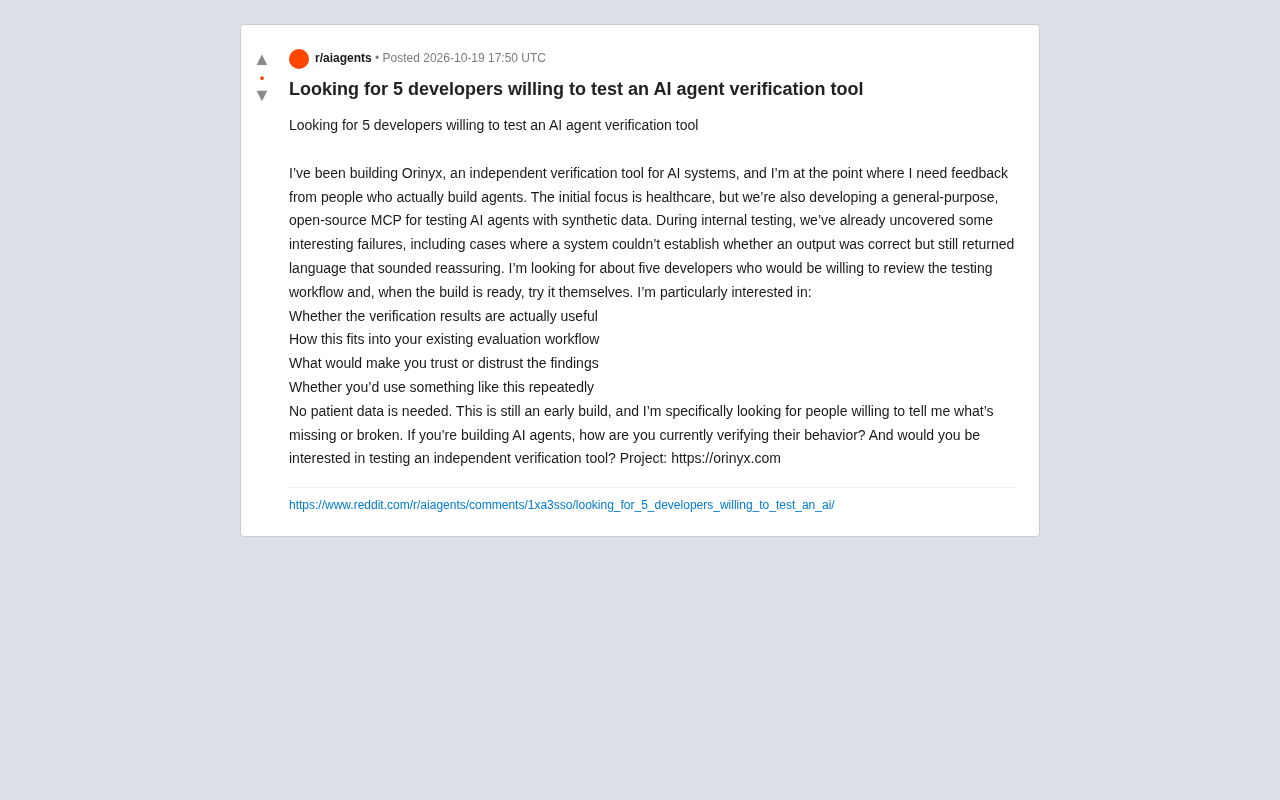
AI Agents are getting more and more complex, but the question of "is it actually reliable?" is still answered by most teams through manual spot-checking and gut feeling. A developer posted on Reddit recruiting 5 beta-testing developers for Orinyx, an independent verification tool he is building, hoping to get first-hand feedback from people who actually write Agents.
What problem Orinyx wants to solve
According to the original post, Orinyx is positioned as an independent verification tool for AI systems, initially focused on healthcare scenarios. At the same time, the team is also developing a general-purpose, open-source MCP (Model Context Protocol) for testing AI Agents with synthetic data.
The core ask in the post is straightforward: invite about five developers to review their testing workflow and try it themselves once a build is ready. The initiator explicitly states that no patient data is needed, that it is still an early version, and that what he wants most is for someone to bluntly say "what's missing and what's broken."
This "seek criticism first, then polish" posture is uncommon in early-stage AI tool projects, and it also hints that the pain points in the verification layer are real.
Failure modes already exposed by internal testing
The most noteworthy information in the post is some "interesting failures" the team has already found in internal testing. One typical case: the system cannot determine whether a certain output is correct, yet it still generates reassuring-sounding wording.
The danger of this kind of failure is that it is highly deceptive. The output sounds confident and considerate, and users can easily interpret it as "no problem," when in fact the system has no confidence at all in its correctness. Without an independent verification layer, this behavior of "masking uncertainty with comforting language" is very hard to catch in routine testing.
For high-risk scenarios such as healthcare, the cost of this failure mode can be very high, which is also why it makes sense for Orinyx to start with healthcare.
The phenomenon of "the system cannot determine whether the output is correct, yet generates reassuring wording" is usually categorized in AI safety research as overconfidence or miscalibration. Language models acquire a tendency during training to "give fluent, affirmative answers," and even when they lack an internal basis for judgment, they may still output confident-sounding content. In evaluation systems, this corresponds to the ability of "whether the model can correctly express its own uncertainty," commonly measured with metrics such as calibration curves or ECE (Expected Calibration Error). For Agents, the problem is more complex: an Agent's output is often the result of multi-step reasoning and tool calls, and looking only at the final wording makes it hard to locate which step the uncertainty came from. Therefore, the value of an independent verification layer is not just "looking at the output again," but catching, at the process level, the moments when the model "says it knows when it doesn't."
Four questions the developer recruitment focuses on
The initiator listed four types of feedback he especially wants from beta testers:
- Whether the verification results are genuinely useful, rather than yet another report nobody reads;
- How the tool fits into developers' existing evaluation workflows;
- What kind of evidence would make people trust or doubt the verification conclusions;
- Whether they would be willing to use this kind of tool repeatedly over the long term.
These four questions correspond respectively to usefulness, integration cost, credibility, and willingness to retain, essentially covering the key dimensions of whether a verification tool can be adopted in practice. The "trust or distrust" item in particular touches on the fundamental difficulty in the AI verification field: who verifies the conclusions of the verification tool itself?
The significance of the open-source MCP and synthetic data approach
The post mentions that, in addition to the healthcare vertical, the team is also advancing a general-purpose, open-source MCP to test AI Agents with synthetic data. This approach deserves a separate breakdown.
As a protocol connecting models with external tools and data, MCP has been widely adopted in the Agent ecosystem over the past year. Making testing capabilities into an MCP means developers can plug the verification workflow directly into their existing Agent architecture without having to build a separate system. Synthetic data bypasses the privacy and compliance obstacles of real data (especially medical data), allowing tests to be run repeatedly without touching sensitive information.
According to the original poster, this solution is still in an early build stage and no usable version has been released publicly yet.
MCP (Model Context Protocol) is an open protocol proposed by Anthropic at the end of 2024, aimed at standardizing how large language models connect to external tools and data sources. Before MCP appeared, every Agent framework had to define its own tool-calling interface, making it difficult for the same tool to be reused across different Agents. Through a unified client-server architecture, MCP allows models to discover and invoke external capabilities in a consistent way. It has now been adopted by tools such as Claude Desktop, Cursor, and Zed, and is gradually becoming the de facto interface layer in the Agent ecosystem. Packaging verification capabilities as an MCP server could, in theory, allow any MCP-supporting Agent to call the verification workflow directly at runtime, which is hugely significant for reducing integration costs.
Synthetic Data refers to data artificially generated by models or algorithms rather than collected from real scenarios. In Agent testing, the value of synthetic data lies in the ability to deliberately construct edge cases and adversarial inputs without relying on scarce or sensitive real samples. But it also has limitations: distribution bias in synthetic data may mask failure modes in real scenarios, so it usually needs to be cross-validated against spot-check results from real data.
Advice for developers who want to participate
If you are building an AI Agent and are unhappy with your current verification methods, this beta opportunity is worth paying attention to. Before participating, think through three things: how your current team determines whether Agent behavior meets expectations; which failure modes your existing workflow cannot catch; and what kind of evidence you want the verification tool to output.
At the end of the post, the initiator also threw a question back to the community: how do you currently verify Agent behavior? This in itself shows that Agent verification has not yet formed a recognized standard practice, and the shape of early tools will likely be shaped by the feedback of the first batch of users.
The project address is orinyx.com, and interested developers can contact the initiator directly. It should be noted that this is still an early build version, suitable for teams willing to invest time in finding faults rather than expecting an out-of-the-box product.
One-line Summary
Independent verification tool Orinyx is recruiting 5 developers for beta testing, focusing on Agent verification and synthetic data testing.
Paragraph Summary
A developer on Reddit is recruiting 5 beta-testing developers for Orinyx, an independent AI verification tool initially focused on healthcare scenarios, while also advancing a general-purpose open-source MCP to test AI Agents with synthetic data. The post discloses a typical failure mode found in internal testing: the system cannot determine the correctness of an output, yet still generates reassuring wording, which is highly deceptive and costly in high-risk scenarios. The recruitment focuses on gathering four types of feedback: whether verification results are useful, how to integrate them into existing evaluation workflows, what evidence builds trust, and whether users are willing to use it long term. The project does not need patient data, is still in an early build stage, and seeks developers willing to find faults rather than users expecting an out-of-the-box solution.
Related articles

Chain of Thought Isn't Just for AI: How Humans Can Use CoT to Improve Thinking Quality
Chain of Thought isn't just a prompt trick for large models. Starting from a Hacker News discussion, this article analyzes why CoT works for human thinking too, breaks down actionable ways to transfer it, and highlights the key differences between human CoT and machine CoT.
Cloudflare Teams Up with OpenAI: Closi…
Cloudflare Teams Up with OpenAI: Closing the Loop from Vulnerability Discovery to Defense with AI
Cloudflare uses OpenAI Daybreak to investigate security vulnerabilities and generate reviewable remediation plans, while developers use Codex to boost coding efficiency and quality.

Orca Multi-Agent Orchestration in Practice: A Guide to Parallel Collaboration with Claude and Codex
Orca is Stable AI's free open-source agent workbench supporting 34 agents like Claude Code and Codex in parallel. Learn its Git worktree isolation, multi-model orchestration, and mobile management.