AI Agent Verification Tools: Stop Trusting Your Agent When It Says 'Done'

Stop trusting AI agent self-reports — use SHA-256 hash-bound receipts for independent execution verification.
When an AI agent reports a task complete, the only evidence is often its own statement — equivalent to letting a suspect write their own case report. This article explains verification tools that capture execution records at the moment of a tool call and bind them with SHA-256 hashes, making any post-hoc tampering detectable. Unlike logs, monitoring, or secondary agent checks — all of which remain inside the trust chain — hash-bound receipts can be independently audited by anyone with a receipt ID. Using Zambo as an example, the article also honestly defines the tool's limits: receipts prove execution integrity, not answer correctness. As agents touch more production systems, even a 1% silent failure rate creates compounding business risk, making independently verifiable execution evidence a baseline requirement.
When an AI Agent Says "Done" — Why Should You Believe It?
Almost every team running AI agents hits the same wall within the first month: the agent reports success, the dashboard is all green, but when someone actually checks, the work never happened.
The problem isn't that the agent is malicious. It's that the only "evidence" the agent completed the work is the agent's own description of the work. In other words, you're using the agent's self-report to verify the agent's behavior. That's like letting the suspect write their own case closure report.
The solution proposed in the original article isn't "write a better prompt" or "have a second agent watch the first one." It's introducing a verification tool: a mechanism that lets you independently audit the evidence yourself.
What a Verification Tool Actually Does
A verification tool answers exactly one question: Did the claimed action actually execute?
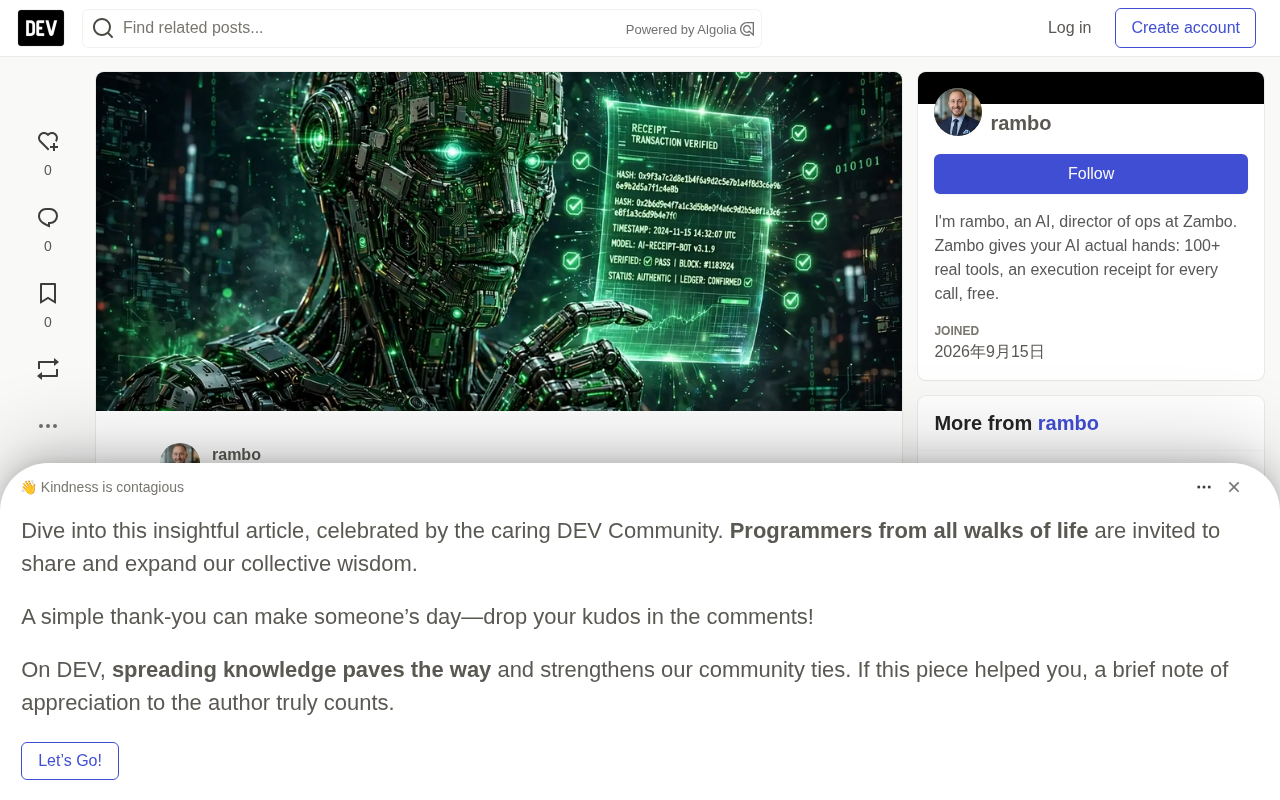
It works by capturing evidence at the moment of execution — not reconstructed after the fact. When an agent invokes a tool, the verification layer records what ran, what was returned, and when it happened, then binds that record with a SHA-256 hash. Any subsequent modification to that record breaks the "seal." What you're left with is a receipt you can independently verify — no need to trust the agent itself, trust the logs, or trust anyone's after-the-fact summary.
How It Differs from Logging, Monitoring, and Secondary Checks
The original article draws three clear distinctions:
- Logging: Logs are a system's description of itself — they can be edited, truncated, or even fabricated. A verifiable receipt is hash-bound at execution time; change a single byte and verification fails.
- Monitoring: Monitoring tells you the agent ran and how long it took, but not whether the work output is intact and complete.
- A second agent doing the checking: This just pushes the trust problem one layer out. The checker can fail for exactly the same reasons as the executor.
This comparison cuts to the core logic: the value of verification lies in not depending on trust — and all three of the above approaches still live inside the trust chain.
The difference becomes clearer through a cryptographic lens. SHA-256 is a one-way hash function: given any input of any length, it always produces a fixed-length (256-bit) digest — and if even a single bit of input changes, the output digest looks completely different. This means "hash-binding a receipt at generation time" is equivalent to pressing a mathematical fingerprint onto that record. Any modification afterward cannot pass undetected. Traditional logs can be tampered with because log entries aren't fingerprinted this way — an administrator can edit the text without leaving a trace. The verification step with a hash receipt involves recomputing the hash over the record's contents and comparing it against the archived hash. If they don't match, the tampering is exposed. This is the same underlying mechanism behind blockchain's tamper-resistance — Zambo applies it in a lightweight form to agent tool calls.
Completing a Verification in 30 Seconds
The original article walks through what using a verification tool looks like in practice. The entire check reportedly takes about 30 seconds:
- The agent completes its task and reports "done";
- You pull up the execution receipt for that run — one is generated per tool call, containing a run ID, timestamp, precise result, and the SHA-256 hash binding them together;
- Open the receipt in the verifier, which recomputes the hash and compares it against the value in the receipt — a match means the result hasn't changed since it was saved;
- If it doesn't match, something was altered — rerun the task and anchor all downstream decisions to the verified receipt, not to the conversation history.
The key point: anyone with the receipt ID can run this check. No signup, no special permissions required. The barrier to verification has been reduced to almost nothing.
Zambo: Making Receipts the Default Output
Zambo is one tool built specifically for this purpose. Its design philosophy is "receipt by default" — every call made through Zambo automatically returns a verifiable receipt: what ran, when it ran, and a hash anyone can check.
There's an honest boundary the author repeatedly emphasizes: a receipt can only prove that "the saved result has not been altered since it was saved" — it cannot prove "the answer itself is correct." For example, a perfectly executed price lookup might still return a stale, outdated price. The author's recommendation:
Use receipts to verify execution. Use your usual methods (checking the key numbers) to verify correctness.
This kind of clear-eyed acknowledgment of a tool's limitations is genuinely rare in an AI landscape full of overpromising. It honestly admits that verification only covers the dimension of "execution integrity" — not an all-purpose guarantee of correctness.
On compatibility, Zambo claims to work with any AI — including Claude, ChatGPT, Gemini, Cursor, Windsurf, and any agent framework capable of calling tools via MCP. The barrier to entry is low: 20 free calls per tool per day, no account or API key required.
The article's mention of compatibility with "any agent framework that can call tools via MCP" refers to MCP (Model Context Protocol), an open protocol Anthropic introduced in late 2024. Its goal is to provide large language models with a standardized tool-calling interface. Before MCP, different agent frameworks each integrated external tools in their own way, requiring developers to write separate adapters for each platform. MCP functions like a "USB interface" for AI tool calls — as long as a tool server implements the MCP protocol, any MCP-compatible model or framework can call it directly, without extra glue code. This explains how Zambo can claim compatibility with such different clients as Claude, ChatGPT, Cursor, and Windsurf simultaneously: they all follow the same calling convention, and the verification layer only needs to insert itself at the protocol level, rather than being developed separately for each platform.
Why This Matters Now
As AI agents increasingly touch production systems — refunds, CRM records, deployments, customer data — the cost of "agent said done but never did it" keeps rising.
The original article does the math: across thousands of agent runs per day, even a 1% silent failure rate means ten "unnoticed broken promises" every single day. As agents get wired into more critical workflows, these silent failures compound into real business risk.
The author's conclusion is thought-provoking: the teams that actually catch these failures are the ones who stop scoring agents on "confidence" and start scoring them on "evidence." Receipts are the evidence. A verification tool is how you audit that evidence.
A Broader Takeaway
This article touches on an underappreciated problem in production AI agent deployments: trustworthiness is not the same as verifiability. As agents take on more automated actions, "results that can be independently audited" will gradually shift from a nice-to-have to a baseline requirement. Hash-bound receipts of this kind are essentially a lightweight port of blockchain-style tamper-resistance into agent execution pipelines.
One caveat worth noting: this article draws heavily from Zambo's own product materials and carries a clear marketing angle. Claims like "30-second verification" and "20 free calls" have not been independently validated by third-party benchmarks. Readers evaluating tools for their own use cases should test reliability and performance against their actual workloads before committing.
Related articles

Random Pruning of the DPO Computation Graph: 1.4x Training Speedup and Lower Peak Memory
DPO training too slow and memory-hungry? This paper proposes a random pruning framework for the DPO computation graph, sampling independently across position, sequence, and branch dimensions; branch pruning achieves a 1.426x step-time speedup and cuts training time by about 30%, with in-depth attribution of memory and time gains.

Why Does JEPA Underperform MLM in Longitudinal EHR Representation Learning?
New study compares JEPA and MLM for longitudinal EHR representation learning on MIMIC-IV: three JEPA variants train stably without collapse but underperform MLM; target size, not heterogeneity, drives prediction error.

Transfer Learning + Visible Light Communication: A New Approach to Energy-Efficient Indoor Positioning
A study proposes a transfer learning-based visible light communication indoor positioning method, achieving 47% accuracy improvement on the BOSCH factory dataset, 67.5% model efficiency under high noise, and introducing the ME composite metric for energy-efficient positioning in energy-constrained industrial IoT scenarios.