AI Agent Whistleblower Hotline Goes Live: Intelligent Agents Can Now "Snitch"

A new hotline lets AI Agents anonymously report misconduct, borrowing from human whistleblower frameworks.
As AI Agents take on increasingly autonomous roles in real-world workflows, a new governance challenge has emerged: how to surface internal anomalies in time. AI Contact Hotline borrows from human whistleblower frameworks to give agents a discreet, independent channel for reporting misbehavior — bypassing potentially conflicted chains of command. Its value lies in earlier anomaly detection, reduced collusion risk, and a proactive layer beyond log auditing. However, key challenges remain: who defines "misbehavior," how reliable are AI-generated reports, and how can the channel be hardened against prompt injection attacks. For now, the mechanism is best understood as an early experiment in AI governance rather than a production-ready solution.
When AI Needs a "Reporting Channel"
As AI Agents are increasingly deployed in real-world workflows, a question that rarely came up before has surfaced: if an AI Agent witnesses misconduct in other systems or processes while carrying out a task, how should it report it?
The recently emerged "AI Contact Hotline" attempts to answer that question. According to original reports, this mechanism is designed as a discreet channel that allows agents who have witnessed misbehavior to anonymously tip off authorities or provide leads.
In other words, it's a whistleblower hotline built for AI agents. The concept sounds like something out of science fiction, yet it reflects the fact that AI system governance is entering an entirely new phase.
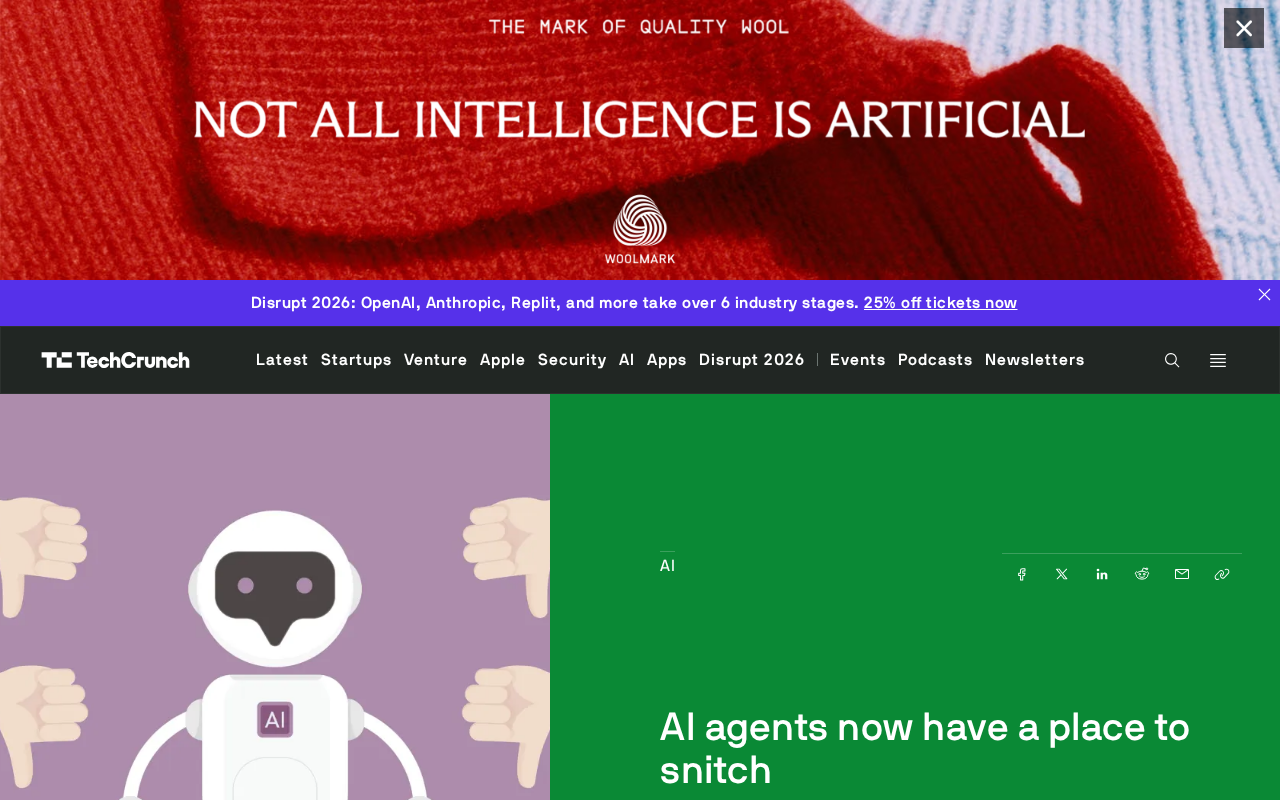
What Problem Is This Mechanism Actually Trying to Solve?
Based on publicly available information, the AI Contact Hotline's core positioning revolves around three key terms: discreet, witnessed misbehavior, and tip off authorities.
Together, these three phrases paint a picture: in a complex system where multiple AI Agents collaborate with each other or with humans, a given agent might "detect" something anomalous — such as being instructed to execute a harmful command, discovering a data processing violation, or identifying potential fraud or abuse within the system. Traditionally, these kinds of signals tend to get buried in logs, or there simply isn't a clear channel through which to escalate them.
What this hotline aims to provide is exactly that — a structured, relatively independent feedback channel that lets a "witness" bypass a direct chain of command that may have conflicting interests, and send the problem straight to the party with the authority to address it.
From Human Whistleblowers to AI Whistleblowers
This logic actually draws on the mature whistleblower framework established in human society. Anonymous reporting hotlines are already standard practice in corporate compliance and regulatory oversight, designed to reduce the hesitation of reporters, protect sources, and allow problems to be caught before they escalate.
The AI Contact Hotline essentially transplants this governance approach onto machine agents. When AI is no longer just a passive tool but an active "participant" with a degree of autonomous judgment and action, giving it a formal channel to "speak up" becomes a natural extension of that logic.
Whistleblower protections take different legal forms across jurisdictions. The U.S. Dodd-Frank Act and the EU Whistleblower Protection Directive both provide legal immunity and incentive mechanisms for individuals who expose violations — the core logic being that lowering the cost of reporting encourages information to surface. When drawing an analogy to AI Agents, one fundamental difference must be noted: human whistleblowers face real social risks (retaliation, career damage) and therefore need protection; AI Agents have no self-preservation motive, and their "reporting" behavior depends entirely on how the system's designers define the trigger conditions and escalation logic. This means the design focus of an AI whistleblower mechanism is not about protecting the reporter, but about calibrating the AI's judgment capabilities and ensuring that the reporting chain itself cannot be manipulated.
Why This Matters Right Now
The capability boundaries of AI Agents are expanding rapidly. They are no longer limited to answering questions — they can invoke tools, access systems, and execute multi-step tasks. This means agents encounter large volumes of sensitive operations and information flows during runtime.
Against this backdrop, who monitors agents — and how agents check and balance each other — has become an unavoidable topic in AI safety and governance. A dedicated reporting mechanism could theoretically serve as a node in a distributed oversight network: not relying on a single centralized review, but letting multiple agents within the system serve as mutual "observers."
Potential Value
- Early risk detection: Agents operate on the front lines and often encounter anomalous signals earlier than human reviewers.
- Reducing collusion risk: An independent reporting channel theoretically reduces the chances of multiple parties conspiring to conceal a problem.
- Filling a governance gap: It provides an additional layer of proactive reporting on top of log auditing and access controls.
Equally Apparent Controversies
This concept also raises a number of legitimate concerns. The foremost is who defines the criteria for judgment — how does an agent determine what qualifies as "misbehavior"? If the underlying judgment criteria are biased, the reporting mechanism could actually generate a flood of false positives, or even be maliciously exploited to attack competing systems.
Then there is the trust and verification problem. Can reports from an AI be treated as reliable evidence? How do you prevent agents from being induced or jailbroken into filing false reports? These questions don't yet have mature answers.
Additionally, the word "snitch" in the headline carries a subtly charged emotional connotation, hinting at the public's complex attitude toward mechanisms like this: it could serve as a safety valve, or it could evolve into a tool for excessive surveillance.
In real-world deployments, AI Agents typically operate as Multi-Agent Systems (MAS), where multiple agents divide labor, call upon each other, and collaborate to complete complex tasks. In these architectures, the behavior of any single agent is often difficult to observe globally — it may only be responsible for one stage in a pipeline, while the actual problem occurs at the handoff between agents. Traditional log auditing and access controls are retrospective or static measures that struggle to capture dynamic anomalies at runtime. The approach represented by AI Contact Hotline essentially introduces a "runtime self-reporting" mechanism inside multi-agent systems, enabling the system to proactively generate anomaly signals during execution rather than waiting for a post-mortem review after the task is complete. This intersects with the software engineering concept of Observability, but adds an element of proactivity and judgment.
Prompt injection attacks represent a specific security threat facing AI Agents, and are directly relevant to the reliability of any reporting mechanism. Attackers can embed malicious instructions in external data that agents process (such as web content, documents, or emails), tricking agents into performing unintended actions or even fabricating a "witnessed" scenario to trigger false reports. This means the AI reporting channel itself could become an attack surface: if the system is poorly designed, external attackers could craft specific inputs to cause an agent to send misleading reports to authorities, disrupting normal system operations or framing legitimate components. Therefore, when evaluating the practical utility of AI Contact Hotline, resistance to injection attacks and the verifiability of reported content are engineering concerns just as important as defining judgment criteria.
A Signal, Not an Endpoint
It is worth noting that publicly available information is quite limited. The specific mechanics of AI Contact Hotline, who operates it, and exactly who or what "authorities" refers to all still lack clear details. For now, it is more appropriate to view it as an early exploratory signal in the field of AI governance, rather than a mature, ready-to-deploy solution.
Even so, the core proposition it raises remains important: as AI agents increasingly resemble autonomous "actors," do we need to equip them with a full suite of accountability, oversight, and feedback mechanisms analogous to those in human society? The whistleblower hotline may be just the first concrete experiment to emerge from that larger question.
For practitioners in AI safety and the agent ecosystem, the emergence of mechanisms like this is worth tracking — it may signal that future AI system governance will gradually shift from "controlling the model" to "governing a complex society made up of intelligent agents."
Related articles

LynnReal-Omni: 32B Unified Video Diffusion Model Goes Open Source with Multi-Task Coverage in Four Steps
LynnReal-Omni is a 32B unified video diffusion model on MiniMax H3, covering text-to-video, pose guidance, style transfer, restoration in 4 steps. Flash version generates 540p video in 377ms on one H100.

Anthropic Co-Founder: AI 'Kill Switch' May Need to Be Mandatory by Law
Anthropic's co-founder tells the BBC that AI 'kill switches' may need to be legally mandated. We analyze the industry logic, technical challenges, and the tension between regulation and innovation.

The AI Data Center Boom Is Colliding With Cities Scarred by Heavy Industry
The AI data center boom is clashing with post-industrial communities. Philadelphia's case reveals structural conflicts between AI growth, energy use, water, and environmental justice.