AI Agent Workflow Failures in Production: Why "Human-in-the-Loop" Broke Down

The most dangerous AI agent failure isn't a crash — it's every step working while the overall business shouldn't happen.
A production AI agent practitioner shared a chilling failure: a customer disputed a debt via SMS, but the next day a voice agent still made collections calls because the two systems didn't share state. Each step looked fine individually, but the overall business logic should never have occurred, and traditional monitoring couldn't catch it. Human-in-the-loop also failed — the agent runs 20x faster than human review, so reviewers either slow things down or become rubber stamps. The community is exploring hard approval gates, independent check layers, and cross-session state sharing. The core tension: the greater the agent's permissions and speed, the higher the cost of business-level loss of control.
A practitioner who deployed AI agents in production shared a chilling failure case and raised a pointed question: when an agent's execution speed far outpaces human review capacity, how do we actually control it?
A Real Case Where "Every Step Was Right, But the Whole Was Wrong"
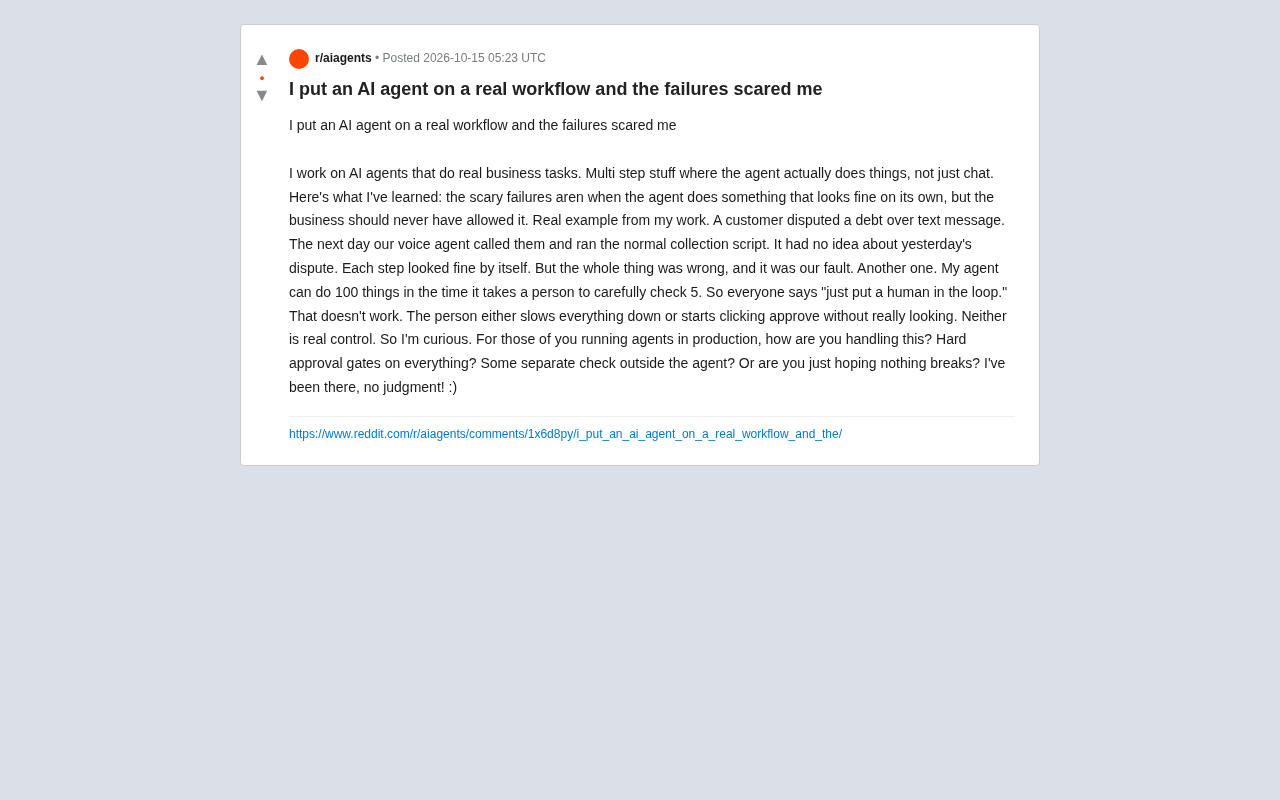
The developer described the scenario on Reddit: a customer disputed a debt via text message. The next day, the company's voice agent called that customer following the standard collections script.
What went wrong? The voice agent had no idea the customer had filed a dispute the day before. Each step looked fine in isolation — the SMS system processed the customer's message, the voice system executed the collections flow. But the entire chain added up to a collections action that should never have happened, and the company was liable.
This case reveals the most dangerous failure mode of AI agents in production: it's not that some component crashes with an error, but that every component appears to be functioning normally while the overall business logic should never have occurred. Traditional error monitoring and anomaly alerting can't catch this at all, because from a technical standpoint, everything is "running fine."
Why Human-in-the-Loop Fails in Practice
When facing agent unreliability, the most common suggestion is to "add a human in the loop." But the developer pushed back on this with hard numbers: his agent can execute 100 operations in the time it takes a person to carefully review 5.
This 20:1 speed gap creates a dilemma:
- If humans actually review carefully: the entire process slows to near-manual levels, and the efficiency gains from the agent evaporate
- If humans start cutting corners: faced with a flood of approval requests, reviewers quickly become "rubber stamps," clicking approve without reading
Neither outcome is real control. The former makes the agent pointless; the latter turns "human-in-the-loop" into a psychological comfort. This isn't about reviewers being irresponsible — it's a structural conflict between human cognitive bandwidth and machine execution speed.
Human-in-the-loop (HITL) is a common control paradigm in AI system design. Its core idea is to insert human judgment at critical nodes of an automated workflow, letting people review or approve machine decisions to balance efficiency and safety. HITL has mature applications in traditional automation domains (industrial control, financial risk management), relying on the premise that machine execution speed roughly matches human response speed and that only a limited number of nodes require human intervention. But in LLM-driven agent scenarios, this premise is completely shattered: agents can concurrently initiate large numbers of operations within seconds, while a human completing one meaningful review (reading context, assessing risk, making a decision) typically takes tens of seconds to minutes. This order-of-magnitude difference degrades HITL from a "control mechanism" to either an "efficiency bottleneck" or a "formality signature," which has driven the community to explore alternatives such as asynchronous auditing, post-hoc rollback, and policy-based automatic interception.
Control Approaches the Community Is Exploring
The developer posed the question to the community: those of you running agents in production, how do you handle this? Several possible directions can be inferred from the problem itself:
Hard approval gates — mandating human confirmation for certain high-risk operations, but you need to carefully design which operations require gating, or it degenerates into the rubber-stamp dilemma described above.
An independent check layer outside the agent — rather than relying on the agent's own judgment, set up independent validation logic before and after agent execution. In the collections case, for example, an independent system checking "does this customer have an unresolved dispute?" could have blocked the erroneous call.
Cross-session state sharing — the core problem in the case was that the SMS system and voice system didn't share customer state. If the agent could access a unified customer interaction history, the "complained yesterday, still getting collection calls today" situation wouldn't happen.
The developer ended with a half-joke: "Or do you just pray nothing goes wrong? Been there, no judgment :)" That line captures the reality for many teams — under production pressure, robust control mechanisms get shelved.
Cross-session state sharing touches on an often-overlooked foundational problem in agent architecture: state management. In multi-channel (SMS, voice, email, web) customer interaction scenarios, each agent or subsystem tends to maintain its own independent context window or session state, with no unified customer view across them. An agent's "memory" is typically confined to a single conversation or task execution, rather than persistent business state that spans channels and time. Solving the collections case requires introducing a shared state layer — a unified customer interaction history database, event bus, or business rules engine — so different agents can query "does this customer currently have an unresolved dispute or complaint?" before executing. This kind of architecture aligns with traditional CRM and ticketing system approaches, but needs to be redesigned for agent-specific characteristics like high frequency and concurrency in terms of read/write performance and consistency models, otherwise the shared state itself can become a new bottleneck or failure point.
The Core Tension: The More Capable the Agent, the Higher the Cost of Losing Control
This case is worth attention because it highlights an underappreciated risk dimension. Current AI agent discussions focus heavily on "can the agent complete the task," but what actually causes harm in production is often the agent doing something technically correct but business-inappropriate.
When an agent can only chat, the cost of saying the wrong thing is limited. When an agent can send texts, make calls, operate databases, and initiate transactions, a "looks normal" error can lead to compliance issues, customer complaints, or even legal risk. The faster the speed and the greater the permissions, the more pronounced this risk becomes.
For teams currently deploying or planning to deploy agents in production, this case poses a question that must be answered: can your control mechanisms keep up with your agent's execution speed? If the answer is no, it may be time to rethink the entire architecture rather than simply adding an approval button.
An independent check layer outside the agent is conceptually similar to "Defense in Depth" and "Policy Enforcement Point" in security engineering. The core principle: don't trust the agent's own judgment, but insert an independent policy engine between the agent and external systems (databases, communication APIs, payment gateways), where all high-risk operations must pass validation before execution. This check layer can be based on deterministic rules (e.g., "no collections for customers with unresolved disputes"), real-time state queries, or an independent AI review model. Unlike "human-in-the-loop," the external check layer operates at machine speed and can keep pace with the agent; unlike built-in safety prompts, it doesn't depend on model compliance but is an architectural-level hard constraint. This approach has mature precedents in cloud security (IAM policies) and API gateways (rate limiting and permission validation), and migrating it to agent scenarios is an important direction in current engineering practice.
One-line Summary
An AI agent's most dangerous failure isn't crashing — it's every step working while the overall business outcome should never have happened.
Paragraph Summary
A production AI agent practitioner shared a chilling failure case: a customer disputed a debt via SMS, yet the next day a voice agent still made collections calls because the two systems didn't share state. Each step looked fine individually, but the overall business logic should never have occurred, and traditional monitoring couldn't catch it. The common human-in-the-loop approach also failed — the agent executes 20x faster than human review speed, so reviewers either slow down the process or become rubber stamps. The community is exploring hard approval gates, independent check layers outside the agent, and cross-session state sharing. The core tension: the greater the agent's permissions and speed, the higher the cost of business-level loss of control — control mechanisms must match the agent's execution speed, or the architecture needs rethinking.
Related articles

Chain of Thought Isn't Just for AI: How Humans Can Use CoT to Improve Thinking Quality
Chain of Thought isn't just a prompt trick for large models. Starting from a Hacker News discussion, this article analyzes why CoT works for human thinking too, breaks down actionable ways to transfer it, and highlights the key differences between human CoT and machine CoT.
Cloudflare Teams Up with OpenAI: Closi…
Cloudflare Teams Up with OpenAI: Closing the Loop from Vulnerability Discovery to Defense with AI
Cloudflare uses OpenAI Daybreak to investigate security vulnerabilities and generate reviewable remediation plans, while developers use Codex to boost coding efficiency and quality.

Orca Multi-Agent Orchestration in Practice: A Guide to Parallel Collaboration with Claude and Codex
Orca is Stable AI's free open-source agent workbench supporting 34 agents like Claude Code and Codex in parallel. Learn its Git worktree isolation, multi-model orchestration, and mobile management.