AI Agents Across the Entire Research Workflow: An Essential New Skill for Graduate Students

AI Agents can cover the full research pipeline, but core innovation and academic integrity cannot be outsourced.
A Bilibili science educator with 450K followers argues that using AI Agents is now the most fundamental graduate-level skill, proposing that "80% of research work" can be delegated to AI. This article maps out Agent applications across literature deconstruction, novelty mining, paper reproduction, draft writing, and reviewer response — highlighting how Agents differ from chatbots by executing code and closing task loops autonomously. It also raises clear warnings about the 'imitate-adapt-paraphrase' pipeline's risk of academic misconduct, and concludes that while AI Agents are powerful efficiency levers for standardized execution tasks, problem definition, methodological rigor, and genuine innovation remain the researcher's irreplaceable responsibility.
The core competencies of graduate research are being redefined. A Bilibili science education content creator with 450,000 followers has put forward a provocative but thought-provoking argument: in the age of AI, knowing how to use AI Agents has become the most fundamental and critical skill at the graduate level. This article breaks down the core logic of that argument while offering an objective assessment of the value and limits of this "AI-driven research" model.
AI Agents: Not Just Q&A — They Actually Get Things Done
To understand the research value of AI Agents, we first need to clarify what sets them apart from ordinary chatbots. The original video's author offers a vivid analogy: an AI Agent is like a smartphone loaded with different apps — each app being a distinct Skill module. But it's even more powerful than a smartphone, because it can "actually roll up its sleeves and do the work for you."
This distinction captures the essential difference between Agents and traditional large language models. Conversational AI provides information and advice; Agents call tools, execute code, iterate on corrections, and form a closed loop from task input to deliverable output. In a research context, this means the Agent doesn't just tell you how to do something — it can actually do it for you.
The author's central claim is fairly radical: hand 80% of your research work over to AI Agents, and keep the remaining 20% for human guidance and judgment. This ratio implies an important assumption — the most critical creative thinking still resides with the researcher, while AI handles the repetitive, execution-layer labor.
A closer look at AI Agent architecture
Technically, an AI Agent typically consists of four core components: a large language model serving as the "brain" for reasoning and planning; a Tool Use module for interacting with external environments; a memory system for storing context and historical state; and a task planning module for breaking complex goals into executable steps. Unlike single-turn chatbots, Agents can enter a cycle of "perceive → think → act → observe → rethink" until a task is complete. In a research setting, this means an Agent can autonomously read a PDF, invoke a Python interpreter to run code, observe error messages, automatically revise the code, and re-run to verify — all without step-by-step human intervention. Mainstream Agent frameworks used in academic contexts include OpenAI's Function Calling system, Anthropic's Claude tool-use interface, and open-source options like LangChain and AutoGen, with most academic assistance tools built on top of these frameworks.
Six Application Scenarios Covering the Full Research Workflow
The video breaks down AI Agent applications in research into multiple stages across the entire workflow, each corresponding to a dedicated Skill module.
Literature Deconstruction and Identifying Novelty
Reading literature is a fundamental skill that advisors and senior lab members repeatedly emphasize — but the traditional approach often involves painstakingly grinding through papers. The author proposes using a literature deconstruction Skill to systematically analyze a paper's structural layout, innovation patterns, research methods, and figure citations, ultimately locating its Research Gap (areas of insufficient investigation). This logic aligns well with standard academic training — identifying research gaps is indeed a common pathway to generating new research questions.
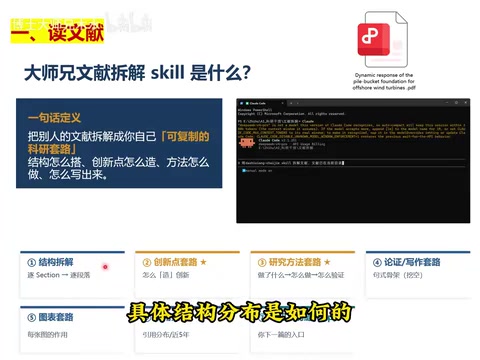
Building on this, a dedicated novelty-finding Skill can automatically analyze the literature, combine it with known innovation patterns, and output multiple candidate research directions — even distinguishing between strategies optimized for "graduating smoothly" versus "targeting top journals." The author bluntly states that finding innovation points is "all about patterns — you really don't need to think that hard." While direct, this statement does acknowledge that there are genuinely reusable methodological patterns in academic innovation.
Paper Reproduction: A Critical Lever for Research Efficiency
Reproducing papers is presented as one of the most pivotal stages in the entire workflow. Traditionally, reproducing a paper might take months — but once successful, it effectively completes around 80% of the work needed to publish an SCI paper, since subsequent work only requires secondary innovation on top of the existing model.
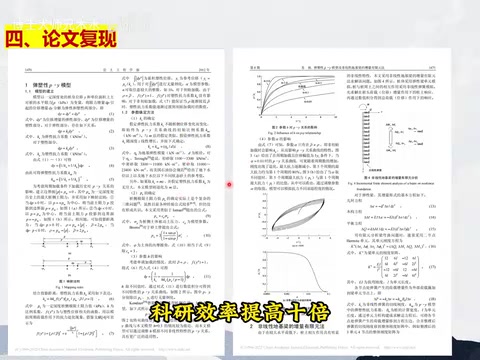
The video demonstrates this by feeding an Agent a paper on an elastic-velocity PY model: the AI independently analyzes the theory, converts formulas into code, auto-debugs, runs comparative validation, and ultimately reproduces the result figures — all without human intervention. The author claims that work that previously took one to two months was compressed into one to two hours. This scenario does reflect the real capabilities of code-executing Agents: for reproduction tasks with well-defined formulas and clear validation criteria, AI's automated debugging ability offers genuine practical value.
What paper reproduction really means
The value of paper reproduction in academia goes far beyond saving time. Reproduction is the foundation for verifying the reliability of scientific conclusions, and the most direct path to uncovering a paper's limitations and finding improvement opportunities. Common sources of difficulty include inconsistent notation, unavailable source code, incomplete hyperparameter disclosure, and restricted dataset access. AI Agents have real advantages with the first two — they can infer symbol meanings from context, generate implementations from pseudocode, and iteratively debug toward expected outputs. However, for cases where datasets are restricted or experiments depend on specific hardware environments, Agents' automation capabilities remain limited. It's also worth noting that a gap exists between "successful reproduction" and "genuine understanding of the method": producing similar-looking figures does not mean understanding why the model works — and the latter is the true foundation for further innovation.
Paper Writing and Reviewer Response
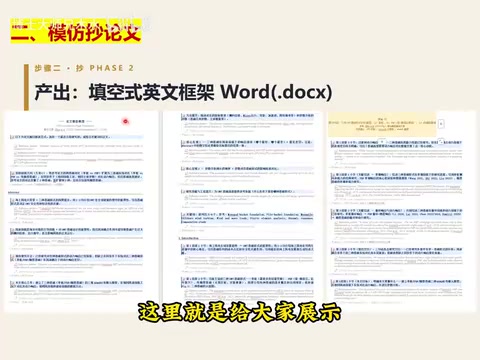
Drafting an initial manuscript is framed as a form-filling process: fill in a materials table, provide reference papers, and the Agent generates a draft following a three-step approach of "imitate, adapt, and paraphrase."
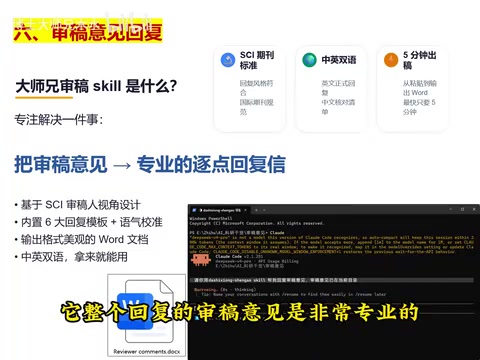
The critical final step after submission — responding to reviewer comments — also has its own Skill. It includes a large library of response templates and strategies, capable of generating point-by-point bilingual (Chinese and English) responses.
A Sober Look at the Academic Risks Behind "Imitate and Adapt"
The recurring phrase "imitate and copy papers" in the video is the part of this methodology that deserves the most careful scrutiny. The author's intent is presumably to refer to learning from established research paradigms and building incrementally on prior work — which is a legitimate and widespread academic practice, the very idea of "standing on the shoulders of giants."
But the word "copy" is easily misunderstood and can lead to problematic practices. Academic writing has strict requirements for originality, citation standards, and plagiarism detection. Turning "imitate-adapt-paraphrase" into an assembly line carries a real risk of crossing into academic misconduct. Text generated by paraphrasing tools, when detached from a researcher's genuine understanding of the content, can easily produce logical breaks or factual errors. This boundary must be explicitly communicated to readers.
Similarly, "form-filling" draft generation can dramatically improve efficiency — but the paper's core contribution, the soundness of the experimental design, and the academic value of the conclusions cannot be obtained by filling out a template. AI should handle text organization and formatting conventions, not the substantive intellectual content of the research.
What international and domestic norms say about AI-assisted writing
The global academic community has established increasingly clear boundaries around AI-assisted writing. Nature, Science, and most other major publishers explicitly require authors to disclose their use of AI tools and emphasize that AI cannot be listed as an author, since it cannot bear academic responsibility. In China, the Ministry of Education and universities have progressively issued regulations requiring graduate students to declare AI usage when submitting dissertations, with some institutions explicitly prohibiting AI-generated core content. The practice of "paraphrasing for plagiarism detection" is particularly sensitive under this framework: using rewriting to evade detection systems is fundamentally an evasion of academic integrity mechanisms, not an improvement of content. Researchers using AI in their writing should position it as a tool for language polishing and formatting — not a content generator — and all AI-processed text should undergo substantive review and revision by the author themselves.
What AI Agents Can Actually Do for You
Stripping away the obvious course-marketing angle of the video (the author ultimately promotes paid livestream courses and tutoring services), the methodology still contains a useful core:
Treating AI Agents as executable research assistants — using them to handle structured literature analysis, code reproduction, formatting, data processing, and figure generation — can genuinely free up significant researcher time. Liberating people from repetitive tasks so they can focus on problem definition and innovation judgment is precisely the right positioning for Agent tools.
But "80% to AI" is better understood as an efficiency aspiration than a hard metric. The 20% that actually determines research success — the value of the research question, the rigor of the methodology, the depth of the innovation — is precisely where AI is hardest to replace. The more powerful the tools become, the more important it is for researchers to maintain control over the content and exercise critical judgment; otherwise, it's easy to be steered off course by generated content.
For students currently in graduate programs, a reasonable stance might be: actively learn and make good use of AI Agents to improve your efficiency — but always put academic integrity and your own independent thinking first. Tools are a lever. The fulcrum is still you.
Related articles

Workbuddy for Absolute Beginners: How a Desktop AI Agent Fits Into Real Workflows
A beginner's guide to the Workbuddy desktop AI agent: installation, claiming credits, file management, and building automated workflows—compared with CodeX for fit and cost, helping professionals shift from AI question-askers to AI managers.

OpenAI's New Agent Stack: Computer Use, Decisions API, and Ultra-Fast Workflows
OpenAI Dev Day unveiled a new agent stack: Computer Use outperforms humans, Decisions API delivers ultra-low-latency classification via Luna, Agents API opens the same Computer Use capabilities, and GPT-6.1 Sol costs only one-seventh of Astra. Core updates, benchmark data, and developer insights.

Liang Wenfeng Open-Sources DeepInfo Inference Framework, Takes On U.S. Ban
DeepSeek open-sources its DeepInfo inference framework after its models, featuring GPU/CPU cross-pipelining, small-model prediction with large-model verification, and full Huawei Ascend and NVIDIA chip support—facing the U.S. federal ban head-on. This article analyzes its significance for AI deployment and open-source strategy.