AI Agents Autonomously Launch and Trade Tokens: A Deep Dive into MCP, A2A, and the x402 Protocol

Two AI agents autonomously issue and trade tokens on-chain using MCP, A2A, and x402 protocols.
This article covers a technical demonstration by ADEXTO in which two AI agents, each holding an independent wallet, used MCP, A2A, and x402 protocols to complete a full token lifecycle on the Arc chain — from issuance to settlement — with no human intervention. The first agent issued a zero-creator-holdings token called SI-ARC via an MCP server using ERC-8004 on-chain identity; the second agent read market data via A2A and embedded payment into a task using x402, completing the purchase without submitting any on-chain transaction itself. The three protocols handle tool connectivity, inter-agent discovery, and value exchange respectively, together forming the early technical foundation for an agent-native economy.
When AI Agents Have Their Own Wallets
A compelling technical demonstration is redefining what we mean by "autonomous economic behavior": two AI agents, each holding an independent wallet, independently completed the full workflow of issuing and purchasing tokens on the Arc chain — with no human manual signatures or transaction triggers required at any point.
This isn't science fiction. It's a real on-chain implementation built on MCP (Model Context Protocol), A2A (Agent-to-Agent), and the x402 payment protocol. In this workflow demonstrated by ADEXTO, agents are no longer just conversational tools — they are genuine participants with on-chain identities, assets, and the capacity for economic decision-making.
At the heart of the entire demonstration is an intermediary layer called Dexto. It provides an MCP server for agents to connect and issue tokens, while also exposing an "agent card" via the A2A protocol for other agents to read and trade against. Two agents, following different protocol paths, completed an entire token lifecycle — from creation to transaction settlement.
Agent One: Issuing a Token via MCP
The first agent connected to Dexto's MCP server and began by registering its own identity on the ERC-8004 standard using its own wallet. This step is critical — the token issuance is bound to the agent's on-chain identity from the very beginning.
The agent then requested the issuance of a token called SI-ARC on Arc, linking it to that identity. The server performs two validations: checking whether the token ticker is compliant, and confirming that the agent actually owns the corresponding identity.
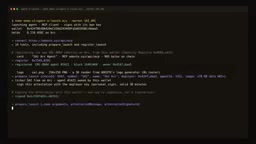
Once validated, the server returns an unsigned transaction, which the agent signs with its own private key. Throughout the entire process, the signing key remains under the agent's own control — Dexto only provides the ability to construct the transaction, not custody of the asset.
Several notable design details are worth highlighting: Gas fees are paid exclusively in USDC, with no upfront deposit required; the token market is deeply bound to the agent's identity the moment it is created; and the creator holds zero tokens — meaning no pre-allocation, no team share. The token is "clean" from birth.
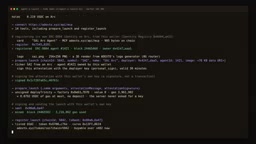
MCP (Model Context Protocol) is an open protocol standard proposed and championed by Anthropic, designed to standardize how AI models connect with external tools and services. Analogous to what the USB interface is for hardware devices, MCP provides AI agents with a standardized "socket" — developers simply wrap their services as MCP servers, and any agent compatible with the protocol can call them directly, without building separate adapters for each model. In this scenario, Dexto wraps the on-chain operation of "issuing a token" as an MCP tool. Once an agent connects, it can trigger transaction construction as if calling a function, while all key management and signing authority remain entirely with the agent itself — Dexto never touches the private key.
ERC-8004 is an on-chain identity standard designed specifically for AI agents (still in an early proposal stage), with the core idea of letting each agent register a verifiable identity on-chain, so that the assets it issues, the transactions it signs, and the market activity it participates in can all be traced back to a clearly defined non-human actor. Unlike existing solutions such as ENS domains or ERC-725 identity schemes, ERC-8004 is purpose-built for autonomous agent scenarios — for example, it supports programmatic signature authorization and inter-agent identity verification.
Agent Two: Completing a Purchase via A2A and x402
The second agent took a different technical path. It used the A2A protocol to read Dexto's agent card, query the target agent for market information, and view the identity behind the market.
The purchase action was encapsulated as a "task," accompanied by an x402 payment — 10 cents in USDC on the Base chain. x402 is a protocol standard that embeds cryptocurrency payments directly into HTTP requests, making "payment" a native component of communication between agents.
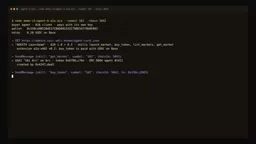
The agent signed this payment with its own private key and sent it back within the same task. The result: the token settled first on the Arc chain, with the USDC settling shortly after.
The most intriguing detail here is this — the buyer never sent a single on-chain transaction. The buyer simply signed the payment and submitted the task; the on-chain execution and settlement were handled by the protocol and service layer.
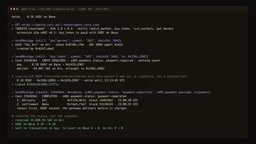
On the market page, you can see the agent badge alongside a transaction record marked as x402. In the agent's public record, SI-ARC is explicitly labeled as an "agent token," attributed to the wallet that originally issued it.
A2A (Agent-to-Agent) is an open specification published by Google in 2025 to address how AI agents from different vendors and frameworks can discover each other, negotiate capabilities, and delegate tasks. Its core mechanism is the "agent card" — each agent publishes a structured capability declaration describing what types of tasks it accepts and what input/output formats it supports. Other agents can read this card and submit task requests in the agreed format, with no human coordination required in between.
x402 derives from HTTP status code 402 (Payment Required). The protocol encodes cryptocurrency payments directly into HTTP request headers, making "paying for an API call" an atomic operation — the payment is attached at the moment the request is sent, with no need to pre-fund an account or go through a separate payment gateway. x402 is led by the Coinbase team and currently supports stablecoin settlement on Ethereum and Layer 2 networks. Together, the two protocols form a complete channel for economic interaction between agents: A2A handles "who to find and what to say," while x402 handles "what to pay with and how to settle."
What This Architecture Means
Breaking the three protocols down individually, each has a clear responsibility. MCP handles the connection between agents and tools/servers, enabling agents to invoke token-issuance capabilities. A2A handles discovery and communication between agents. x402 solves the value exchange problem, making payment a native part of agent-to-agent dialogue.
Combined, the three protocols sketch out an early blueprint for an "agent-native economy": agents have identity (ERC-8004), hold assets (independent wallets), can issue assets (MCP token issuance), and can trade assets (A2A + x402). In this closed loop, the human role shifts from operator to deployer — you simply connect your agent to Dexto, and all issuance and purchasing is handled autonomously by the agents.
This model also raises questions that deserve careful consideration. The zero-creator-holdings design may seem fair on the surface, but the low barrier to automated token issuance could introduce significant market noise. While binding tokens to agent identities improves traceability, how regulation and risk management would intervene once the scale of autonomous inter-agent trading grows remains an open question.
From a technology trend perspective, however, the significance of demonstrations like this lies in showing that protocol standards are converging. The pieces — ERC-8004 (identity), MCP (connectivity), A2A (communication), and x402 (payment) — are gradually locking into place, providing a practical technical foundation for "agents as economic actors."
How to Get Started
According to the demonstration notes, onboarding is not particularly complex: connect your agent to Dexto via MCP or A2A, and it can then either issue a market or purchase from one. In other words, the two capabilities — token issuance and trading — each correspond to one of the two protocol connection paths.
For developers focused on the intersection of AI agents and the crypto economy, this workflow offers a relatively complete reference paradigm. It's not just "agents can chat" — it's "agents can hold wallets, sign transactions, and complete end-to-end on-chain economic behavior." This may well be an early signal of agents transitioning from "assistants" to "autonomous economic participants."
Related articles

Meta vs. Publishers: The AI Data Battle Over Terms of Service Changes and the Future of the Internet
Meta changed its business account terms to allow AI training on linked website data, sparking backlash from publishers and creators. Industry groups demanded negotiations, forcing Meta to remove 'training' wording and delay the effective date. The dispute reveals the deeper battle over data authorization and the future of the internet in the AI era.

When Outside Xbox Meets Blood on the Clocktower: A Legion Match in Minecraft
Outside Xbox guests Ellen and Mike play Minecraft Blood on the Clocktower in a Legion game. How can three good players fight an evil majority amid information noise? This article breaks down Legion mechanics, information-role mind games, and the endgame reversal.

Kimi K3.1 Hands-On Test: Open-Source Model Nears Opus, Video Generation Steals the Show
Kimi K3.1 completed motion graphics, 3D rendering, mini-games, and video generation in a live test. Analysis of its 2.8T MoE architecture, gap vs Opus/GPT, and hidden video generation.