Meta vs. Publishers: The AI Data Battle Over Terms of Service Changes and the Future of the Internet

Meta changed business account terms to train AI on linked data, sparking backlash from publishers and creators.
Meta quietly changed its business account terms of service to allow any linked website or service to be used for AI model training, sparking strong opposition from publishers and creators. Meta first downplayed the reaction, then removed the word 'training' and said the new terms applied only to advertising products, but lawyers noted the terms still preserve AI training authority. Media industry groups sent a joint letter to Zuckerberg demanding formal negotiations, forcing Meta to delay the effective date to November 20. The dispute is essentially about a platform trying to legitimize the appropriation of vast third-party content through a default-consent terms update, depriving users of the right to say no.
Meta vs. Publishers: The AI Data Battle Over Terms of Service Changes and the Future of the Internet
Meta is mired in a dispute that appears to be about terms of service but is really a war over the future of the internet. At the heart of the controversy: Meta quietly changed the terms of service for its business accounts to allow the company to use any website or service linked to a business account to train its AI models. That means if you log into or link a website or a news email with an Instagram account, Meta could theoretically scrape that content for model training. According to analysis from a YouTube tech commentary channel, publishers and creators see this as a blatant overreach.
Timeline: From Terms Update to Collective Backlash
Meta's Initial Response and Retreat
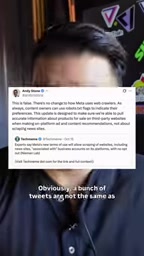
After the news broke, the backlash escalated quickly. Meta's first reaction was to have its PR team cool things down, claiming the reaction was "overblown." But as commentators noted, a few tweets are not the same as legally binding terms of service. Under pressure, Meta released a revised agreement, removed the word "training," and explained that the new terms applied only to advertising products.
A Business Account is the account type Meta offers to users who run brands, place ads, or manage pages on Facebook and Instagram, separate from personal accounts. Business accounts usually need to be linked to a Facebook Page or an Instagram professional account and may have additional contact information, website links, or third-party apps attached. The business account section of Meta's terms of service differs from the personal account terms because business accounts are treated as commercial use, and their data usage rules may be broader. The core of this controversy is that Meta sought, through changes to the business account terms, to bring content from third-party websites or services linked to business accounts into the scope of data that can be used for AI training—while many users did not realize that changes to business account terms could affect their content outside the Meta ecosystem.
Lawyers and Industry Groups Strike Again
The retreat did not calm things down. After reviewing the new terms, multiple lawyers pointed out that even with the adjusted wording, Meta still retains ample authority to train AI models. Subsequently, major trade organizations representing the media industry's interests sent a joint letter to Mark Zuckerberg, explicitly stating that the terms were unacceptable and demanding formal negotiations over the provisions. Facing united industry pressure, Meta conceded again, postponing the effective date of the new terms to November 20—widely interpreted as leaving a window for negotiations.

AI model training requires massive amounts of text, images, and other data, typically sourced from public web scraping, licensed datasets, or user-generated content. However, using copyrighted content or users' private data to train models without explicit consent may involve copyright infringement, breach of contract, or even violations of data protection regulations. The key issue in Meta's terms controversy is that it sought, through the "default consent" mechanism of its terms of service, to legitimize data usage that might otherwise constitute infringement. Legally, if terms of service are not prominently presented to users and explicitly agreed to, their validity may be challenged. Lawyers noted that even after Meta removed the word "training," the broad language in the terms about "using" and "analyzing" linked content could still be interpreted as permitting AI training, so clearer wording and user choice are needed.
Why This Is Not an Ordinary Terms Update
On the surface, this is a tug-of-war over data authorization. But the deeper conflict is that Meta is trying, through a single "default consent" update to its terms of service, to legitimize the appropriation of vast amounts of third-party content. Commentators pointed out bluntly that all platforms crave more data—especially the ability for AI agent systems (such as Meta's Muse) to access other websites, collect data, and enjoy ordinary user privileges. And those privileges have never been negotiated in any form.

What makes cramming such a major expansion of authority into a routine terms-of-service update so inflammatory is that it deprives people of the chance to say "no." As AI begins to disrupt how the internet works, every individual and institution caught up in it deserves the right to refuse. What Meta is experiencing right now is precisely the concentrated release of that suppressed backlash.
The "default consent" mechanism in terms of service means that if users do not actively decline or opt out when using a service, they are deemed to have accepted the updated terms. This mechanism is common among internet platforms, but it easily sparks controversy when used for major changes in rights. Regulations such as the EU's General Data Protection Regulation (GDPR) require explicit user consent for changes in the purpose of data use, not default consent. Meta's terms update attempted to use the default consent mechanism to expand the scope of data use—which might otherwise be restricted—to AI training, depriving users of the opportunity to negotiate and refuse in advance. Commentators stressed that when AI systems need to access third-party websites and collect data, platforms should provide clear opt-out options rather than hiding major expansions of authority in routine terms updates.
Practical Impact on Creators and Businesses
For creators and businesses operating within the Meta ecosystem, the risks are concrete and direct. If your business account is linked to an independent store, blog, or news email, under the original terms all of that content could become training material. Although Meta has removed the "training" wording and postponed the effective date, legal uncertainty remains. Commentators warn that the current version could still be interpreted as permitting AI training, so staying vigilant and carefully assessing linked assets is necessary self-protection.
For creators and businesses, linked assets include independent websites, blogs, news emails, portfolio pages, and more. These assets are usually tied to the account through the "contact information" or "website" fields of a Meta business account, for purposes such as driving traffic or identity verification. If Meta's terms allow linked content to be used for AI training, original content on these assets could be incorporated into model training, and creators may be unable to track it or receive compensation. In addition, outputs from trained AI models may imitate or replicate original styles, posing a potential threat to creators' market competitiveness. Creators should therefore review the list of assets linked to their Meta accounts and consider whether to unlink them before the terms take effect, or to seek legal avenues to require Meta to clarify the scope of data use.
The Game Is Far From Over
Postponing the effective date is only a delaying tactic, not the endgame. The formal negotiations demanded by media industry organizations have yet to produce substantive results, and it remains unknown whether Meta will offer terms that genuinely respect content owners' rights. This conflict reveals a broader trend: in the AI era, data acquisition is shifting from "covert scraping" to "terms-based authorization," and once the latter lacks transparency and negotiation mechanisms, it will turn into a trust crisis between platforms and the content ecosystem. The future shape of the internet may well depend on how these terms negotiations unfold.
One-line Summary
Meta changed its business account terms to use linked data for AI training, triggering a collective backlash from publishers and creators.
Paragraph Summary
Meta quietly changed its business account terms of service to allow any website or service linked to a business account to be used for training AI models, sparking strong opposition from publishers and creators. Meta first had its PR team cool things down, then removed the word "training" and explained that the new terms applied only to advertising products—but lawyers pointed out that the new terms still preserve AI training authority. Media industry organizations sent a joint letter to Zuckerberg demanding formal negotiations, and Meta was forced to postpone the effective date to November 20. The essence of the dispute is that the platform is trying, through a default-consent terms update, to legitimize the appropriation of vast amounts of third-party content and deprive users of the right to say "no." Creators and businesses need to watch out for the risk that linked assets could be used for AI training—the game is far from over.
Related articles

LLaMA-Factory in Practice: A Complete No-Code Guide to Fine-Tuning Large Models
An introduction to LLaMA-Factory, the open-source fine-tuning tool: its 60.1K-star background, supported models and algorithms, local vs. cloud deployment, and CUDA setup steps.

Zeng Ming's Deep Retrospective: Why OpenAI May Not Be the Ultimate Winner — and Why the Corporate System Will Disappear
Zeng Ming's deep retrospective on the AI endgame: model companies are just infrastructure, OpenAI and Anthropic won't be the final winners; the next battle is the Agent entry point standard; the corporate system will disappear as AI restructures collaboration, and only mission-driven companies can survive the cycle.

OpenHands v1.28.0: OpenCode and PI Added as Built-in Agents, API Keys Requestable In-Conversation
OpenHands ships 5 releases in 21 days: v1.27.0 adds OpenCode and PI as built-in agents, v1.28.0 enables in-chat key requests. ACP integration, credential reuse, model list changes, and upgrade advice.