AI Agents Break Free from Isolation: Busabase's Open-Source Database Makes Outputs Reusable

Busabase's MIT open-source workspace transforms AI Agent outputs from disposable chat logs into reusable team knowledge assets.
A core pain point with today's AI Agents is that their outputs get trapped in isolated chat histories, unable to accumulate into reusable team assets. Busabase addresses this with an MIT-licensed open-source structured database and workspace, letting Agents write outputs directly into persistent storage as shareable data, docs, and skills. The permissive MIT license lowers adoption barriers and supports self-hosting for data security. This points to a key evolution in AI Agent tooling: shifting from single-task execution to building organizational knowledge infrastructure over time.
The "Isolated Silo" Problem with AI Agents
Using AI Agents today feels a lot like playing a single-player game with no save feature. They do get work done — writing documents, analyzing data, generating code — but the results are often trapped inside isolated conversation histories. Close the chat window, and the context vanishes. The research summary an Agent compiled for you yesterday? You'll have to start from scratch today.
This "use-and-discard" pattern creates a fundamental problem: work products can't accumulate, let alone compound over time. Every interaction with an Agent starts from zero. Knowledge can't circulate within a team, nor can it build up into reusable assets over time. For teams serious about integrating AI Agents into their production workflows, this is a bottleneck that's hard to work around.
Busabase's Solution: A Structured Workspace for Agents
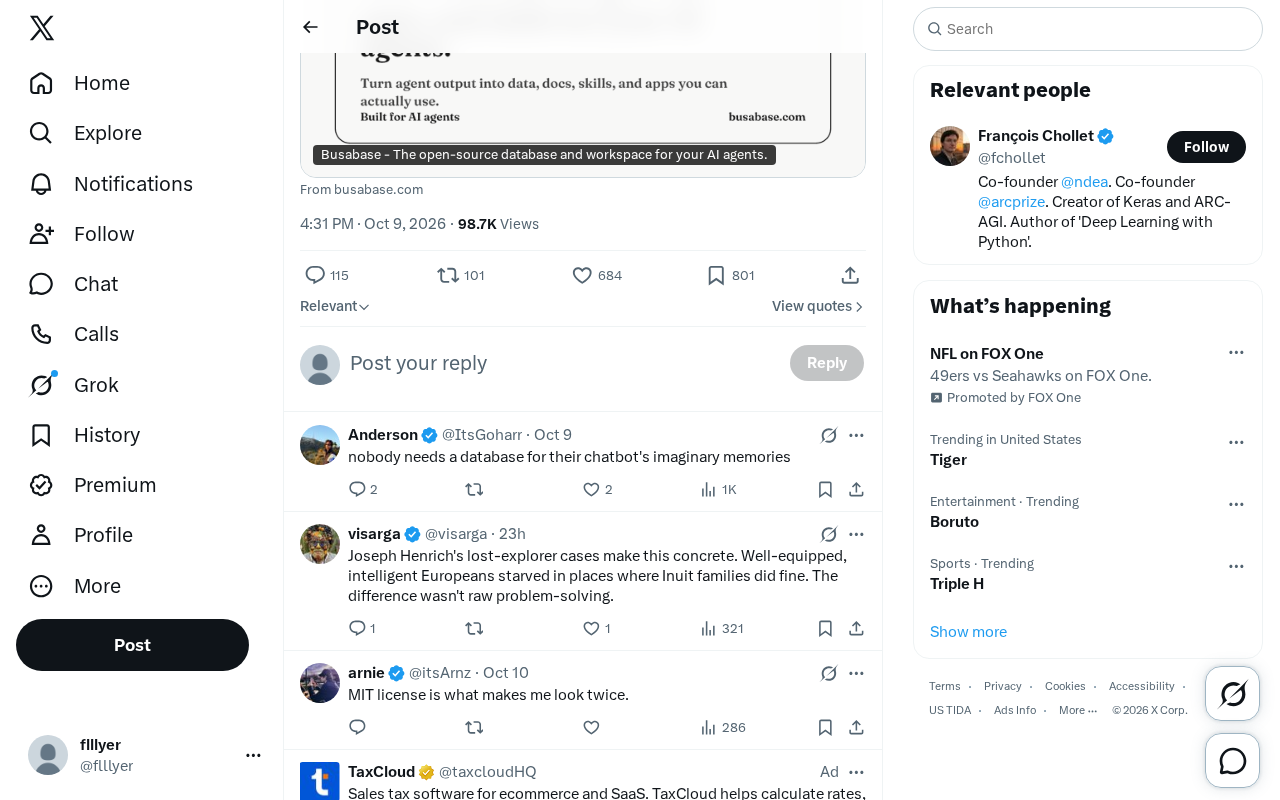
The Busabase team (@Busabase4agent) has built a solution specifically targeting this pain point. They've released an open-source database and workspace under the MIT License, designed from the ground up for AI Agents.
The core idea is straightforward: instead of letting Agent outputs disappear into ephemeral chat logs, have them write directly into a structured workspace. Within this framework, what an Agent produces is no longer a one-off conversation snippet — it's transformed into reusable data, docs, and skills.
This means every piece of work an Agent completes adds another brick to a shared knowledge base. Outputs that were once locked inside private conversations become persistent assets that the entire team can access and build upon.
From "Chat History" to "Persistent Assets"
Traditional Agent interaction is fundamentally session-driven — outputs are loosely formatted, hard to search, and impossible to accumulate. What Busabase is trying to change is having Agent work connect directly to structured storage.
This reflects a deeper philosophical shift in product design: Agents shouldn't just be temporary task executors — they should become producers within a team's knowledge system. Once outputs are structured and persisted, subsequent Agents and team members can pick up where things left off and build on existing work, creating a true compounding effect.
The gap between structured storage and unstructured chat logs is especially stark at the engineering level. Chat history is essentially a linear stream of natural language — difficult to index, query, or programmatically reuse. A structured database, on the other hand, allows content to be precisely retrieved and combined via fields, tags, and relationships. In an AI Agent context, this difference directly determines the quality of "memory": a loose conversation summary can only offer vague contextual reference, while a structured "skills" entry can be invoked by subsequent Agents like a function in a library. This is precisely why technologies like vector databases and knowledge graphs have attracted so much attention in the Agent infrastructure space in recent years — they're all trying to solve the same core problem: making machine-generated knowledge addressable and reusable.
What Open Source and Team Collaboration Mean Here
It's worth noting that Busabase chose the MIT License — one of the most permissive open-source licenses available. Developers are free to use, modify, and integrate the code with minimal restrictions. This lowers the barrier to adoption for teams and leaves room for community contributions and derivative development.
For teams looking to deeply embed AI Agents into their workflows, open source means control and transparency — you own how your data is stored, rather than being beholden to a closed SaaS platform. Combined with its positioning as a "shared team workspace," Busabase's ambition is clearly to upgrade Agents from personal tools to collaborative infrastructure for entire organizations.
The MIT License is one of the most permissive in the open-source world. Unlike "copyleft" licenses such as the GPL, MIT doesn't require that modifications be released under the same terms. This means companies can integrate Busabase into proprietary products or internal systems without having to open-source their own business logic. For teams that prioritize data security and compliance autonomy, this is especially significant — they can deploy the entire stack on their own servers, completely eliminating concerns about data flowing to third-party cloud platforms. This aligns well with the growing trend of enterprises treating "data sovereignty" as a hard requirement when evaluating AI tools.
A Direction Worth Watching
Based on what's been shared, Busabase represents an important thread in the evolution of AI Agent toolchains: how to make Agent outputs accumulative, shareable, and reusable.
As more teams scale up their Agent deployments, "memory" and "knowledge accumulation" will become critical differentiators. Agents that can simply complete tasks are no longer rare — the real competition in the next phase will be about infrastructure that structures outputs and lets entire organizations benefit from them. Whether Busabase can genuinely solve the problem of "outputs trapped in chat history" still needs to be validated through real-world use, but the direction it points to clearly addresses a genuine pain point in the industry.
Related articles

Chain of Thought Isn't Just for AI: How Humans Can Use CoT to Improve Thinking Quality
Chain of Thought isn't just a prompt trick for large models. Starting from a Hacker News discussion, this article analyzes why CoT works for human thinking too, breaks down actionable ways to transfer it, and highlights the key differences between human CoT and machine CoT.
Cloudflare Teams Up with OpenAI: Closi…
Cloudflare Teams Up with OpenAI: Closing the Loop from Vulnerability Discovery to Defense with AI
Cloudflare uses OpenAI Daybreak to investigate security vulnerabilities and generate reviewable remediation plans, while developers use Codex to boost coding efficiency and quality.

Orca Multi-Agent Orchestration in Practice: A Guide to Parallel Collaboration with Claude and Codex
Orca is Stable AI's free open-source agent workbench supporting 34 agents like Claude Code and Codex in parallel. Learn its Git worktree isolation, multi-model orchestration, and mobile management.