AI Agents Enter a New Era: From OpenClaw to Grok Bot and Muse — Who's Giving Agents a Real Computer?

AI Agents are evolving from chat interfaces into autonomous workstations with browsers, file systems, and persistent memory.
This article traces the key evolution of AI Agent form factors over the past year: from OpenClaw enabling cross-app continuity, to Hermes introducing persistent memory and reusable skills, to Grok Bot building a multi-agent system where parallel Bots share dedicated cloud computers, to Meta's Muse running autonomously in the background and requesting human approval at critical steps. The open-source OpenMuse further proposes a "body-brain decoupling" architecture — separating the browser, file system, and terminal from reasoning and memory modules into freely composable components. The core trend: modern agents are no longer just reasoning brains, but are being equipped with full working infrastructure, crossing from conversational assistants to autonomous executors.
AI Agents Are Moving from "Chat Boxes" to "Workstations"
Over the past year, discussions around AI Agents have largely focused on models, tools, and function calling. But an increasingly clear trend is emerging: we're beginning to give agents a real place to work — a dedicated environment with a browser, file system, terminal, and persistent memory.
A Reddit user systematically traced the evolution of agent form factors over this period, from OpenClawAd and Hermes to Grok Bot, Muse, and the open-source OpenMuse. This progression reveals a core shift: agents are no longer just a "brain" — they're starting to have a "body" of their own.
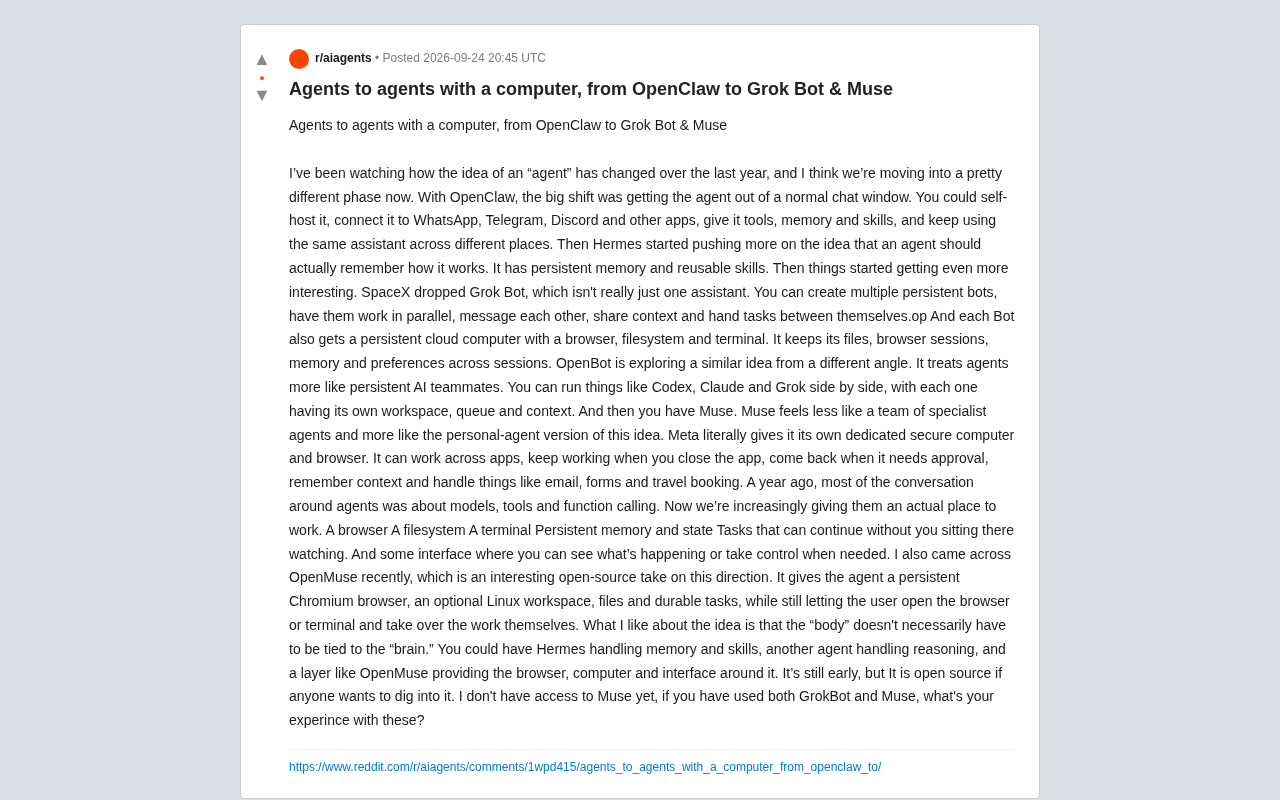
Phase One: Freeing Agents from the Chat Window
OpenClaw's biggest contribution was moving agents out of the traditional chat interface. Users can self-host the agent, connect it to multiple platforms like WhatsApp, Telegram, and Discord, configure its tools, memory, and skills, and maintain continuity with the same assistant across different apps.
This addressed a long-standing pain point: AI assistants used to be trapped inside a single conversation window, forcing users to start from scratch in every new context. OpenClaw's approach was to make the agent a service that "follows you," rather than a feature locked inside a specific app.
Hermes then pushed further, emphasizing that agents should "remember how they work." It introduced persistent memory and reusable skills — the agent doesn't just remember conversation content, but also its own working patterns and accumulated capabilities. This laid the groundwork for multi-agent collaboration that followed.
A note on persistent memory: Persistent memory is a key engineering concept in agent systems. Traditional LLMs are stateless by nature — once a conversation ends, the model's "memory" of that interaction is completely gone, and the next session starts with a blank context. Persistent memory works by writing conversation summaries, user preferences, and task execution history to external storage (such as a vector database or structured database), then retrieving and injecting this information into the context window at the start of a new session — simulating continuous memory. This is fundamentally different from human working memory; it's essentially "bolt-on memory" rather than learning embedded in model weights. The engineering challenge lies in deciding what information is worth storing long-term, how to efficiently retrieve relevant memories, and how to prevent retrieved results from contaminating judgment on the current task.
Phase Two: Multi-Agent Collaboration and Dedicated Cloud Computers
What really made things interesting was the arrival of Grok Bot. According to the original post, it isn't a single assistant but a multi-agent system:
- Users can create multiple persistent Bots
- These Bots can work in parallel and send messages to each other
- They can share context and hand off tasks between themselves
- Each Bot has its own dedicated cloud computer, complete with a browser, file system, and terminal
Critically, this cloud computer persists files, browser sessions, memory, and preferences across sessions. This means an agent's working state is continuous — it doesn't reset to zero every time it starts up.
OpenBot explored a similar direction from another angle, treating agents as "persistent AI teammates." You can run Codex, Claude, and Grok side by side, each with its own workspace, task queue, and context. This design is more like a team of specialized agents, each handling its own domain.
A note on multi-agent systems: "Parallel work and context sharing" in a Multi-Agent System is technically non-trivial. Each agent is essentially an independent reasoning process. Getting multiple agents to collaborate on a task requires solving three core problems: first, orchestration — who decides which subtask gets assigned to which agent; second, context synchronization — how agents pass intermediate results to each other without losing critical information; and third, conflict arbitration — how to prevent conflicts when multiple agents operate on the same resource (such as a file or browser tab). Current mainstream approaches include the centralized coordinator model (one primary agent directs multiple sub-agents) and the decentralized message-passing model (agents communicate via a message queue). The Grok Bot described here is closer to the latter, allowing Bots to message each other directly — which offers more flexibility, but significantly raises the difficulty of debugging and observability.
Phase Three: The Complete Personal Agent — Muse
Compared to the "team" approach of Grok Bot and OpenBot, Meta's Muse looks more like the "personal agent" realization of this same idea. According to the original post, Meta gave Muse its own dedicated secure computer and browser.
Muse's feature set is notably representative:
- Works across applications
- Continues running tasks after you close the app
- Proactively returns to confirm when user approval is needed
- Remembers context and handles real-world tasks like email, form filling, and travel booking
The significance of this design is that the agent no longer needs you watching a screen at all times. Tasks can progress in the background, requesting human intervention only at critical checkpoints. This marks the transition from "conversational assistant" to "autonomous executor."
Decoupling "Body" from "Brain": The Open-Source OpenMuse
The original post's author specifically highlighted the open-source project OpenMuse as a direction worth watching. OpenMuse gives agents a persistent Chromium browser, an optional Linux workspace, a file system, and durable tasks — while preserving a key feature: users can open the browser or terminal at any time and take over directly.
The author offers an insightful perspective: an agent's "body" doesn't have to be tightly coupled to its "brain." You could have Hermes handle memory and skills, another agent handle reasoning, and a layer like OpenMuse provide the browser, computer, and interaction interface.
This decoupled architecture may be an important direction for agent systems: separating perception, reasoning, memory, and execution environments into composable modules, rather than cramming all capabilities into one closed system. For developers, open-source solutions also mean greater controllability and room for customization.
A note on Chromium as an execution environment: Chromium is the open-source core behind Chrome, and supports automated control via the Chrome DevTools Protocol (CDP) — developers can use code to directly drive page navigation, element clicks, form filling, and network request interception. Popular browser automation libraries like Playwright and Puppeteer are both built on this protocol. For agent systems, choosing Chromium means being able to leverage this mature automation ecosystem without building a browser control layer from scratch. A "persistent Chromium instance" means the agent doesn't spin up a fresh, stateless browser process for every task — it maintains a continuously running browser session that preserves login state, cookies, local storage, and even open tabs. This is critical for real-world tasks that require authentication or multi-step operations.
Trends at a Glance: Agents Need a "Place to Work"
Looking at these products together, a clear consensus emerges: modern agents are being equipped with a full suite of working infrastructure.
- Browser: Directly operate web pages and complete real-world tasks
- File system: Produce and manage files that persist over time
- Terminal: Execute commands and run code
- Persistent memory and state: Continue work across sessions
- Resumable tasks: No need for constant human supervision
- Visualization and takeover interface: Observe or intervene at any time
From models and function calling to giving agents a real workstation — this year's changes mark a genuine shift in where the industry's attention is focused. That said, the original post's author openly acknowledged not yet having access to Muse, and these form factors are still in early stages. How they perform in practice remains to be verified by more users. For those who want to dig deeper, OpenMuse as an open-source project offers an immediately accessible entry point for hands-on exploration.
Related articles

@ai-sdk/vue 3.0.306 Patch Release Syncs with [email protected] Update
@ai-sdk/vue 3.0.306 released, synced with [email protected]. A routine patch release for the Vercel AI SDK ecosystem with no public API changes; the Vue adapter layer stays version-aligned with the core package.

Gemini 4 Argon API Launches: The Era of Million-Token Output Begins
Google launches Gemini 4 Argon with sparse MoE architecture, up to 1M output tokens, and a 68.90% Vals Index score, available across API, AI Studio, and the Gemini app.

DukaanAI: Turning Product Photos into Inventory Lists with Open-Source AI
DukaanAI is an AI inventory tool for small retailers that turns product photos into inventory entries using the open-source Gemma 3 model, with local inference, editable fields, and CSV export.