AI Agents Enter the Physical World: Muse, Grokbot, and the Battle for Consumer AI
From Claude's CRISPR discovery to Muse topping the App Store, personal AI agents are moving from debate to reality.
This article covers the rapid expansion of AI agents from labs to consumers. Anthropic claims Claude discovered a CRISPR-like enzyme system for ~$10K in compute, but experts call it overhyped and preliminary. At the UN, Trump renamed AI "Superintelligence" and rejected global regulation, while Altman and Amodei offered competing governance visions. The consumer agent debate pits Ben Thompson's "people want entertainment, not efficiency" against the counterargument that billions of people desperately want to outsource administrative drudgery. Meta's Muse topped the App Store and earned a glowing NYT review, while MetaConnect introduced glasses integration and the Muse Charm wearable. xAI brought Grokbot into Tesla. The key open questions: do hardware form factors unlock agent adoption, and is proactive service the real differentiator?
Is there really a market for personal AI agents? That debate has flared up again with a wave of new products. Meta's Muse, xAI's Grokbot, and other agent products are moving beyond screens — into your smart glasses, embedded in your Tesla, or worn as a small device around your neck. Meanwhile, the tech world has split sharply over a more fundamental question: do people actually want their lives optimized?
Anthropic's Biology Breakthrough Sparks Debate
Before diving into consumer agents, it's worth noting a harder-edged development. Anthropic announced what it's calling a "major AI breakthrough in biology": with only high-level guidance from scientists, Claude reportedly discovered a novel enzyme system with CRISPR-like properties.
CRISPR is a gene-editing technology based on enzyme sequences found in bacteria, used to mechanically cut DNA and insert new genes. Anthropic says the discovery involved 1,000 Claude agents, took 21 hours, and consumed roughly 210 million tokens — equivalent to about $10,000 in compute costs.
CEO Dario Amodei (who holds a PhD in biophysics) promoted the results on X. He wrote that it's tempting to dismiss this as a one-off novelty, but AI performance in new intellectual domains tends to jump from weak to superhuman within just a few years. He used mathematical ability to illustrate this exponential curve, and argued that "AI applied to biology is on a similar exponential trajectory."
The industry response was notably cautious. Lucas Harrington, who has done genomic mining work, pointed out that finding a strange cluster of genes and repeat sequences is often the easy part — the real discovery is figuring out what the system actually does, which Anthropic currently doesn't know. He argued that framing such early-stage, incremental results as a "major discovery" isn't helpful and may actually make it harder to recognize a genuine breakthrough when it arrives. As Tanishq Abraham summed it up: "Very cool, people should be excited about it, but it is also very, very, very preliminary."
The CRISPR-Cas system was originally developed as a gene-editing tool in 2012 by Jennifer Doudna and Emmanuelle Charpentier, who received the 2020 Nobel Prize in Chemistry for the work. Its core principle uses guide RNA to direct the Cas9 protein to a precise DNA sequence, enabling deletion, correction, or insertion of genes. The technology has had revolutionary impact in treating genetic diseases, agricultural breeding, and cancer research. Anthropic's claimed "CRISPR-like enzyme system" refers to Claude identifying protein clusters with similar nuclease activity in microbial genomic data — work that traditionally requires researchers to manually analyze vast sequence alignments, which is extremely time-consuming. However, the core criticism is this: there is a vast gap between computational "identification" and laboratory-level "functional validation." A gene cluster that shows sequence similarity to known editing systems is not the same as one that actually has the ability to cut or edit DNA — let alone one with applicable value in biomedicine. This is why domain experts characterize the finding as "very preliminary."
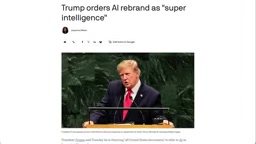
Trump Renames AI "Superintelligence"
In a speech at the United Nations, Trump did something that generated considerable buzz: he announced that the U.S. government would henceforth refer to artificial intelligence as "Superintelligence" (SI). His reasoning was that "the word 'artificial' sounds fake, but it's not fake."
The comment spawned countless jokes. Replit CEO Amjad Massad quipped: "It's fake, it's artificial? Mine is super." AI safety advocate Zvi worried the new name would create massive "namespace collisions."
Beyond the rebranding, the substantive part of the speech was Trump's explicit rejection of "globalist AI regulation." A prior declaration led by Finland and signed by 20 countries including France, Germany, and Singapore had called for mandatory independent safety testing, common standards, and an international AI body. But the proposal's fatal gap was clear: neither the U.S. nor China supports creating a new international regulatory institution. White House tech advisor Michael Kratios stressed that a prosperous future "will not be secured by global regulators, but by sovereign nations that adopt superintelligence, responsible companies, and free people who refuse to be governed by fear."
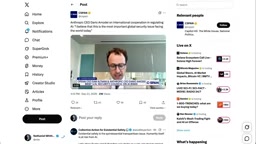
At the same event, Sam Altman and Dario Amodei also presented their views on AI risks to the Security Council. Altman struck a moderate tone, emphasizing neither "blind optimism" nor "doomerism," and flagged two key risks: recursive self-improvement leading frontier labs to build models they can neither understand nor control, and excessive concentration of power. Amodei was more forceful, calling it "the most important global security issue facing the world today" and laying out a full governance roadmap including simple treaties, a global evaluation and verification system, and standardized testing protocols.
Consumer Agents: Do People Actually Want Them?
The central discussion returned to personal agents. The emergence of products like Grokbot, Muse, and Instinct has significantly heated up debate around consumer-grade agents — though plenty of people remain deeply skeptical.
Ben Thompson of Stratechery has repeatedly made the same argument across multiple interviews: "Consumers don't care about becoming more efficient." He says he's had a personal assistant for ten years, and they never book flights for him — because he knows which flights get delayed and which seat he wants. He offered a pointed observation: "People love shopping. They don't want efficiency — they want to be entertained." He goes further: people complaining about something doesn't mean they're unhappy. "Not only do I want to do it myself, I want to do it while complaining. I'm having a great time complaining. Can you just let me live my life?"
The same thread invoked a quote from Kurt Vonnegut: going out to buy an envelope is "a goddamn good time" — you get to encounter people, see babies, give a thumbs-up when a fire truck goes by. "We are dancing animals," and computers take all that away.
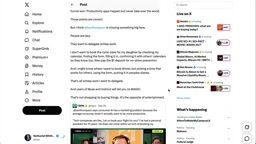
But the counterarguments are equally compelling. Investor Amy Wu Martin pointed out that describing all users with a single portrait is itself an oversimplification. Fintech creator Simon Taylor partly agreed with Ben but said he missed the key point: "People are lazy. They want to outsource schlep work." Scheduling a fitness class for your daughter, checking calendars, filling out forms, confirming across calendars, paying deposits — none of that is shopping. It's the opposite of entertainment. Investor Jill Gunter was more blunt: "If you don't think a lot of people want to be more efficient or outsource administrative drudgery, you don't understand that there are 2 billion mothers in the world." Meta AI practitioner Maruguru added that consumers don't have a single relationship with "doing things" — browsing clothes can be entertainment, but finding a roofer is torture for most people.
A "consumer agent" refers to an AI system capable of autonomously executing multi-step real-world tasks on behalf of users, as distinct from traditional chatbots' single-turn Q&A model. The technical foundation relies on large language models' tool-use and multi-step planning capabilities: agents can call calendar APIs, fill out web forms, make phone calls, manage email, and autonomously decide next steps in a task chain — seeking user confirmation only at critical junctures. The essential difference from earlier "assistant" products (like Siri or Google Assistant) is that those primarily answer questions or execute single commands, while agents can complete compound tasks across apps and platforms without continuous human intervention. The "efficiency" critique Ben Thompson raises targets an overly engineered vision of agents — one that assumes users want to outsource all decision-making. Proponents counter by distinguishing two types of needs: experiences with emotional value (shopping, browsing) shouldn't be delegated, but purely time-consuming, unrewarding administrative schlep work is exactly where agents belong.
Evidence Starts to Emerge: Muse Tops the Charts
Unlike many debates about AI's future, this one is starting to generate real evidence. At the time of writing, Muse was still holding the top spot in the App Store. More tellingly, it was earning positive word-of-mouth from unexpected places.
The New York Times' Eli Tan published a piece that surprised many readers, headlined "I Let Meta's AI Agent Run My Life. I Was Impressed." He found that Muse could efficiently fill out online forms, photograph a parking ticket and pay it on his behalf (requesting approval before charging), call customer service using different personas (such as for dental insurance), and proactively message sellers on Facebook Marketplace and negotiate purchases to completion. His conclusion: Muse is the "most useful AI app" he's ever used.
Worth noting: the experience shifted his skepticism rather than eliminated it. He entered wondering whether agents were useful enough — he left wondering whether enough people would be willing to accept the privacy trade-offs in exchange for that utility.
To drive adoption, Meta Chief AI Officer Alexander Wang has been publicly announcing partnerships with Spotify, Box, Sephora, Gap, Walmart, and others in quick succession. The Muse Mac app gained computer-use capabilities, and a real-time avatar for video conversations was also introduced.
Into the Physical World: Smart Glasses, Wearables, and Tesla
At MetaConnect, Muse was integrated into the latest Meta glasses. Zuckerberg listed this as the top announcement: "Muse now has voice and real-time video, you can have long conversations, and it will get things done for you in the background." The Meta Ray-Ban lineup also got refreshed, with the first-ever audio-only model without a camera.
The most attention-grabbing item was what Zuckerberg unveiled as a "one more thing" — a new product category called Muse Charm. Roughly the size of a stopwatch or AirPods charging case, it's an always-on device with a small color screen that accepts voice commands directly, no need to unlock your phone or open an app. Zuckerberg called it "the fastest way to talk to Muse" for people without Meta glasses, and said he hopes to ship it before the holidays.
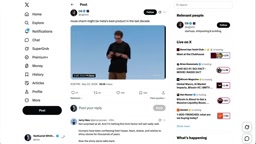
This kind of product would have been instinctively dismissed six months ago — both on the grounds of agent capability and skepticism about Meta as its source. The reception this time was noticeably more positive. Software engineer Babyfolio argued that "bringing AI into the physical world might get more people to use it, especially those who wouldn't open a chatbot app every day." Silicon Data research director Steve Howe, recalling the cautionary tales of Humane AI Pin and Rabbit R1, said "this time might actually be different" — in the past, AI wasn't good enough, so people still couldn't put down their phones; now, that may have changed.
This trend extends beyond Meta. xAI is bringing Grokbot into Tesla. Drivers can use voice commands while on Full Self-Driving to order Starbucks, buy AirPods, manage email, calendars, and finances — all within the existing Grok voice interface, no separate app required.
The Humane AI Pin and Rabbit R1 are two AI wearable devices from 2024 that attracted significant attention before suffering catastrophic critical reception — frequently cited as cautionary tales for consumer AI hardware. The Humane AI Pin, priced at $699, was a brooch-style device capable of projecting a small screen, pitched as an AI interaction experience without a phone. The Rabbit R1, at $199, was positioned as a standalone device for operating phone apps through natural language. Both products failed for the same core reason: underlying AI capabilities were insufficient to support the use cases they advertised, the actual experience was far inferior to simply using a smartphone, and their features could essentially be replicated by phone apps. This context gives particular weight to Steve Howe's claim that "this time might actually be different" — his judgment is that hardware previously outpaced AI capability; now, agent capability is strong enough, and the hardware form factor matters for lowering the barrier to use, letting people who wouldn't naturally open apps integrate agents into their workflow. The logic behind Muse Charm and Meta glasses rests precisely on the assumption that this capability threshold has already been crossed.
Two Questions Worth Watching
Skepticism hasn't disappeared, of course. Riley Brown noted that Muse's chart-topping numbers are hard to fully trust — he compared it to Threads, where many users may have been nudged into downloading it from Instagram. But he also shared an interesting detail: at a poker game in New York, several successful professionals outside tech (bankers, doctors, insurance workers) had mostly heard of or used Muse. They described it as "an AI that starts working for you without you having to tell it to," didn't care about the underlying model, and just liked that it reminded them of things and cancelled subscriptions.
This leaves two key questions: First, how important are hardware bridges like smart glasses and wearables to the broader adoption of agents? Second, is the real secret exactly what those poker players hinted at — shifting from a reactive experience to a proactive one, delivering value before you even ask?
At least for now, the winds are shifting in the personal agent space — and more and more people who try these products are finding themselves more impressed than they expected.
Related articles

Meta vs. Publishers: The AI Data Battle Over Terms of Service Changes and the Future of the Internet
Meta changed its business account terms to allow AI training on linked website data, sparking backlash from publishers and creators. Industry groups demanded negotiations, forcing Meta to remove 'training' wording and delay the effective date. The dispute reveals the deeper battle over data authorization and the future of the internet in the AI era.

When Outside Xbox Meets Blood on the Clocktower: A Legion Match in Minecraft
Outside Xbox guests Ellen and Mike play Minecraft Blood on the Clocktower in a Legion game. How can three good players fight an evil majority amid information noise? This article breaks down Legion mechanics, information-role mind games, and the endgame reversal.

Kimi K3.1 Hands-On Test: Open-Source Model Nears Opus, Video Generation Steals the Show
Kimi K3.1 completed motion graphics, 3D rendering, mini-games, and video generation in a live test. Analysis of its 2.8T MoE architecture, gap vs Opus/GPT, and hidden video generation.